Farmington– The Minister of Finance and Development Planning, Augustine Ngafuan, has warned that the road to ECOWAS’ long-delayed single currency (ECO) project demands more than mere ceremonial compliance.
By Jaheim T. [email protected]
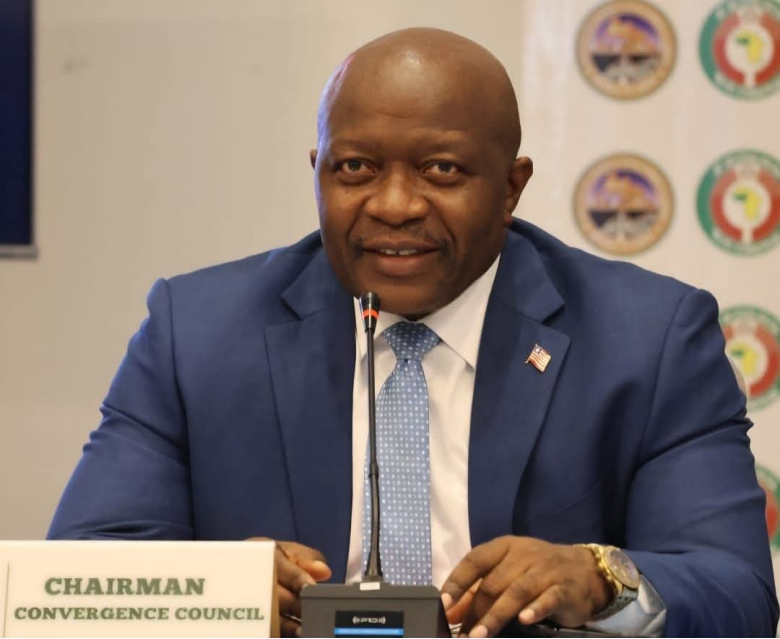
Speaking at the 55th In-Year Convergence Council Meeting in Ngafuan said, “Meeting the convergence criteria is not a ceremonial exercise. It is a test of discipline. The six convergence criteria are the pillars of a stable monetary union.”
Ngafuan likened the single currency to a bridge connecting markets and lowering costs, but cautioned that “bridges require strong pillars.” He stressed the need to accelerate reforms, harmonize policies, and confront political-economic challenges that have slowed progress.
“Recent developments involving certain member states require careful navigation to ensure that our integration agenda remains on course while respecting national sovereignty,” he said.
Liberia reported significant strides across all six ECOWAS convergence indicators by the end of 2025- inflation control, fiscal deficit management, central bank financing discipline, reserve accumulation, exchange rate stability, and debt sustainability.
Ngafuan emphasized that these achievements reflect “not only technical compliance, but a deeper commitment to sound governance and regional solidarity.”
Liberia’s economy is projected to grow by 5.1 percent in 2025, up from 4 percent in 2024, driven by mining, agriculture, and services. Inflation has fallen sharply, and the exchange rate remains stable.
Looking ahead, Ngafuan explained that GDP growth is expected to reach 5.4 percent in 2026, while inflation is expected to continue declining. “These gains are the result of deliberate policy actions, not chance,” Ngafuan told the Council.
Across ECOWAS, regional growth is forecast to rise to 4.8 percent in 2025, up from 4.3 percent in 2024, supported by stronger trade, favorable financing conditions, and improved supply chains.
Four member states are projected to meet all four primary convergence criteria by 2025, compared to two in 2024. By the end of 2025, Côte d’Ivoire, Benin, and Togo are expected to achieve full compliance with all six criteria, a sharp improvement from 2024, when only one member state met the requirements.
Yet challenges remain. Inflation continues to test several countries. Ngafuan admitted, “Although progress has been made in many countries, there are still challenges in meeting the convergence criteria in some countries, especially the inflation criteria. This is not a failure. It is a reality check.”
With July 2027 set as the new horizon for the single currency launch, Ngafuan urged decisive action. “We no longer have the luxury of drifting. The current demands decisive action, rigorous implementation, and unwavering commitment from every member state.”
He warned that the credibility of ECOWAS’ monetary union will be judged by actions, not intentions: “We judge us by our actions, not our intentions.”
Ngafuan closed with a metaphor of integration as a river. “Sometimes slow, sometimes forceful, but always moving forward, or always moving toward a larger ocean of shared prosperity.”
He called on member states to recommit, innovate, and act, stressing that the people of West Africa “deserve a monetary union that lowers transaction costs, facilitates trade, attracts investment, and improves livelihoods.”
Proxying for President Joseph Boakai, Minister of Justice, Oswald Tweh told regional leaders that macroeconomic stability must translate into tangible benefits for citizens, not remain confined to charts and forecasts.
“Macroeconomic stability is a cornerstone for development. But stability must be more than statistical achievement. It must translate into tangible improvements in the lives of our citizens,” Tweh said at the ECOWAS Convergence Council meeting.
Tweh emphasized that low inflation, prudent public finance, and sound banking systems are essential, but they are “means, not ends.”
He argued that the ultimate aim is to generate sustainable jobs, empower entrepreneurs, expand access to education and health care, and ensure growth is equitably shared. “More jobs, stable prices, better services, and fairer opportunities,” he said, outlining the priorities that should define regional integration.
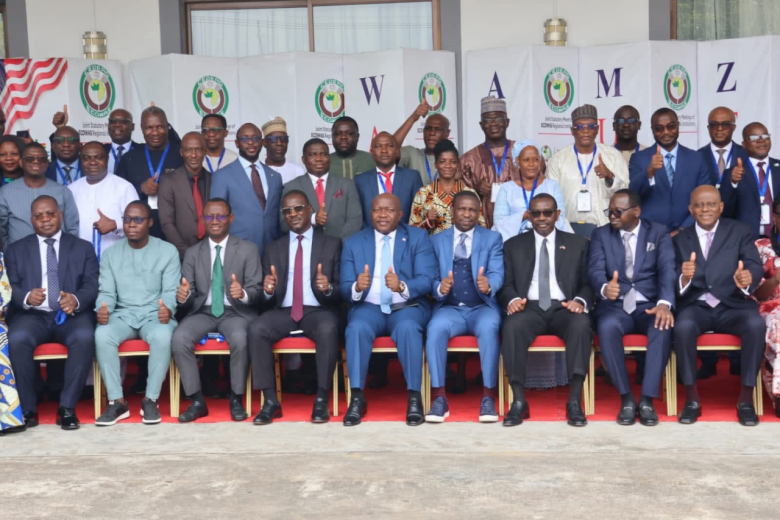
Tweh called for bold, coordinated action across five fronts, including policy harmonization. “We must enhance our information sharing, strengthen our regional surveillance mechanisms, and commit to policy frameworks that reduce destabilizing imbalances while preserving national policy space.”
The decision for financial inclusion, which would expand the banking and digital services, particularly for women, youth, and rural populations, governance, and rule of law: “Investors and citizens alike require predictable, impartial, and efficient institutions. Post-regulatory bodies and anti-corruption institutions must be empowered and resourced to deliver justice swiftly and fairly.”
He also called for the need of human capital and technology, investing in education, vocational training, and digital literacy to harness the fourth industrial revolution, while addressing climate resilience:
“Climate risks are macroeconomic risks. We must mainstream adaptation and mitigation into our budgets, fiscal policy, and public investment plans,” he said.
Tweh underscored that integration requires solidarity and compromise. “Let us be guided by solidarity, by the shared knowledge that when our neighbors prosper, we all prosper,” he said, urging member states to align fiscal, monetary, and administrative policies to catalyze investment and protect vulnerable populations.
Tweh pressed for urgency: “Let us use this joint meeting to transform explorations into action, to translate policy prescriptions into concrete reforms, to align our resources and capabilities, and to deliver results that ordinary citizens will see and feel.”
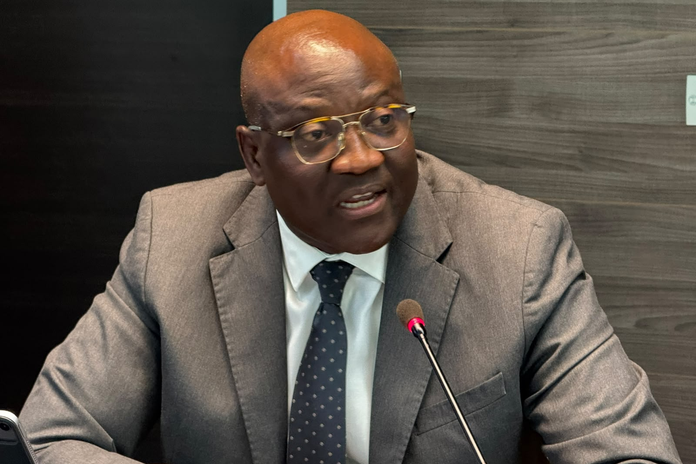
The outgoing chairman of the ECOWAS Convergence Council and Finance Minister of Sierra Leone, Sheku Ahmed Fantamadi Bangura warned that indecision over key institutional frameworks could derail the region’s plan to launch a single currency by 2027.
Bangura said that the obstacles facing the monetary union are “not primarily technical, they are political and collective.”
He stressed that questions of sovereignty, reform sequencing, and benefit distribution remain unresolved. “This is where leadership matters. The Convergence Council must rise to the level of history and ensure that we embrace cooperation over unilateralism,” Bangura said.
Bangura acknowledged that ECOWAS has repeatedly missed deadlines for the single currency. “Several timelines for ECOWAS single currency have been set and missed. Roadmaps have been agreed upon and revised. New target dates have been announced only to be overtaken by events and hesitation,” he noted.
A review of 130 time-bound activities under the ECOWAS roadmap showed uneven progress: 38 percent fully completed, 47 percent missed deadlines, 12 percent still within structural timelines, and 3 percent started but unfinished. For five ongoing activities without fixed end dates, the implementation rate stood at 40 percent as of the end of 2025.
Bangura urged the Council to act decisively on unresolved issues, including selecting the location of the Central Bank of West Africa, hosting the payment system infrastructure, finalizing the legal and institutional framework for monetary union, establishing the ECOWAS Solidarity and Stabilization Fund and agreeing on the exchange rate mechanism
“In today’s meeting, there are concrete decisions before us that we can no longer afford to defer. The credibility of the single currency agenda and of this council itself depends on its ability to deliver on these decisions,” he warned.
With the July 2027 deadline approaching, Bangura called for renewed cooperation: “I urge all member states to redouble our commitments and cooperation by swiftly implementing agreed reforms, strengthening the institutions that support our shared monetary and economic goals, and let us decisively remove the remaining barriers to trade, payments, financial integration.”
He cautioned that further delays would erode credibility, increase transaction costs, and entrench fragmentation. “If we fail to act now, we push further into the future the aspirations of our unfounded leaders of this initiative who envision a single currency as a cornerstone for deeper integration, shared prosperity and a stronger collective voice on the global stage,” Bangura said.
Support Independent Journalism
Your support helps FrontPage Africa continue delivering independent, credible, and impactful journalism. Every contribution strengthens our ability to investigate, inform, and hold power accountable while keeping quality journalism accessible to our readers.
Support our journalism or subscribe to receive the latest FrontPage Africa stories and updates.