Ganta, Nimba County – The ongoing conflict surrounding the Prince Yormie Johnson Polytechnic University (PYJPU) is more than a family dispute over property. It is a multifaceted drama involving personal legacies, post-war memory, political silence, institutional failure, and the deeply emotional stakes of education in a country still healing from its violent past.
By Selma Lomax [email protected], and Franklin Doloquee, [email protected]
At the center of the storm is the question what happens when the legacy of one of Liberia’s most polarizing figures is up for sale. And who gets to define that legacy — the family, the state, or the people whose lives were most directly shaped by the man himself?
Prince Y. Johnson, the man at the heart of this storm, was no ordinary Liberian politician. He was a warlord, feared and revered, whose name is etched in Liberia’s troubled history books. His brutal role in the execution of President Samuel Doe in 1990 — infamously captured on videotape — forever tied his image to the savagery of Liberia’s civil conflict. But in the decades following the war, Johnson transformed into a senator and religious leader, becoming an enigmatic political force in Nimba County and, by extension, Liberian politics.

During his nearly 20 years in the Senate, Johnson acquired several properties and built a network of influence that included churches, schools, and ultimately PYJ Polytechnic University in Ganta. To some, the institution represented a genuine attempt to give back to his community. To others, it was a personal monument to a man who never fully reckoned with his violent past. And now, that monument may be slipping away — not into ruin, but into someone else’s hands.
The roots of the current crisis lie in the deep divisions within Johnson’s family following his death in November 2024. His widow, Mrs. Ameria Boyidee Aridi Johnson, and several of his children are now on opposing sides of a proposal to sell the university to BASILEIA Industrial University, a US-affiliated, faith-based institution promising to revive the struggling campus.
Amy Johnson, one of Johnson’s daughters, strongly opposes the sale. Her statement is emotionally charged, pointing to a desire for generational continuity and pride in her father’s accomplishments — despite his contradictions.
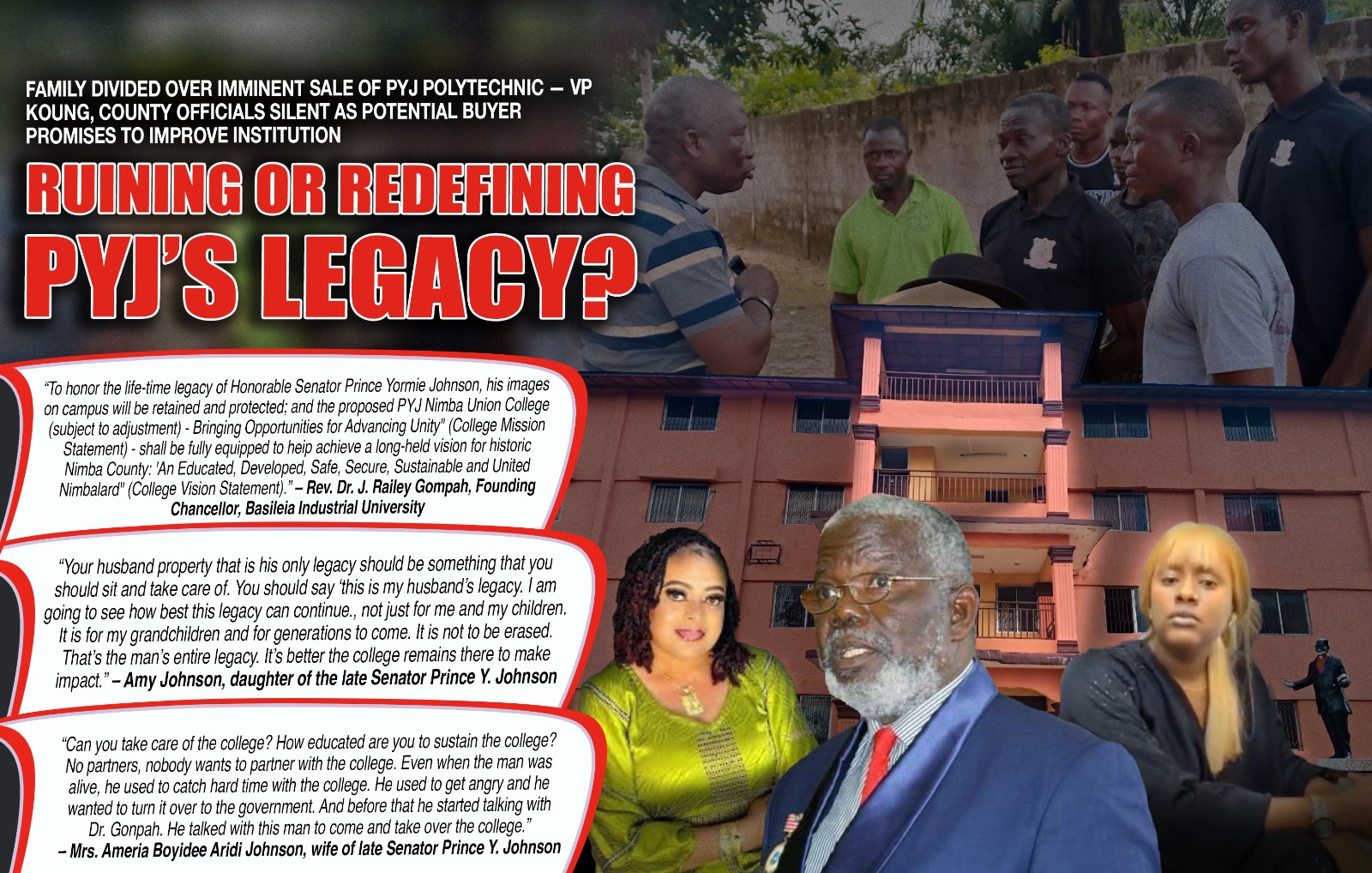
“Your husband’s property — that is his only legacy — should be something that you should sit and take care of,” she said. “You should say, ‘This is my husband’s legacy. I am going to see how best this legacy can continue, not just for me and my children. It is for my grandchildren and for generations to come.’ It is not to be erased. That’s the man’s entire legacy. It’s better the college remains there to make impact.”

Her call is as much about respect for legacy as it is a critique of the perceived haste and secrecy with which the sale is being negotiated.
But Mrs. Johnson, the widow, offers a contrasting narrative — one grounded in financial realism and personal disillusionment. In a series of revelations that surprised even the most informed political observers, she painted a bleak picture of what Prince Johnson left behind, saying no savings, no titled property in the children’s names, and no clear path for the university’s sustainability.
“Can you take care of the college? How educated are you to sustain the college? she asked rhetorically. “No partners, nobody wants to partner with the college. Even when the man was alive, he used to catch hard time with the college. He used to get angry and he wanted to turn it over to the government. And before that, he started talking with Dr. Gonpah. He talked with this man to come and take over the college.”
Her assertion that the university was always a financial liability, even during her husband’s lifetime, reframes the issue — not as betrayal, but perhaps as closure. Mrs. Johnson went further, controversially describing her late husband as “broke” and recounting that he had “kidnapped” her during the war, taking her to Nigeria before marrying her under the counsel of Prophet T.B. Joshua.

These are not just personal recollections — they are indictments of a man whose life has long oscillated between power and instability. Whether one sees them as justified or not, these comments have dramatically shifted public discourse around the sale.
While the Johnson family debates in public and private, BASILEIA Industrial University is trying to present itself as a neutral actor with a noble mission. Its leadership insists that its proposed takeover of the PYJPU campus is aimed at uplifting Nimba County through a tuition-free, work-integrated education system modeled after American technical colleges.
“To honor the lifetime legacy of Honorable Senator Prince Yormie Johnson, his images on campus will be retained and protected,” said Dr. J. Railey Gompah, Founding Chancellor of BASILEIA. “The proposed PYJ Nimba Union College shall be fully equipped to help achieve a long-held vision for historic Nimba County: An Educated, Developed, Safe, Secure, Sustainable, and United Nimbalard.”
To his credit, Dr. Gompah appears deeply committed to preserving the late senator’s symbolic presence on campus. The university plans to retain staff, continue existing programs, and introduce new ones in agriculture and religion. But for all the institution’s promises, it cannot escape the cloud of controversy that now surrounds its association with the property.

Perhaps the most vocal opposition has come not from the Johnson family, but from the students of PYJ Polytechnic themselves. Feeling betrayed and ignored, they have mobilized under the banner of the “Concerned Students of PYJ Polytechnic University” and issued a fiery press statement demanding answers.
“This action has left the entire student population in frustration, sadness, and uncertainty,” they wrote. “We demand that our documents be placed in our possession before Mrs. Johnson proceeds with her personal transaction, because her future intentions remain unclear.”
The students allege the school was sold for US$8 million without consultation. They question the transparency surrounding government subsidies received by the university, the safety of their academic records, and whether the institution will continue to function as a university under new management. Their grievances reflect a larger systemic issue in Liberian higher education — weak accountability, inconsistent policy enforcement, and a disregard for student welfare during administrative transitions.

One of the most striking aspects of this saga is the conspicuous silence of Vice President Jeremiah Koung. As one of Johnson’s closest political protégés, Vice President Koung’s silence has not gone unnoticed. For a man whose rise to national office was tied to PYJ’s political machinery, his decision to remain quiet during this highly public dispute is being interpreted by some as political distancing, while others see it as strategic avoidance.

In contrast, Senator Samuel Kogar, who has been accused of Amy Johnson of colluding with her stepmother to sell the college, took a more direct approach. Responding to the accusation, he said: “My only focus towards the Johnson family is for the best. Every property has its owner. I am not the owner of their belongings. My role in the family is to guide them to make the right decisions. If there is a problem in the family, my anticipation is whosoever that may have problems should bring it to our attention for redress but not to complain on social media.”
He added pointedly: “If anyone is insinuating that a property can be bought without a legitimate document, then that person is stupid.”
Senator Kogar’s comments, though blunt, reflect the complexity of the situation: legal ownership versus moral obligation, family discord versus institutional transformation.
At its core, the battle over PYJ Polytechnic is not simply about real estate. It is a conflict over memory, identity, and post-war reckoning. Should the institution be preserved in its original form as a tribute to a man with a complicated legacy? Should it be modernized and repurposed for community development, even if that means letting go of control? Or should it be dismantled entirely and replaced with something new?

These are difficult questions with no easy answers. For the Johnson family, it is a question of legacy and legitimacy. For the students, it is a matter of trust, transparency, and continuity. For BASILEIA, it is a strategic expansion of their mission. And for the broader Liberian public, it is yet another test of how the nation handles the ghosts of its past while trying to build a more stable, educated future.
Whether or not the sale proceeds, the damage has already been done in terms of public trust. The Johnson family appears fractured. Students feel abandoned. Political leaders are absent or cautious. BASILEIA may yet succeed in transforming the institution, but it will need more than infrastructure and academic programs to win over the community — it will need credibility, dialogue, and healing.
In the end, the legacy of Prince Yormie Johnson may not be written in stone or cemented in campus buildings. It may be determined by what happens next — whether his name becomes a relic of division or a catalyst for transformation.
And perhaps the real question now is not what to do with PYJ University, but how Liberia — and especially Nimba — chooses to reconcile with the complex legacies left behind by those who once ruled its darkest hours.
Support Independent Journalism
Your support helps FrontPage Africa continue delivering independent, credible, and impactful journalism. Every contribution strengthens our ability to investigate, inform, and hold power accountable while keeping quality journalism accessible to our readers.
Support our journalism or subscribe to receive the latest FrontPage Africa stories and updates.