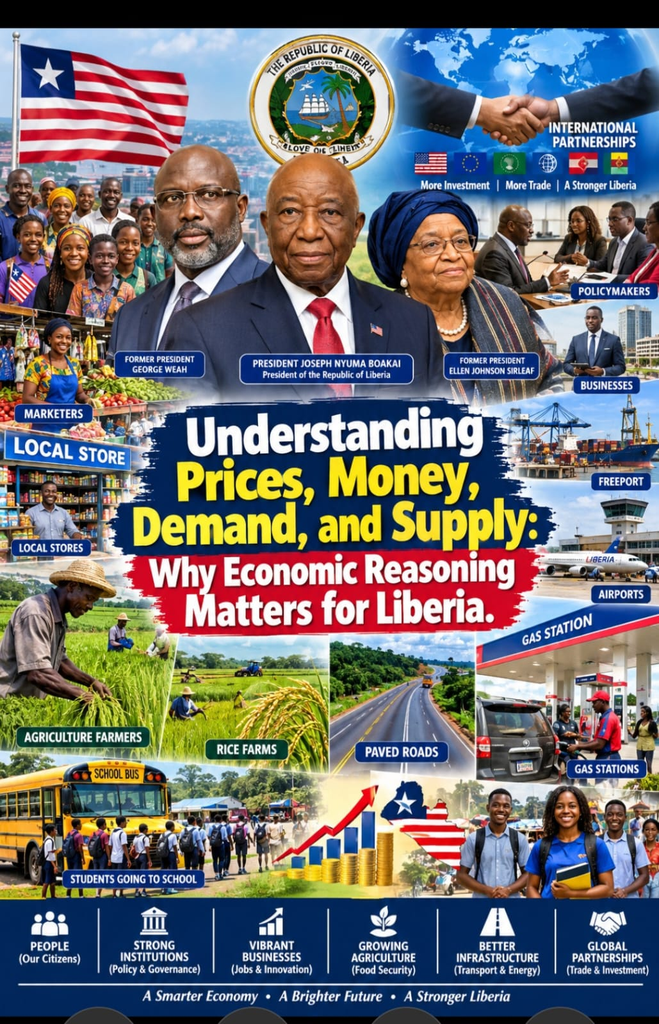
Economic concept: Central banks worldwide use monetary-policy instruments to influence financial conditions and inflation expectations.
By: Austin S Fallah – A True Son of the Planet Earth Soil: [email protected]
Economic growth and inflation -January 26, 2026: In his 2026 Annual Message, President Boakai reported: “We are proud to announce that the economy grew by 5.1 percent in 2025.” He attributed the growth to “significant gains in mining, agriculture, fisheries, and services.”
He also reported: “Inflation fell to 4 percent by December 2025 – the lowest in over two decades, down from 10 percent when we took over in 2024.” The President connected these developments with monetary and fiscal policies and lower import costs.
Liberia’s productive capacity — March 29, 2024
In a BBC interview, President Boakai stated:
“Liberia has the potential to feed the world if its endowments are managed well.” He specifically pointed to Liberia’s fertile soil and land and its capacity to produce rice.
Speaking at a Cabinet meeting focused on agriculture, President Boakai stated: “Agriculture remains one of the most important sectors of our economy.” He added: “Our objective must be to ensure that farmers receive the support they need to increase production and contribute meaningfully to national development.”
President Joseph Nyuma Boakai:Prices and affordability – September 2, 2025“These reductions represent my government’s commitment to ensuring that the ordinary Liberian family has access to affordable food.”
Commodity prices and global economic forces — January 27, 2025: In his 2025 Annual Message, President Boakai stated: “Despite global trends affecting commodity supply and prices, we have seen consistent declines in the costs of essential commodities, including rice and petroleum products.”
President Joseph Nyuma Boakai: “At the same time, we are working with producers and importers to maintain fair and sustainable trade practices that safeguard continuous supply.”
Former President George Manneh Weah, in his July 2018 address on Liberia’s economic situation, stated:
“The prices and demand for our exports are determined and affected by factors beyond our borders, and are therefore beyond our control.”He continued: “Slumps in demand for the products which utilize our raw materials will always result in externally-generated shocks to our economy.”
Former President George Manneh Weah: Trade Deficit: Former President Weah stated, “For many decades, we have incurred trade deficits because we import more than we export.”
Former President George Manneh Weah:— Domestic Production and Supply: “The key to success in this endeavor is for Liberians to produce more goods and services locally, so that we reduce our importation of goods and services from abroad, whilst at the same time increasing our exports and adding value to the raw materials that we ship to the world.”
Former President Ellen Johnson Sirleaf, in her Annual Message to the Liberian Legislature, directly referred to supply and demand when discussing the price of rice: “As a result of market forces of supply and demand, the price of butter rice has been reduced from US$35 to US$30.”She immediately linked this to policy measures involving rice imports and domestic production, including opening the rice market to additional importers and establishing a US$1 million facility to purchase paddy rice from local producers.
Central Bank of Liberia — Exchange Rate and Supply & Demand: The Central Bank of Liberia (CBL) stated in November 2024: “The exchange rate is strictly market-determined.” The CBL further explained that foreign currency exchanged for Liberian dollars supports the domestic currency’s value, describing this as evidence of the market-driven nature of Liberia’s exchange rate.
Economic ideas are essential tools for understanding the everyday challenges Liberian households, businesses, students, and policymakers face.
When the price of rice, gasoline, transportation, building materials, or school supplies rises, people naturally ask: Who is responsible?
Is the Liberian government to blame? Are international markets responsible? Is the problem caused by businesses, consumers, wages, the exchange rate, or the supply of money?
Sound economic analysis does not always offer a single answer.
Still, it gives citizens a disciplined way to investigate the causes of price changes rather than relying on rumor or political arguments.
In simple terms, prices tend to rise when demand is strong relative to supply, and prices tend to fall when demand is weak relative to supply.
This basic statement is correct, but it needs careful explanation.
Prices do not change because demand alone rises or falls.
They change because of the interaction between demand and supply.
Furthermore, when economists discuss the overall rise in prices throughout an economy, they use the term inflation, which is mainly a macroeconomic issue.
When economists examine the price of one particular good, such as cassava, cement, or mobile phone service, they are often dealing with microeconomics.
Understanding the distinction between microeconomics and macroeconomics can help Liberians determine whether a price problem comes mainly from local market conditions, national economic policy, or the global economy.
The concepts of demand, supply, elasticity, wages, money supply, inflation, exchange rates, and production costs have been useful in the past, remain valuable today, and will remain important in the future.
These concepts have helped me and many students in Econ. 203/303 under Professor Dorley; Econ. 204/304 under Professor Yassiah; Econ. 409 and 410 under Professors Tetteh and Sleweon; Econ. 320 under Professor Dukuly; and many other economics courses at the University of Liberia, culminating in my sitting in economics classrooms for academic lectures and grading at the University of Minnesota.
These courses have value beyond academics.
Economic knowledge equips students and citizens to interpret national events, assess government policies, understand business decisions, and participate responsibly in public debate.
Demand and Supply: The Starting Point of Price Analysis:
The first correct principle is that demand and supply jointly determine market prices.
Demand refers to the quantity of a good or service that consumers are willing and able to buy at different prices, holding other factors constant.
Supply refers to the quantity that producers are willing and able to sell at different prices, holding other factors constant.
The market price tends to move toward an equilibrium point where quantity demanded equals quantity supplied.
When demand increases while supply remains unchanged, prices generally rise.
For example, if more Liberian households want to buy rice because incomes increase, population grows, or consumers expect future shortages, demand for rice may rise.
If rice importers and local suppliers cannot bring more rice to the market quickly, the price of rice will likely increase.
On the other hand, if supply increases while demand remains unchanged—for example, because transportation improves, imports become cheaper, or domestic production increases- the price may fall.
However, it is not enough to say that prices rise when demand is high and fall when demand is low.
A price can rise even when demand is falling if supply falls by an even greater amount.
Consider a situation in which the road to a farming community becomes impassable during heavy rains.
Farmers may be unable to transport vegetables to Monrovia.
Even if consumers are not demanding more vegetables, the reduction in supply can cause prices to rise sharply.
Similarly, a global fuel shortage can raise transportation costs, reducing the supply of many goods in Liberia and increasing their prices.
Therefore, citizens should ask two questions whenever prices change: What happened to demand? And what happened to supply?
This approach is more accurate than immediately blaming one person, one business, or one government institution.
Is This Microeconomics or Macroeconomics?
Demand and supply analysis belongs primarily to microeconomics when it concerns individual markets.
For instance, analyzing the price of bread in a particular city, the supply of fish from a particular county, or consumer demand for a certain brand of phone is microeconomic analysis.
Microeconomics studies the behavior of consumers, firms, workers, and specific markets.
However, when economists analyze the general price level across the entire country, unemployment, national income, economic growth, exchange rates, and the money supply, they are dealing mainly with macroeconomics.
Inflation is a macroeconomic issue because it refers to a sustained increase in the general price level, not merely a price increase in one product.
This distinction is important for Liberia. If only the price of onions rises because of a poor harvest or damaged roads, that is mostly a microeconomic or sector-specific supply problem.
But if rice, gasoline, rent, transportation, school fees, imported goods, and many other necessities all become more expensive at the same time, the country may be facing a broader macroeconomic challenge, such as inflation, exchange-rate depreciation, rapid money growth, or international price shocks.
A responsible analysis must recognize that microeconomic and macroeconomic factors can occur together.
For example, a global increase in fuel prices is an international shock, but it affects local transportation costs and the prices of individual goods.
This links global macroeconomic forces to local microeconomic markets.
Wages, Salaries, and Prices: A Necessary Correction:
The statement that prices can fall only if salaries and the money supply move in the same direction is not fully correct.
Prices do not automatically fall simply because salaries fall or because salaries and money supply change in the same direction.
The relationship is more complex.
Wages and salaries can influence prices because labor is an important cost of production.
If wages rise faster than productivity, firms may face higher production costs. Businesses may then increase prices in order to protect their profits.
This situation is sometimes described as cost-push inflation (one of Prof. Dorley’s favorable economicterms), especially when rising wages, fuel prices, imported inputs, or taxes increase production costs.
Yet higher wages do not always cause inflation.
If workers become more productive, for example, if better equipment, training, roads, electricity, or technology allows them to produce more goods per hour, then firms may be able to pay higher wages without increasing prices.
The key concept is not merely wages, but unit labor cost, which measures labor costs relative to output.
If productivity rises alongside wages, price pressure may be limited.
Likewise, falling wages do not guarantee falling prices.
If businesses face expensive imports, high shipping costs, currency depreciation, electricity shortages, or reduced supply, prices may remain high even if workers’ wages decline.
In fact, falling salaries can reduce consumer purchasing power and increase hardship without necessarily solving inflation.
For this reason, economists distinguish between nominal wages, and real wages.
Nominal wages are the amount of money a worker receives.
Real wages represent what that money can actually buy after considering inflation.
A worker may receive a higher nominal salary but still become poorer in real terms if food, transportation, rent, and other prices rise faster than the salary increase.
Money Supply and Keynesian Economic Theory:
The money supply is the total amount of money available in an economy, including currency and certain forms of bank deposits.
Changes in the money supply can affect spending, investment, interest rates, exchange rates, and inflation.
However, the effect is not automatic or identical in every situation.
In the Keynesian tradition, associated with economist John Maynard Keynes, the economy can suffer from weak aggregate demand.
Aggregate demand is the total demand for goods and services in the entire economy.
It includes consumption by households, investment by businesses, government spending, and net exports.
When aggregate demand is too low, businesses sell fewer goods, reduce production, and may lay off workers.
Unemployment rises, incomes fall, and economic growth slows.
Keynesian economics argues that government can play a useful role during periods of recession or high unemployment.
The government may increase public spending on roads, schools, hospitals, electricity, agriculture, sanitation, and other infrastructure.
It may also reduce taxes or provide targeted support to vulnerable households. These measures can raise aggregate demand, create jobs, and encourage businesses to produce more.
Monetary policy can also matter. If the central bank expands the money supply or lowers interest rates, borrowing may become easier, investment may increase, and consumers may spend more.
However, if too much money is created while the supply of goods and services does not increase, more money may chase too few goods.
This can lead to demand-pull inflation(Another Prof. Dorle’s term).
The Keynesian view therefore does not simply say that printing money is always good or always bad.
It emphasizes the condition of the economy.
If there are unemployed workers, unused factories, and weak demand, increasing spending or money availability may raise production and employment.
But if the economy is already producing near its capacity and there are shortages of goods, additional demand can mainly raise prices.
For Liberia, this lesson is highly relevant.
Expansionary government spending may be helpful when it is directed toward productive investments that improve supply capacity, such as farm-to-market roads, ports, storage facilities, electricity, education, health services, and agricultural support.
Such investments can raise output over time. But if money enters the economy without a corresponding increase in domestic production or imports, inflationary pressure may result.
Elasticity: Why Some Prices Change More Than Others:
The phrase “elasticity of economic needs” should be refined. The correct general term is elasticity(This word was often used in our 320 class when discussing Liberia’s economy under Prof. Dukuly(May his soul rest in peace), especially price elasticity of demand, and price elasticity of supply.
Price elasticity of demand measures how strongly consumers respond when the price of a good changes.
If a small price increase causes consumers to buy much less, demand is elastic.
If consumers continue buying nearly the same amount even after the price rises, demand is inelastic.
Basic necessities usually have relatively inelastic demand.
Families may reduce their consumption of rice, fuel, medicine, or transportation only slightly even when prices rise because these items are necessary.
This is one reason why price increases in essential goods can cause severe hardship.
People can not easily stop buying food or medicine.
Luxury goods, by contrast, often have more elastic demand.
If the price of an expensive imported item rises, consumers may choose substitutes, delay their purchases, or stop buying it.
Understanding elasticity helps government officials predict the effects of taxes, price increases, subsidies, and shortages.
Price elasticity of supply measures how easily producers can increase or decrease production when prices change.
Agricultural supply may be inelastic in the short run because farmers can not immediately grow more crops after prices rise. (This concept was introduced to us in our Agricultural Economics classes , Econ 423 and Econ. 424 at the UofL.)
It takes time to prepare land, plant seeds, harvest crops, and transport products to markets.
In the long run, however, supply can become more responsive if farmers obtain credit, equipment, storage, irrigation, roads, and access to markets.
Isoquants(Prof. Tetteh big word as well): Important, but Not for Determining Inflation:
In our Money and Bank class, Econ. 410,in the 1990s at the UofL, there was an intellectual abd academic debate with proven evidence on the role of the Ministry of Finace as the Fiscal policy armed of the government and National Bank(now Central Bank) as the Monetary Policy armed of government.That class produced some of the best minds in monetary and banking economists.
The statement that isoquant lines can be used to determine demand, supply, or general price changes requires correction.
Isoquants are mainly a microeconomic tool used in the theory of production.
An isoquant shows different combinations of inputs, such as labor and capital, that can produce the same quantity of output.
For example, a Liberian rice-processing business may be able to produce the same quantity of processed rice using more workers and fewer machines, or more machines and fewer workers.
Each combination that produces the same output lies on the same isoquant.
Isoquants help firms understand production choices, efficiency, substitution between labor and capital, and the effects of technology.
Isoquants do not directly determine the market price of goods, nor do they directly measure inflation.
Instead, they help explain the supply side of the economy.
If a firm can use labor, machinery, energy, land, and raw materials efficiently, its production costs may decline.
Lower production costs can increase supply and may reduce price pressure.
Thus, isoquants are relevant to production decisions and cost management, but supply and demand analysis, aggregate demand and aggregate supply, monetary policy, and inflation analysis are more appropriate tools for studying economy-wide price changes.
Should Liberia Blame the Government or the Global Economy?
Liberians should avoid automatically blaming either the government or the global economy without examining evidence. Both can influence prices, but their roles differ.
The global economy can affect Liberia through imported food, fuel, machinery, shipping costs, international interest rates, commodity prices, wars, pandemics, and disruptions in global supply chains.
Because Liberia imports many essential goods, global price increases can quickly affect domestic prices.
If the world price of petroleum rises, transportation costs rise.
Higher transportation costs can then raise the prices of food, construction materials, and other necessities across the country.
At the same time, domestic policy matters greatly.
Government decisions can influence taxes, import procedures, road quality, port efficiency, agricultural investment, electricity costs, public spending, exchange rate stability, financial regulation, and anti-corruption enforcement.
If domestic infrastructure is poor, businesses may face high transportation and storage costs.
If the Liberian dollar depreciates significantly against the United States dollar, imported goods can become more expensive.
If policies discourage local production, dependence on imports may deepen.
Citizens should therefore learn to identify the source of a problem.
If international fuel prices rise sharply in many countries, the global economy is likely a major cause.
If neighboring countries have stable prices while Liberia experiences unusually high price increases, domestic policy, exchange rate management, market competition, or local supply problems may deserve closer attention.
The correct response is evidence based analysis, not blind blame.
Economic reasoning gives Liberians the power to understand the forces affecting their lives.
Demand and supply explain how individual markets function.
Elasticity explains why consumers and producers respond differently to price changes.
Wages affect costs and purchasing power, but wage changes alone do not determine inflation.
The money supply influences spending and prices, but its effects depend on production capacity, employment, expectations, and government policy.
Keynesian theory teaches that government action can support employment and growth during weak economic periods, while also warning that excessive demand without sufficient production can create inflation.
Isoquants are valuable tools for understanding how firms combine labor and capital to produce output efficiently, but they should not be confused with tools for directly determining national prices or inflation.
Most importantly, the study of economics teaches citizens to distinguish between microeconomic market problems and macroeconomic national challenges.
The lessons taught in Econ. 203/303, Econ. 204/304, Econ 423/424, Econ. 320, Econ. 409, Econ. 410, and other University of Liberia economics courses are therefore not merely classroom concepts.
They are practical instruments for evaluating the economy, demanding accountable leadership, understanding global pressures, and building a stronger Liberia.
When citizens can analyze prices carefully, they are better able to decide whether the government, international conditions, private sector behavior, or a combination of factors is responsible.
That ability is necessary not only for academic success, but also for informed citizenship and national development.
Support Independent Journalism
Your support helps FrontPage Africa continue delivering independent, credible, and impactful journalism. Every contribution strengthens our ability to investigate, inform, and hold power accountable while keeping quality journalism accessible to our readers.
Support our journalism or subscribe to receive the latest FrontPage Africa stories and updates.