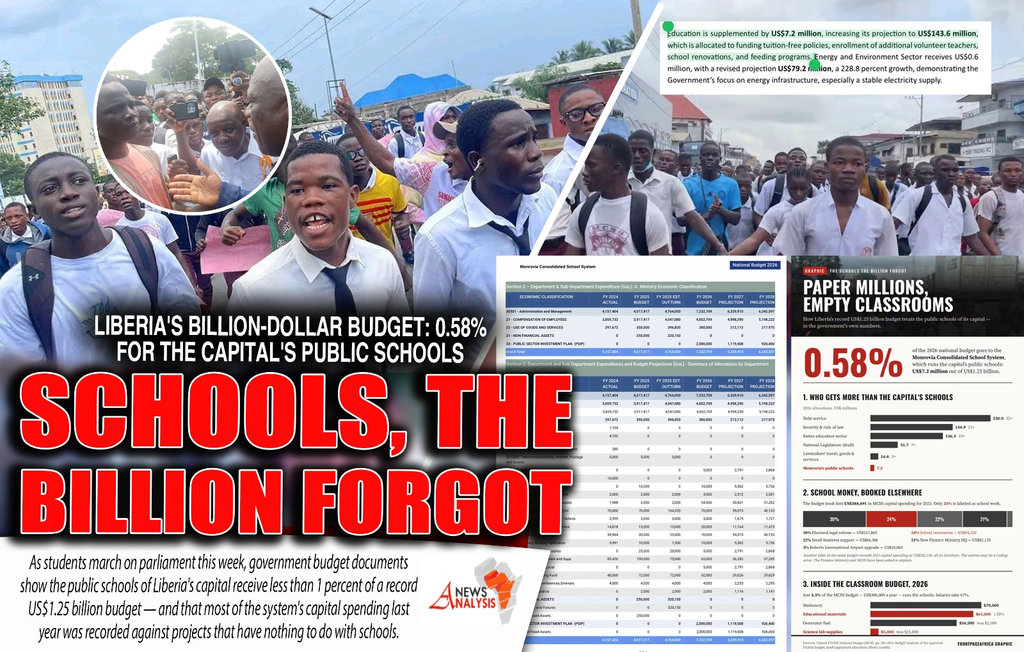
Monrovia — Thousands of students in school uniforms marched on Liberia’s legislature on Tuesday, chanting “We want to learn too.” They were protesting months of disruption in the public schools of the capital, Monrovia, where unpaid teachers have repeatedly walked out of classrooms.
By Rodney D. Sieh
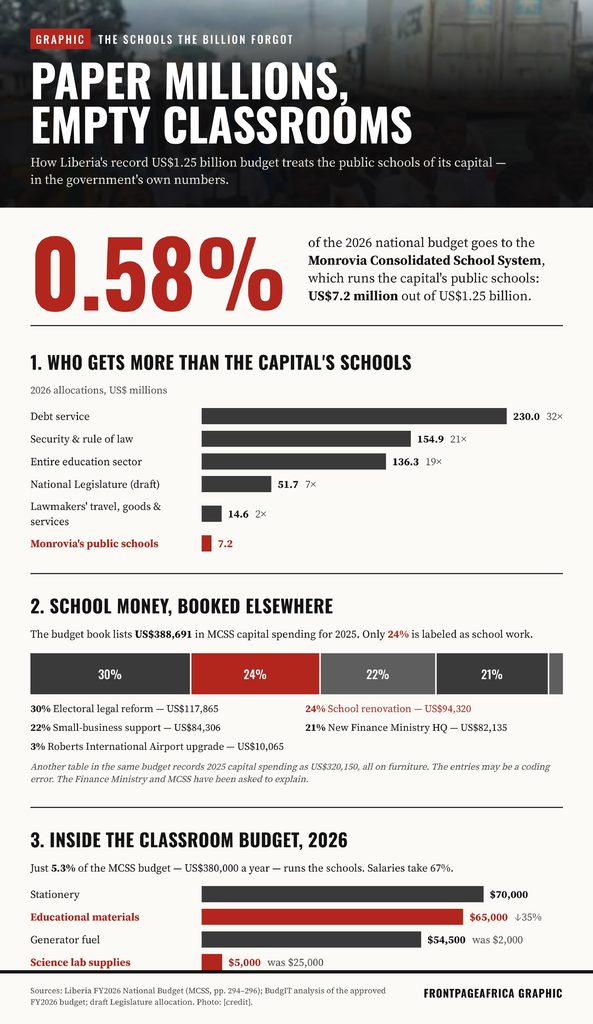
The students’ anger has a paper trail. Liberia’s own 2026 budget documents show that the Monrovia Consolidated School System (MCSS), which runs the city’s public schools, receives US$7.23 million. That is 0.58 percent of a national budget the government celebrates as the largest in the country’s history.
The same documents show that schools in the system get US$65,000 a year for educational materials — less than they get for stationery. They also show that three-quarters of the money recorded as the system’s capital spending last year was booked against an airport, a Finance Ministry headquarters and electoral reform.
A billion-dollar milestone
Liberia, a West African nation of about 5.2 million people, is still rebuilding from 14 years of civil war that ended in 2003. Its national budget crossed US$1 billion for the first time this year. Lawmakers approved US$1.25 billion for 2026, up 41.9 percent from the year before, according to an analysis by the budget-monitoring group BudgIT.
President Joseph Boakai’s development plan, known as the ARREST Agenda, names six priorities. The “E” stands for education. The “A” stands for agriculture, which receives about 1.19 percent of the budget even though the Agriculture Ministry’s own target is 10 percent.
The Monrovia Consolidated School System was created by law in 1964 to run public schools in the capital and surrounding communities. Families who cannot afford private fees depend on it. It is where the gap between budget promises and classroom reality is easiest to see.
“Our patience must not be mistaken for weakness”
Tuesday’s march, organized by the MCSS Students Union, lasted more than two hours. It followed a 24-hour ultimatum that expired the same day. Students gathered between the University of Liberia and the Capitol, the seat of the legislature, and handed lawmakers a petition with four demands.
They want the government to carry out a March 27 agreement with the school system on teachers’ pay and status. They want an investigation into alleged intimidation of student leaders. They want the dismissal of an assistant superintendent, Emmanuel Kyne Robertson, whom they accuse of disrupting classes and threatening students. And they want a bigger school budget and more transparency in how it is spent. The allegations have not been independently verified.
“Our patience must not be mistaken for weakness,” the union wrote, “and our commitment to peace must not be used to justify continued inaction while students’ education remains at risk.”
The House of Representatives read the petition in plenary and gave its education and petitions committees one week to report back.
Hours after the march, the government said it would add the remaining 201 volunteer MCSS teachers to the national payroll from October. That brings the number of verified MCSS volunteers absorbed to 409. Back pay is promised one week after October salaries. Teachers’ demands for higher pay were deferred to a government-wide salary reform, for which no date was given.
Where the money goes instead
Education receives US$136.3 million in 2026, or 10.9 percent of the budget. Security and rule of law receive US$154.9 million, about US$18.6 million more than education. Debt service takes US$230 million, 1.7 times the entire education sector.
Capital spending tells a similar story. Of the US$289.7 million set aside for investment projects, education gets 5.3 percent. Roads and energy together take about 61 percent.
Then there is the legislature. The draft budget gave lawmakers US$51.7 million, up from US$41.3 million in 2024. Their travel, goods and services line alone rose to US$14.6 million.
Put differently: the legislature’s running costs for travel and supplies are 38 times what the capital’s public schools get to run their classrooms for a year.
Stationery over science
The school system’s own pages in the 2026 budget book show how little reaches the classroom.
Salaries take 67 percent of the MCSS budget. Capital projects take 28 percent. Everything needed to actually run schools — books, chalk, cleaning, repairs, fuel — gets 5.3 percent, or US$380,000 for a whole year.
Within that sliver:
• Educational materials: US$65,000, down 35 percent from US$100,000 in 2025. That is less than the US$70,000 budgeted for stationery.
• Laboratory supplies: US$5,000 for every science lab in the system, cut from US$25,000.
• Generator fuel: US$54,500, up from US$2,000 — a 27-fold increase. It now nearly equals the entire budget for learning materials.
•
The outlook gets worse, not better. The government’s own projections cut the system’s operating budget by another 44 percent in 2027, to US$212,112. Educational materials would fall to US$36,282.
The budget also files every dollar of the school system under a single program: “Administration and Management.” There is no separate line for teaching.
The system’s payroll of US$4.85 million covers 1,088 staff, an average of about US$372 a month. That figure includes non-teaching staff. The budget keeps that headcount frozen through 2028, even as hundreds of volunteer teachers are added to the payroll.
An airport, a ministry and an election law
The most striking entry is on page 294 of the budget book. It lists the school system’s estimated capital spending for 2025 at US$388,691.
Only US$94,320 of that — 24 percent — is labeled as school renovation. The remaining US$294,371 is recorded under projects with no apparent link to schools: electoral legal reform (US$117,865), support for small and medium enterprises (US$84,306), a new Finance Ministry headquarters (US$82,135) and an upgrade of Robert International Airport (US$10,065).
The budget book contradicts itself. Elsewhere it records the system’s 2025 capital spending as US$320,150, all on furniture and fixtures, and none under the investment plan at all.
The entries may reflect a coding error rather than diverted money. But either way, the official record of what Liberia spent on its capital’s schools cannot be trusted as published.
For 2026, the budget promises US$2 million for renovating and furnishing MCSS schools. The system’s own list of 2025 achievements, however, claims only that it completed the procurement process to renovate four campuses — not the renovations themselves.
A school system running on volunteers
In December, Finance Minister Augustine Kpehe Ngafuan returned to his old school in Monrovia and announced a 60 percent increase for the capital’s schools, including a US$2 million fund to fix them. On paper, the promise holds: the MCSS budget rose from US$4.52 million to US$7.23 million. Take out the US$2 million capital line, much of it not yet delivered, and the increase is about 16 percent.
The teacher shortage the students are protesting is national. The Education Ministry says Liberia relies on 6,198 volunteer teachers who work without government salaries. In October, the ministry said it had removed more than 1,000 teachers who had abandoned their classrooms from the payroll. Lawmakers have also pressed officials over the U.S.-dollar portion of teachers’ salaries, unpaid since October 2025.
A mid-year supplementary budget, approved in May, added US$7.25 million for education. About 73 percent of it goes to closing payroll gaps and absorbing volunteers — paying for the past rather than building classrooms. MCSS received US$514,510. That includes US$200,000 for its volunteer teachers, roughly US$995 for each of the 201 now being added.
That money is fragile. About nine of every ten dollars in the supplementary package came from the World Bank, not Liberian revenue. BudgIT warned that moving volunteers onto the payroll creates permanent salary costs a one-off top-up cannot sustain. Meanwhile, the government projects total spending will fall to US$1.02 billion in 2027.
The largest share of that mid-year package — 27.8 percent — went not to schools or clinics but to public administration. It included an ambassador’s residence lease in Accra and Independence Day celebrations.
Who lives on the budget
The students did not cite budget codes on Tuesday. But their demands — pay the teachers, fix the classrooms, show where the money goes — line up closely with what the government’s own figures reveal.
The pattern echoes agriculture. A government that puts farming first in its slogan gives it about 1 percent of the budget. A government that puts education among its pillars gives the capital’s public schools less than 1 percent, and less for learning materials than for stationery.
The House committees have until next Tuesday to report on the students’ petition. The salary reform teachers were promised has no start date. The 2027 budget, now being prepared, is projected to be smaller.
For the students who marched, the question is simpler than any budget table. When a country spends US$1.25 billion in a year, why are they still waiting for a teacher to show up?
Support Independent Journalism
Your support helps FrontPage Africa continue delivering independent, credible, and impactful journalism. Every contribution strengthens our ability to investigate, inform, and hold power accountable while keeping quality journalism accessible to our readers.
Support our journalism or subscribe to receive the latest FrontPage Africa stories and updates.