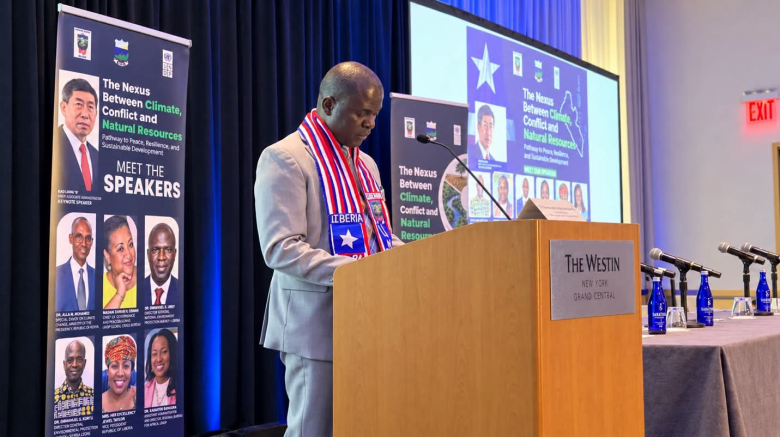
NEW YORK, USA — Liberia’s natural-resource wealth should be managed as a foundation for peace, resilience and sustainable development rather than treated solely as an economic asset, Environmental Protection Agency Executive Director Dr. Emmanuel K. Urey Yarkpawolo has told an international gathering in New York.
By Selma Lomax, [email protected]
Dr. Yarkpawolo made the assertion Wednesday during a high-level Government of Liberia side event convened on the margins of the 81st Session of the United Nations General Assembly.
The meeting brought together government officials, United Nations representatives, development partners and experts to discuss the increasingly important connection between climate change, natural resources and conflict.
The event, held under the theme “The Nexus Between Climate, Conflict and Natural Resources: Pathways to Peace, Resilience, and Sustainable Development,” was organized by the Government of Liberia through the Environmental Protection Agency, in partnership with the United Nations Development Programme.
The engagement is taking place ahead of Liberia’s December 2026 presidency of the United Nations Security Council, with the organizers seeking to draw greater international attention to the links between environmental challenges, peace and sustainable development.
Opening the event, Dr. Yarkpawolo said Liberia’s natural endowment presents the country with significant opportunities, but cautioned that the benefits of those resources depend heavily on how they are governed.
He identified Liberia’s forests, minerals, rivers, fisheries and coastal ecosystems among the country’s most important natural assets, noting their potential to contribute to economic development and improve livelihoods.
But the EPA chief said the exploitation and management of those resources must be accompanied by strong institutions, transparency and meaningful participation from communities.
He warned that environmental pressures can compound existing social and economic difficulties, particularly in communities already affected by poverty, inequality and limited access to basic services.
Dr. Yarkpawolo said climate change can also place additional pressure on land, water and other resources, potentially increasing competition and tensions if institutions lack the capacity to manage those pressures effectively.
“Our natural resources are among Liberia’s greatest assets, but their value to the nation will depend on how responsibly and transparently we manage them,” he said.
He said government agencies and other stakeholders must therefore work together to ensure that resource management contributes to stability rather than creating new grievances among communities.
The EPA Executive Director emphasized that community involvement should be central to natural-resource governance, particularly because local communities are often directly affected by decisions involving forests, land, waterways, fisheries and other environmental resources.
“Communities cannot be treated as observers when decisions are being made about the resources upon which their livelihoods depend. Their participation is essential to building ownership, trust and lasting solutions,” Dr. Yarkpawolo said.
He further argued that stronger environmental governance could help Liberia confront climate-related risks while creating opportunities for sustainable economic activity.
According to Dr. Yarkpawolo, protecting natural resources should not be viewed as an obstacle to development, but as an essential component of development planning.
He said Liberia’s forests and coastal ecosystems, for example, have environmental functions that extend beyond their immediate economic value, including supporting livelihoods and strengthening the country’s resilience to climate-related impacts.
The EPA boss also stressed the importance of transparency in ensuring that citizens understand how natural resources are governed and how their economic benefits are distributed.
He said effective institutions are necessary to ensure that environmental regulations are enforced, resource exploitation is conducted responsibly and communities have avenues through which their concerns can be addressed.
The Wednesday gathering provided Liberia with an international platform to discuss how lessons from its peace experience could inform its response to emerging climate and environmental challenges.
Dr. Yarkpawolo said Liberia should use its peace as a foundation for addressing vulnerabilities before they escalate into wider social tensions. He noted that preventing environmental pressures from becoming sources of conflict requires early action, stronger institutions and cooperation among government, communities, international partners and the private sector.
The discussions also underscored the need for climate resilience to be incorporated into national development planning, particularly as Liberia seeks to maximize the benefits of its natural resources while protecting ecosystems.
The EPA Executive Director maintained that sustainable management of Liberia’s natural wealth requires a balance between economic development, environmental protection and the interests of communities.
The side event is expected to contribute to ongoing discussions on climate, peace and sustainable development while reinforcing Liberia’s role in international conversations on the governance of natural resources.
Support Independent Journalism
Your support helps FrontPage Africa continue delivering independent, credible, and impactful journalism. Every contribution strengthens our ability to investigate, inform, and hold power accountable while keeping quality journalism accessible to our readers.
Support our journalism or subscribe to receive the latest FrontPage Africa stories and updates.