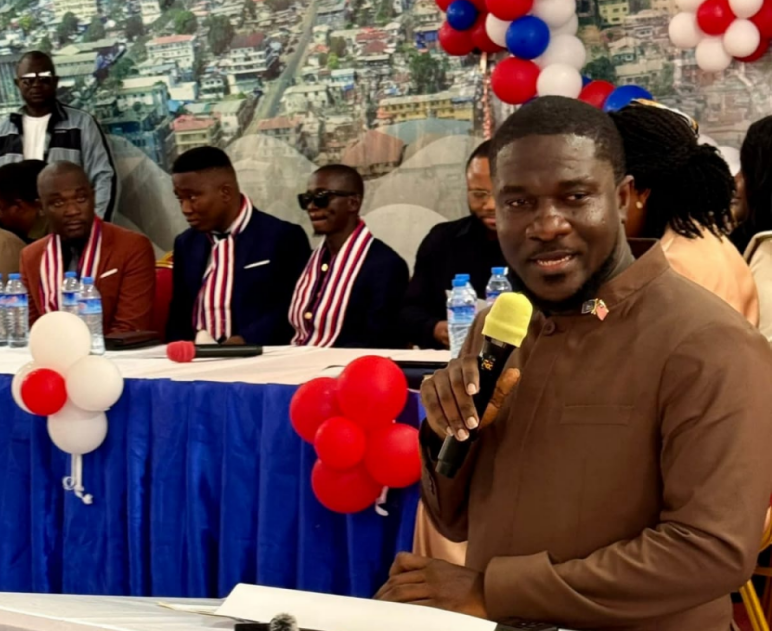
Monrovia – The Special Assistant to Justice Minister, Atty. Siaffa Bahn Kemokai, has challenged the newly inducted leadership of the Federation of Liberian Youth (FLY) to strengthen youth leadership through unity, discipline, innovation and respect for the rule of law, describing the organization as a critical institution for Liberia’s national transformation.
Delivering the keynote address at the inauguration of FLY’s newly elected leadership under the theme:, “Strengthening Youth Leadership for National Transformation,” Atty. Kemokai likened the Federation to a centuries-old cotton tree that survived a devastating storm because villagers chose to repair it rather than destroy it.
Recalling the story of an old Cotton Tree in Cape Mount County, he said the lesson reflects the current state of the Federation following months of internal electoral disputes.
“Do not let the crack finish what the storm began. A tree that splits is not a dead tree. Bind the wound, support the trunk, and give it time, and the same roots that held it for a hundred years will hold it for a hundred more,” Atty. Kemokai stressed.
He explained that just as the villagers restored the damaged tree, FLY has overcome its own internal divisions through patience and lawful means.
“The Federation of Liberian Youth is our iroko,” Atty. Kemokai declared. “A wound that is properly bound does not weaken a tree; in time, it becomes the strongest part of the trunk.”
According to him, the Federation has remained Liberia’s foremost youth umbrella organization for more than five decades, producing leaders who now serve across government, civil society and the diaspora.
“History alone does not justify an institution; results do,” he noted, saying that FLY’s greatest contribution has been developing generations of young leaders who continue to shape national development.
Addressing the organization’s recent leadership dispute, Atty. Kemokai acknowledged that the election process was contentious but praised all parties for resolving their differences through the courts instead of violence.
“Leadership is not only what you say from a podium; it is how you conduct yourself when you believe you have been wronged, and how you respond when the outcome does not go your way,” Atty Kemokai said.
“When the disagreement reached its hardest point, the parties did not turn to the street, to intimidation, or to violence. Instead, they turned to the courts of the Republic of Liberia, and they accepted the outcome that followed,” accentuated.
Atty. Kemokai commended the outgoing leadership, contestants and stakeholders for choosing “the law over lawlessness and the courtroom over chaos,” describing their actions as an example for young people across the region.
He, however, urged the Government of Liberia(GoL) to equally respect judicial decisions involving youth institutions.
According to him, when a leadership emerges through due legal process, every branch of government should recognize and work with it.
A government that asks its young people to trust the courts cannot then treat a court-validated leadership as though it does not exist; that is not merely inconsistent, it undermines the very rule of law the state asks its citizens to respect,” he asserted.
Atty. Kemokai further called on national leaders, particularly those responsible for youth affairs, to serve as bridges rather than barriers between young people and government.
Turning to institutional development, he expressed concern that despite existing for more than fifty years, FLY still lacks a permanent national headquarters.
“FLY is over fifty years old, and yet, to this day, it does not have a national headquarters of its own. Fifty years of producing leaders for this nation, and we still gather in borrowed halls to conduct the Federation’s business,” Atty. Kemokai intoned.
He challenged the newly inaugurated leadership to mobilize support from government, the private sector, development partners and the Liberian diaspora to construct the Federation’s first headquarters.
“Let our generation be remembered as the one that finally gave FLY a national headquarters through creative partnerships with government, private investors, the diaspora and development partners,” he intimated.
While acknowledging the youth-focused commitments contained in President Joseph Nyuma Boakai’s ARREST Agenda for Inclusive Development, Atty. Kemokai stressed that policies must produce tangible results.
He welcomed the administration’s plans, including the National Youth Policy, Youth Peace and Security Action Plan, and skills development initiatives, but insisted that FLY should remain an independent partner capable of holding government accountable.
“Policies on paper must translate into programs on the ground, and promises made in speeches must be matched by budgets and genuine partnership with organized youth structures such as this Federation,” he said.
The lawyer reminded the newly inducted leadership that national transformation requires service to all Liberian youth while safeguarding the Federation’s independence.
He urged government officials to support rather than obstruct the Federation’s work and encouraged young Liberians to remain committed to peaceful, lawful engagement.
Concluding his address, Atty. Kemokai returned to the story of the Cotton Tree, urging the new leadership to continue nurturing the organization instead of allowing past disagreements to define its future.
“Do not let the crack finish what the storm began.”
“The storm has passed. The crack has been bound by the law and by the patience of all who respected it. What remains is the work of the seasons, the quiet, faithful tending that turns a wounded tree into a stronger one,” he pointed out.
Atty. Kemokai also renewed his appeal for the construction of a permanent FLY headquarters, saying that just as the villagers eventually built around the restored tree, Liberia’s youth should build a lasting home for their national organization.
“Long after we have left this hall, long after our names are forgotten, let it be said of this generation what is still said of that village: that when the storm came, they did not cut the cotton tree down; they bound it, they tended it, and they built beneath it a home that lasted,” he added.
Support Independent Journalism
Your support helps FrontPage Africa continue delivering independent, credible, and impactful journalism. Every contribution strengthens our ability to investigate, inform, and hold power accountable while keeping quality journalism accessible to our readers.
Support our journalism or subscribe to receive the latest FrontPage Africa stories and updates.