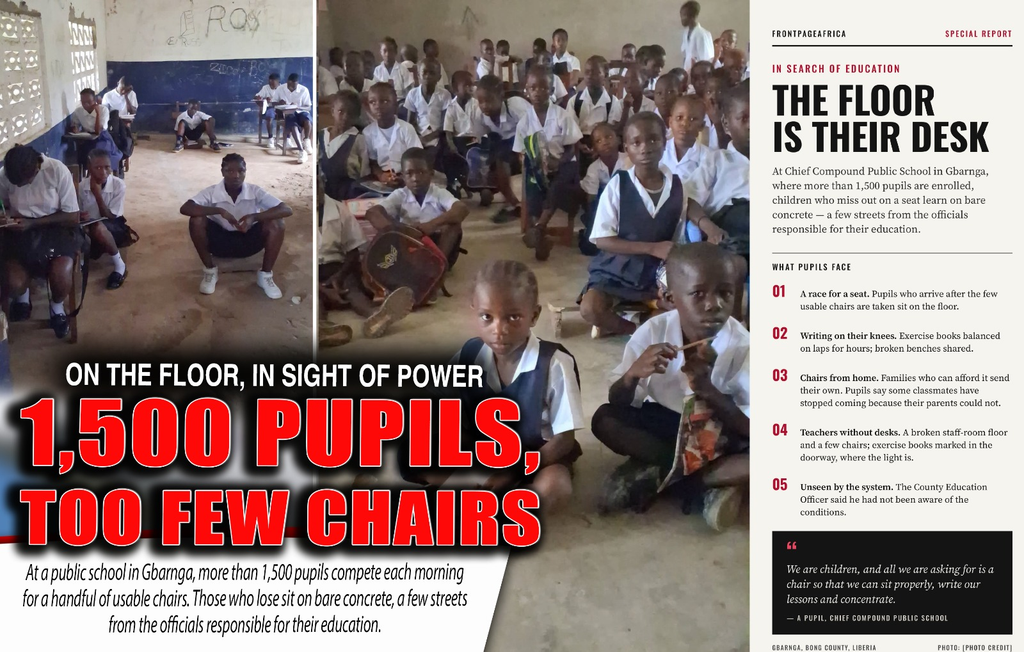
GBARNGA, Bong County — The competition starts before the first lesson. Pupils arriving each morning at Chief Compound Public School look first for somewhere to sit: a chair, a gap on a broken bench, anything. Those who come after the seats are gone have one option. The floor.
By Selma Lomax| [email protected]
The school, which enrolls more than 1,500 pupils, is not in a remote village beyond the reach of government. It stands in Gbarnga, the administrative and political capital of Bong County, within easy reach of the government offices and education authorities charged with the welfare of the county’s children.
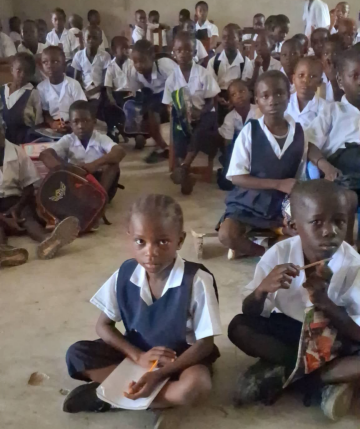
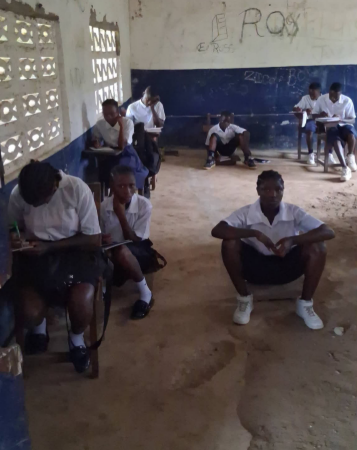
Inside some classrooms, children sit for hours on bare concrete, balancing exercise books on their knees as they try to follow lessons. Others crowd onto broken benches, squeeze onto whatever furniture is still usable, or bring chairs from home.
What they are asking for is modest. Not computers, air conditioners or science laboratories — just chairs and desks that would let them sit properly, write comfortably and concentrate.
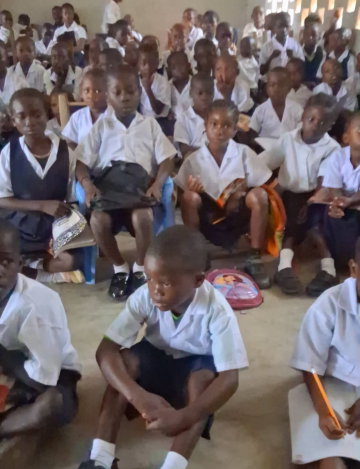
“We are in the city, not somewhere that people cannot reach,” one pupil said. “Our school is here in Gbarnga, and the people who are responsible for education are also in this city. We see government offices and other important people around us, so sometimes we ask ourselves why we have to sit on the floor to learn. We are children, and all we are asking for is a chair so that we can sit properly, write our lessons and concentrate. We want to believe that somebody will hear us.”
FrontPageAfrica is not identifying the pupils interviewed for this story because they are minors.
The distance between the school and the offices that could help it can be counted in streets. The distance between the problem and a solution, the pupils suggest, is far greater.
For the children, the shortage is not a policy abstraction. It greets them every morning — and, they say, it may be keeping some of their classmates away altogether.
Friends who stopped coming
Pupils spoke of friends who no longer attend school, and they tied those absences to money: parents who could not afford to buy a chair.
FrontPageAfrica could not verify the claim against attendance records, and its scale is unknown. But it reflects a pressure familiar to many Liberian households. When income is thin, every expense competes with every other. A chair is not food. It is not medicine or transport fare. In the hard choices poor families are forced to make, a chair can lose.
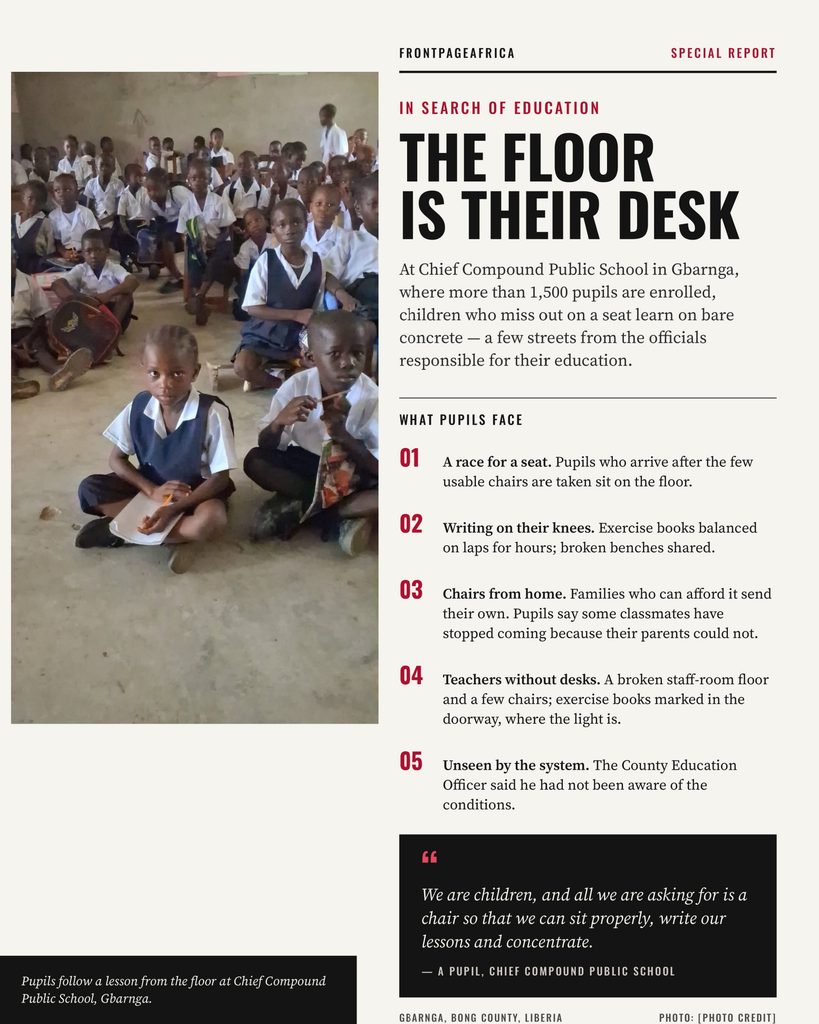
The pupils spoke of their absent classmates less with anger than with a sense of loss, the way people talk about a friend who has moved away. What they want, they said, is for everyone to learn together.
A desk in the doorway
The staff room tells its own story. Its floor is pitted with holes, and a handful of chairs sit clustered in one corner. During a visit by FrontPageAfrica, a female teacher searched for somewhere to set down her lesson notes. She later carried pupils’ exercise books to the classroom doorway — the only place with enough light to read them.
Teachers who improvise this way keep the school running, but the improvisation has a cost. A teacher straining to read a child’s handwriting in a doorway is more likely to rush her feedback, and it is the child who loses.
An admission from the county
Asked by FrontPageAfrica about conditions at the school, County Education Officer David Boakai said he had not been aware of them. His office, he said, would need to look into the situation, particularly the learning environment and the shortage of chairs and other basic facilities.
His candor offers a clear starting point — and a commitment against which progress can be measured. But it also exposes a gap. Chief Compound is not hidden beyond a river crossing. It sits in the county seat and serves well over a thousand children. If its condition had not reached the county’s top education official, then somewhere between the classroom and his office, the system’s ability to notice has broken down.
A proper assessment would not be complicated: count the pupils and the usable seats; separate what can be repaired from what must be replaced; inspect classroom space and the condition of the buildings. Those figures would give parents something to hold on to — and officials something to answer for.
What a chair carry
It is tempting to treat a shortage of chairs as a small matter beside Liberia’s larger struggles. But small things can carry large meanings. A chair holds up a child’s body so that the mind can do its work. It marks out a space that belongs, however briefly, to one pupil. It tells a child that the school expected her and made room.
Take the chair away, and the message reverses. The child becomes someone to be accommodated by improvisation, someone whose comfort is optional. The pupils at Chief Compound have noticed. What they ask in return is neither grand nor unusual: equal treatment, a seat beside their friends, and an end to writing on their knees.
Who will stand up?
The pupils have done what they can. They have described their classrooms, named what they lack, and trusted a visiting reporter to carry their words further than they could.
The responsibility now lies with others. The county has promised to look. Parents could organize. Donors, civic groups and local leaders could each take a share. However, the response takes shape, it will be judged by a simple test: whether, one morning soon, a child in Gbarnga walks into a classroom and finds a seat waiting.
Until then, the children of Chief Compound will keep adapting, as children do. The question is how long the school system intends to rely on their patience.
Support Independent Journalism
Your support helps FrontPage Africa continue delivering independent, credible, and impactful journalism. Every contribution strengthens our ability to investigate, inform, and hold power accountable while keeping quality journalism accessible to our readers.
Support our journalism or subscribe to receive the latest FrontPage Africa stories and updates.