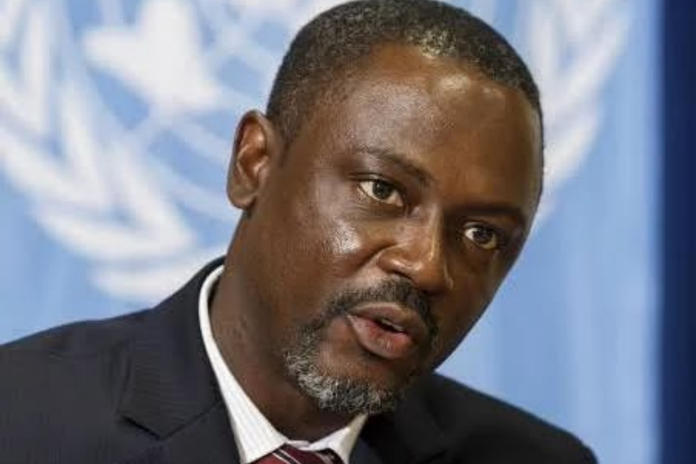
NEW YORK — Nigerian billionaire and Heirs Holdings Chairman Tony Elumelu has called for a fundamental shift in Africa’s development model, urging governments and international partners to move beyond aid dependence toward trade, investment, entrepreneurship and private sector-led growth.
Elumelu made the call during a fireside chat on the sidelines of the 2026 United Nations General Assembly (UNGA) in New York, where he argued that Africa must take greater ownership of its economic transformation while attracting capital to build sustainable industries and create jobs.
The discussion, titled the Darryl G. Behrman Lecture on Africa Policy, was moderated by Michael Froman, president of the Council on Foreign Relations (CFR). It examined Africa’s place in the global economy, entrepreneurship, energy security, private sector development and the future of US-Africa relations.
Elumelu urged international investors to abandon outdated perceptions of Africa as an aid-dependent continent and recognize its potential as a destination for commercial investment and long-term growth.
He argued that treating Africa as a single, high-risk market overlooks the economic diversity and investment opportunities across its 54 countries.
According to Elumelu, international investors can better navigate African markets by forming strategic co-investment partnerships with credible local business leaders who understand the operating environment.
He reaffirmed his philosophy of Africapitalism, which promotes private sector-led development and argues that businesses should play a central role in driving Africa’s economic transformation.
While acknowledging the role of aid in providing immediate relief, Elumelu said it could not substitute for sustained investment in industries, infrastructure and productive economic activities.
He called on foreign venture capital firms, pension funds and development finance institutions to work with local financial institutions to finance critical infrastructure and strengthen trade corridors across the continent.
Youth Entrepreneurship as an Economic Imperative
Elumelu also highlighted Africa’s youthful population, describing young entrepreneurs as essential to the continent’s economic development, security and long-term stability.
He argued that tackling youth unemployment was critical to reducing irregular migration and preventing social instability, urging international philanthropies, multilateral agencies and corporations to expand support for youth-led businesses.
Citing the work of the Tony Elumelu Foundation, which has committed $100 million to empowering young African entrepreneurs, he pointed to the provision of $5,000 in non-refundable seed capital, alongside business training, as a way to stimulate enterprise development and job creation in rural and urban communities.
He called for greater investment in micro, small and medium-sized enterprises, which he said could help expand economic opportunities and strengthen local economies.
Energy Access Central to Africa’s Industrialization
On energy security and climate policy, Elumelu advocated a pragmatic and equitable approach to the global energy transition, warning that Africa’s industrial and digital ambitions would remain constrained without reliable electricity.
He noted that more than 600 million Africans still lack access to electricity, underscoring the scale of the challenge facing governments seeking to expand manufacturing, digital services and other productive sectors.
Elumelu called for Africa’s natural gas resources to be used as a transition fuel to power industries and stabilize electricity grids while investment in renewable energy infrastructure continues.
His position emphasized the need to balance energy access and industrial development with the ongoing transition toward cleaner energy sources.
Rethinking US-Africa Trade Relations
Elumelu also called for a shift in US-Africa economic relations, urging both sides to move beyond traditional concessionary arrangements toward partnerships that support manufacturing, investment and deeper integration into global supply chains.
While expressing support for the African Growth and Opportunity Act (AGOA), he said policymakers should pay greater attention to the cost of producing African goods and delivering them to US markets.
He also advocated bilateral trade arrangements that could strengthen supply-chain integration, encourage domestic manufacturing and remove regulatory barriers to intra-African commerce as the African Continental Free Trade Area gains momentum.
For Elumelu, expanding trade and investment requires more than market access. African businesses must also be able to produce competitively, move goods efficiently and access the capital needed to scale operations.
He maintained that Africa’s economic prosperity was in the broader interest of the international community, arguing that persistent poverty in one part of the world could undermine economic peace and security elsewhere.
His message was that sustainable development would require Africans to take the lead in building productive economies, supported by international partnerships that prioritize investment, enterprise and long-term economic growth over continued reliance on aid.
Support Independent Journalism
Your support helps FrontPage Africa continue delivering independent, credible, and impactful journalism. Every contribution strengthens our ability to investigate, inform, and hold power accountable while keeping quality journalism accessible to our readers.
Support our journalism or subscribe to receive the latest FrontPage Africa stories and updates.