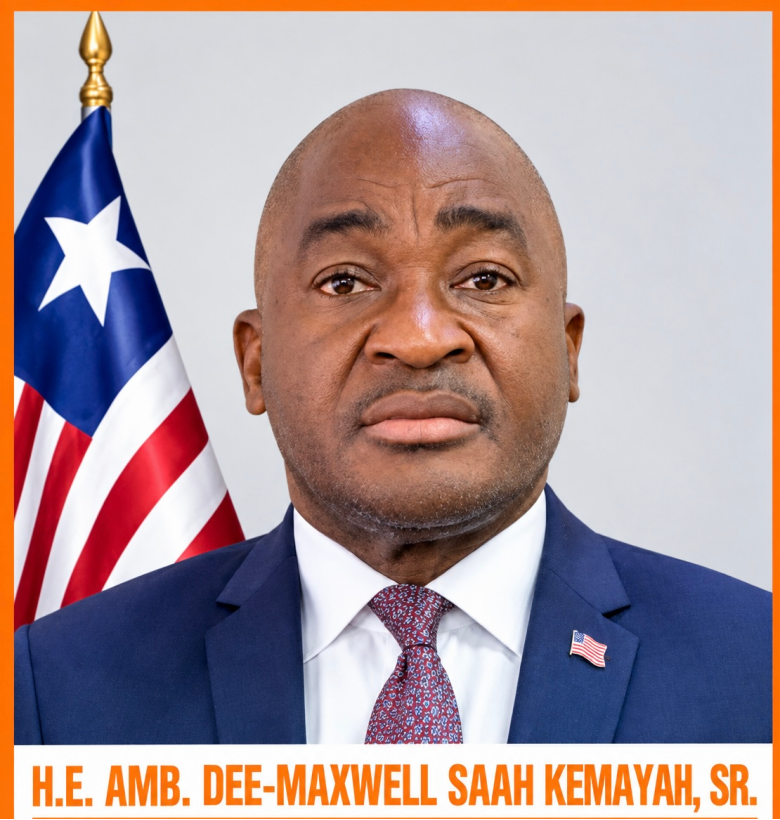
Monrovia — Former Liberian Foreign Affairs Minister Dee-Maxwell Saah Kemayah has warned that growing political tensions, declining public confidence in state institutions and concerns over the politicization of justice could undermine Liberia’s hard-won peace, calling for urgent action to prevent political disagreements from escalating into national instability.
By Gerald C. Koinyeneh, [email protected]
Kemayah issued the warning Monday, September 21, while delivering the special keynote address at the First International Peace Summit 2026, held virtually to commemorate the International Day of Peace.
Speaking under the theme “Peace in a Fractured World: Restoring Dialogue, Justice and Confidence in Institutions,” the former minister identified credible diplomacy, justice under the rule of law and public confidence in institutions as essential pillars for achieving sustainable peace.
Drawing on Liberia’s experience following 14 years of civil conflict, Kemayah cautioned that the country’s post-war stability could become vulnerable if political divisions deepen and citizens lose confidence in the impartiality of national institutions.
“Liberia knows the terrible cost of institutional collapse,” he said, noting that the country has spent more than two decades rebuilding a fragile peace.
He expressed concern over what he described as rising political tensions amid highly charged prosecutions of former government officials, saying questions surrounding the administration of justice and the perceived politicization of accountability were deepening mistrust between the government and opposition.
“When political persecution and witch-hunt seem to be the emerging trend, rather than resolve political disputes, and citizens begin to doubt the impartiality of national institutions, with selective justice; the foundations of peace may be dangerously vulnerable,” Kemayah said.
He warned that prolonged mistrust could harden political divisions, make future elections more confrontational and push public grievances from institutional channels onto the streets.
In a post-conflict society such as Liberia, he said, even isolated incidents could become dangerous when they occur in an atmosphere of deep political mistrust.
“Conflict does not begin when a first gun is fired. It begins when trust dies, institutions lose credibility, political opponents become enemies, and citizens cease to believe that justice will protect them equally,” he stated.
Kemayah urged Liberians to recognize the warning signs before political tensions evolve into a broader crisis.
“We have paid too high a price for peace to gamble with it again,” he said. “Liberia must act before political tension becomes political crisis and before political crisis becomes national instability.”
Accountability Must Not Become Political Persecution
A central theme of Kemayah’s address was the need to balance accountability with the protection of constitutional rights, particularly during changes in government.
While affirming that former public officials must remain accountable for their actions, he stressed that prosecutions must be grounded in credible evidence, transparency, impartiality and due process.
“Where credible evidence of wrongdoing exists, the law must take its course. But accountability must be evidence-based, transparent, impartial, and consistent with due process,” he said.
He cautioned that without these safeguards, legitimate accountability efforts could be perceived as political persecution.
“Otherwise, prosecution can be persecution in disguise,” Kemayah warned.
He argued that democratic systems must reject both impunity and politically motivated prosecutions, emphasizing that credible justice—not selective enforcement or political witch-hunts—is necessary to sustain public trust.
According to him, when political actors begin to believe that losing an election could result in imprisonment through politically motivated legal processes, the stakes of political competition become dangerously high.
Kemayah also emphasized that no individual should be above the law, while no one should be denied its protection.
Courts, Diplomacy as Pillars of Peace
The former foreign minister described the judiciary as more than an institution responsible for interpreting and enforcing the law, arguing that courts also serve as mechanisms for preventing conflict.
He said independent courts provide an orderly alternative to confrontation by allowing political, constitutional and electoral disputes to be resolved through established legal processes rather than violence.
“Courts are also institutions of peace,” Kemayah said, calling for greater support for the judiciary as an investment in national stability.
He also underscored the importance of preventive diplomacy, arguing that preventing conflict is less costly than resolving it after violence has erupted.
According to Kemayah, diplomacy should not be treated merely as an emergency response but as a continuous process involving early warning, mediation, confidence-building measures and sustained dialogue.
“Dialogue is not capitulation. Negotiation is not surrender. Diplomacy is not weakness,” he said, describing diplomacy as the disciplined search for alternatives to destruction.
He urged governments and international organizations to strengthen early-warning systems and establish standing mediation teams capable of intervening before disputes escalate into crises.
Calls for Institutional Independence, Political Restraint
Kemayah further called for stronger safeguards to protect the independence of the judiciary, electoral bodies, legislatures and public accountability institutions from political interference.
He recommended transparent, merit-based appointments, clearly defined terms of office, lawful removal procedures and adequate institutional funding.
He also urged political leaders to exercise restraint in using legal and administrative powers against opponents, emphasizing that constitutional democracy requires more than technical compliance with the law.
“The spirit of constitutional democracy requires more than legality. It requires restraint and consideration of expediency,” he said.
On political leadership, Kemayah called for a reduction in inflammatory rhetoric, warning that statements by public officials and political actors could either ease tensions or deepen divisions.
He stressed that political opponents should not automatically be treated as enemies of the state and that governments must tolerate criticism while allowing opposition groups to challenge them within constitutional boundaries.
“The ultimate test of statesmanship is not the ability to defeat every opponent. Sometimes, it is the ability to create sufficient common ground for former adversaries to coexist,” he said.
Challenges International Institutions
Beyond Liberia, Kemayah called on international institutions to demonstrate greater consistency in applying international law, warning that perceived double standards undermine confidence in the international system.
He argued that smaller states, developing countries and vulnerable populations must have confidence that international laws protect them as meaningfully as they protect powerful nations.
“When similar conduct attracts different international responses, depending upon who commits it, confidence diminishes,” he said.
He called for greater transparency, representation, accountability and consistency in multilateral institutions, while urging stronger support for regional organizations that are often better positioned to understand and resolve neighboring countries’ crises.
Proposes Five-Point Peacebuilding Agenda
To translate his recommendations into action, Kemayah outlined five priority areas: strengthening preventive diplomacy, protecting institutional independence, upholding the rule of law consistently, preserving dialogue among adversaries and restoring confidence in multilateralism.
He called for permanent national dialogue mechanisms involving governments, opposition parties, civil society, business leaders, youth, women and traditional authorities.
He also urged political parties to establish internal dispute-resolution mechanisms and commit to nonviolent political competition.
Kemayah highlighted the media’s role in peacebuilding, calling for responsible journalism that provides facts without deliberately intensifying political divisions.
He also urged social media platforms and technology companies to cooperate with governments and civil society in addressing coordinated disinformation and incitement, while protecting legitimate freedom of expression.
In concluding his address, Kemayah said peace must be continuously nurtured through responsible governance, impartial justice, open diplomacy and institutions that command public confidence.
“Lasting peace cannot be imposed by force alone. It must be built through trust, protected by justice, sustained through dialogue, and anchored in institutions that command the confidence of the people they serve,” he said.
He closed by urging world leaders to embrace the summit’s declaration of “One World, One Humanity, One Future,” emphasizing that sustainable peace requires cooperation and a shared commitment to preventing future conflicts.
Support Independent Journalism
Your support helps FrontPage Africa continue delivering independent, credible, and impactful journalism. Every contribution strengthens our ability to investigate, inform, and hold power accountable while keeping quality journalism accessible to our readers.
Support our journalism or subscribe to receive the latest FrontPage Africa stories and updates.