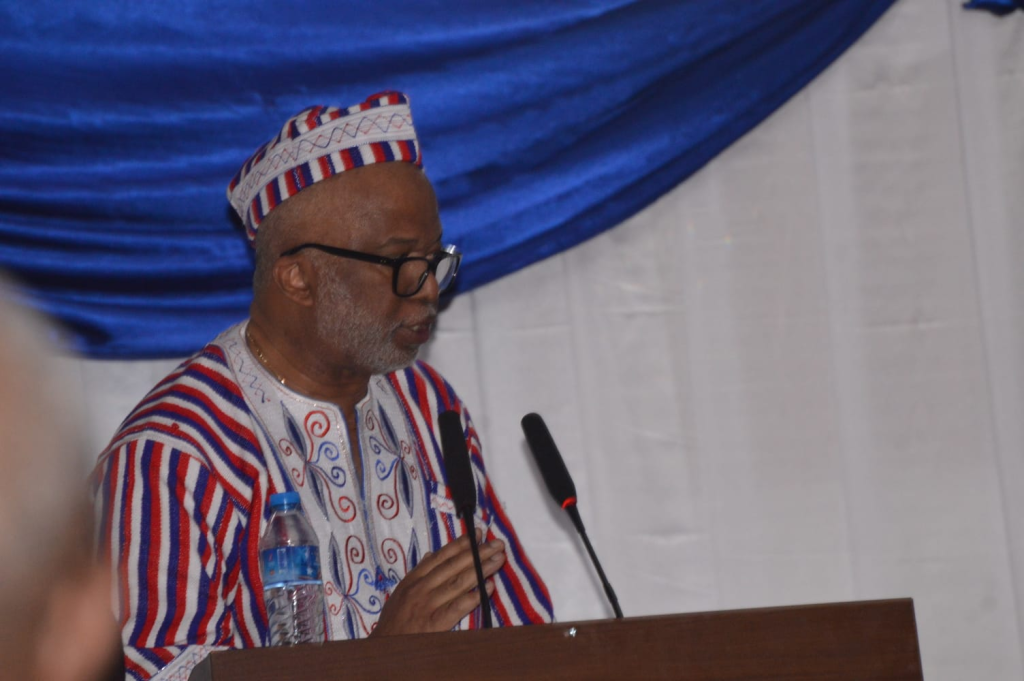
As the Orator delivered it:
Herbert Brewer-Historian, Liberia’s 179th Independence Orator
Mr. President and Madam Boakai, Mr. Vice President, Mr. Speaker, Madam President Pro Tempore, members of the National Legislature, Your Honor, the Chief Justice, the Associate Justices of the Supreme Court, members of the Cabinet, the Dean and members of the Cabinet, the Doyen and members of the Diplomatic and Consular Service, Consular Corps, traditional leaders, religious leaders, members of the Armed Forces, distinguished guests, fellow Liberians at home and throughout the diaspora, ladies and gentlemen.
First, let me say that I am deeply humbled and very grateful for the honor bestowed on me. This is the honor of a lifetime. Thank you, Mr. President, for the invitation to serve as this year’s Independence Day orator.
And if you please, allow me before I begin to acknowledge my mother, Elizabeth Woods Brewer, a daughter of Bassa, who is buried in the soil of this great county, right there across the St. John River. May she continue to rest in peace. Thank you, Ripa.
I also want to acknowledge Erica Rapier, my wife of 40 years, and our son, Aiden. My fellow Liberians, as we gather today to commemorate the 179th anniversary of our nation’s independence, I would like to consider a question that many young Liberians have asked. Sometimes quietly and sometimes aloud.
What is there to celebrate? Others can go even further. They tell us that our history is little more than a catalog of failure and disappointment. Indeed, some would even suggest that the whole idea of Liberia was a mistake.
Others have urged us to believe the past behind altogether and concern ourselves only with the present and the future. Now, these are serious questions and they deserve thoughtful answers and responses. This morning, I wish to offer a different way of thinking about Liberia and its history.
My argument is simple. Liberian history is one of our greatest national assets. And when it comes to understanding our collective past, the great challenge facing us is not simply that too many Liberians do not know their history.
Our great challenge is that too many have come to believe their history has little value. Yet, a people who lose confidence in their history eventually lose confidence in themselves. History is not merely a record of yesterday’s events.
History is the source of our identity, our memory, our wisdom, our sense of national purpose. You might gain and lose wealth. Governments may come, rise and fall.
Borders change. But a nation’s history remains the foundation upon which every generation builds. No one else can claim Liberian history for us.
Only Liberians can. And today, I would like to reflect on three questions. First, how did we arrive at this moment in our long national journey? Second, why does July 26, 1847 matter? Not only to Liberia, but to the wider world.
And finally, how should we think about the past and what responsibilities does it place upon us? To claim Liberia’s history, we must first understand that Liberian history did not begin in 1847. Nor did it begin in 1822. The republic whose independence we celebrate today rests upon foundations laid over many centuries.
Historians often remind us that the past is not flat. Every generation inherits a different Liberia. Every age confronts new challenges.
And to understand who we are today, we must begin at the beginning. Our knowledge of Liberia’s earliest history is necessarily incomplete. Yet, we know enough to say with confidence that the people who have occupied this land have lived here for many, many centuries.
Portuguese mariners left written descriptions of the Windward Coast. The Windward Coast is basically between Cape Mountain and Cape Amos. And I’ll refer to it as that, because he did.
The Portuguese accounts are corroborated by oral traditions, by archaeology, and by linguistics. Together, all these sources reveal a long history of migration, settlement, and cultural exchange. They tell us that communities speaking Gula and Gisi were among the oldest inhabitants of this region.
That the Dey-speaking people were the first to arrive at the coast. While later migrations from the north and east brought the ancestors of many of today’s Liberian people. But what I want to put on the table for you, and for your consideration, is that when it comes to the issues of our various ethnic identities, which has gained prominence in the national consciousness over the last generation, there is a larger point, which is this.
The ethnic communities we know today did not emerge fully formed like all human societies, they evolved over time. People migrated, they traded, they forged alliances, they intermarried, they divided, reconciled, fought wars over the differences, sometimes created entirely new ethnic identities. The Liberia of today is the product of centuries of migration and cultural interaction and exchange.
Our ethnic identities are not fixed by nature. They were shaped by history, by that migration, by trade, by marriage, by conflict, by cooperation over these many centuries. Our ancestors were not born into the identities that we know and have today.
Indeed, our ancestors created those identities. Before the European colonial powers drew borders on maps, identities and boundaries were far more fluid than we often imagined them to be today. Communities, again, migrated, they divided, they merged, they reinvented themselves.
And as the distinguished West African historian, Bukwaka Bari, reminds us, West Africa was, and I’ll quote him, a land of people without frontiers. Understanding this longer history reminds us that Liberia did not create its people. Rather, its many people over countless generations created the Liberia we have inherited.
Long before there was a Liberian state, there was already a Liberian historical experience. Long before the Republic of Liberia, there were sovereign African societies existing in this space. They governed themselves according to their own laws and institutions.
They maintained systems of diplomacy. They maintained commerce. They maintained spirituality and justice systems.
They cultivated the land, managed regional trade, developed technology suited to their environment. They built these institutions like Puru and Sande, whose history right now, by the way, Professor Jason Carr, a Liberian, is currently researching. So the desire for self-government then did not begin in 1847.
Let’s establish that. What independence did, however, was to give that older aspiration a new and modern constitutional form. Among the most celebrated of these sovereign communities, existing at the time, was Bobolu, a thriving commercial center, and perhaps the oldest continuously inhabited town in present-day Liberia.
Far from being isolated, our ancestors participated in regional and international commerce. As the Liberian historian Patrick Burroughs has shown, cola and malaguera pepper, cultivated in this region, found their way into the Mediterranean markets centuries ago. The scholar Judith Kearney has amply demonstrated that the rice-growing knowledge carried by captives from this part of West Africa entirely transformed the Carolina Lowcountry in the United States, where their descendants, the Gullah and Geechee people of South Carolina, today remain living testimony to the resilience of African culture.
This, too, my fellow citizens, is our inheritance. Yet, every nation has chapters of its history that are painful to revisit. Let’s look at one of ours.
As European traders established themselves along the Atlantic coast of West Africa, commercial networks that had long connected our region to the Sahara gradually shifted toward the Atlantic Ocean. What followed was one of the greatest strategies in human history, the Atlantic slave trade, which did not simply remove millions of Africans from their homes, it shattered families, redirected economies, it fueled warfare, it interrupted centuries of political development. No community in what is now Liberia escaped its effects.
Every single society was touched by it. Like our own civil conflict in recent memory, the transatlantic slave trade drew entire communities into a catastrophe from which few would escape untouched. Yet, even in this tragedy, even in this tragedy, we can discover another thread that runs through Liberian history.
Centuries of resisting enslavement and capture by these slave trading networks strengthened among many of our ancestors a profound attachment to freedom, self-government, and sovereignty. Those ideals would later shape the Republic itself. In 1722, I’ll tell you a story.
In 1722, when the French slave trader Chevalier de Marché, and he wrote about his adventures in Liberia, he attempted to persuade the rulers of Cape Mesurado to permit the construction of a European fort. The day ruler, known as Peter, firmly refused. Peter informed Chevalier that they were welcome to build a warehouse in the swamps of Bouchard Island, but not upon the Cape itself.
That decision speaks across the centuries. It reminds us that long before the modern Republic, the peoples of this coast understood the value of sovereignty. Nor was this coast some isolated frontier awaiting discovery, because that’s how some of the visitors talked about it.
Beneath Cape Mesurado was Dukaw, already a multilingual commercial settlement connected to the wider Atlantic world. Merchants, sailors, fisher folk, interpreters, Africans who had traveled abroad, Europeans, people of mixed ancestry, all lived and traded at Ducor in the 1700s. It was a place of diplomacy and commerce and cultural exchange a whole century before the arrival of the first American repatriates.
This too, my fellow citizens, is our inheritance. The story of the Republic of Liberia’s founding then did not begin with the American colonization society. It began much earlier in the hearts and minds of people of African descent who, though separated from their ancestral homeland by slavery, never entirely forgot Africa.
In 1811, Paul Kofi, a black American shipowner and sea captain from Massachusetts, sailed here to West Africa in search of a place where free people of African descent might build new lives. He later carried a shipload of African American immigrants to Freetown. That voyage captured the imagination of free black communities up and down the east coast of the United States at the point.
Hundreds of them volunteered to accompany him on his second expedition, but Kofi died before his dream was realized. But the dream, however, didn’t die. Let us acknowledge here, though, that black Americans never spoke with one voice on this question.
At that time, many free African Americans opposed immigration to Africa, and they believed that their future lay in the United States. But, however, like the Reverend Lott Carey of the Richmond African Baptist Missionary Society, others believed that they had a duty to return to the land of their ancestors. Reverend Carey, not the ACS, paid his own way to come to Liberia.
He paid his own way to come to Liberia. The ACS did not send him here. They did not bring him here.
And he was not the only one who did that. They raised their own money. Why? Because they had particular aspirations.
Explaining his decision, Lock Kerry wrote these memorable words. And I’m quoting him. I am an African.
I feel bound to labor for my suffering race. That’s Lott Carey. And as I said, Reverend Carey was not alone.
As early as the 18th century, free black communities established organizations such as the African Union Society in Rhode Island, way back there, and proudly identified themselves through institutions bearing the name African. We all here in Liberia know the African Methodist Episcopal Church, founded at that time. The African Baptist Church of Savannah, one of the oldest black Christian congregations in the United States.
The African Baptist Church of Richmond, Virginia. And so many more like that. African schools established in New York, in Baltimore, in Boston.
This is all before the ACS. And I hope you get my point. So long before the republic was founded, there already existed a powerful conviction among many people of the African diaspora, in the diaspora, that Africa’s future belonged in African hands.
This, my fellow citizens, this is our inheritance. So it is long past time then to recognize that the Republic of Liberia emerged from one of the most remarkable meet-ups in history. Returning descendants of Africa brought the hard-earned lessons they learned of survival, of education, of faith, of resistance, and the determination to build a free republic upon the continent of their ancestors.
At a time when African sovereignty was under assault across much of the continent. Some of them had endured slavery. Others had been born free.
Some came from the United States. Others from the Caribbean, or from Sierra Leone, from neighboring African countries or territories, recaptured Africans from illegal slave ships, added their languages, their cultures, their skills, and their resilience to this emerging nation. Africans who had remained on the continent, who had remained here on the ground, brought to the table generations of political experience, the people they met, generations of political experience, commercial knowledge, diplomatic skill, cultural continuity.
And among those people who they met here, whose contributions deserve renewed recognition here in Liberia, are three who I will name. William Campbell, David Noah, and William Davis. Don’t let their last names fool you.
Those are Liberian people, meaning African people, meaning indigenous people. These men, abolitionists, understood the political landscape of the Windward Coast. They spoke its languages.
They enjoyed the confidence of African rulers. They built relationships across cultural boundaries. They were the ones who introduced the ACS to Cape Maserato.
They interpreted local political institutions, explained customs and traditions, and helped establish trusts upon which successful diplomacy depended. So the ACS agents who are coming, heirs and bacon and the rest of them, entered not an unknown land and not an unfamiliar people. They entered a country whose rulers, merchants, interpreters, diplomats had long participated in the Atlantic commerce and Atlantic economy.
And it was people like William Campbell, David Noah, William Davis, who transformed unfamiliarity into understanding and who transformed that understanding into diplomacy and transformed that diplomacy into cooperation. Their leadership reminds us that the founding of the Liberian Republic was made possible not only by the vision of the returning descendants of Africa, but also by the African people themselves already on the ground, whose wisdom and statesmanship helped us to prepare the way. So why does July 26 matter? Let me stress again that it is important to see July 26 not as the beginning of Liberian history, but as the beginning of the Liberian Republic.
Two separate things. The Republic has a founding date. The history of its people does not.
We go all the way back. I need not rehearse every detail that led to the Declaration of Independence. What matters is understanding why that declaration became necessary.
For many years, the American repatriates and the rulers of this coast negotiated, cooperated, and at times they struggled together to build a new political community. Three. One fact deserves particular attention.
The rulers of Cape Mesurado ultimately agreed to transfer sovereignty over the Cape to the new Black Republic. Ultimately, I said. Things didn’t happen in a day.
But 100 years earlier, they had refused to surrender that sovereignty to European slave traders. Yet they choose to become partners in a different enterprise. The creation of a sovereign Black state.
And in doing so, they became the co-founders of Liberia and the Liberian state. Even if certain history books might not mention that. That fact deserves a more prominent place in our national history.
And we have to, of course, do something, I would suggest, about it. So why does that date matter? Not because Liberia suddenly became a perfect nation. No nation is born perfect.
July 26th matters because a free Black people declared to the world that they possessed the right and the capacity to govern themselves. Joseph Jenkins Roberts explained the purpose of independence. In 1846, they were having a discussion, a debate, a public debate in Monrovia.
And Roberts said, very nice quote here. In this, to vindicate the race from scandal. Those are Roberts’ words.
To vindicate the race from scandal. In other words, to demonstrate that people of African descent were fully capable of sustaining a modern constitutional state. To appreciate the boldness of that declaration, we have to remember the world in which he made that declaration.
Across much of the globe, slavery still existed. European empires were expanding, questioning the fledgling state’s right to levy customs duties and those sorts of things. What do they know about government? Against that tide, Liberia declared something radically different.
That African people could govern themselves. That Black liberty could sustain Republican government. That an African nation could take its place among the family of nations.
That achievement was imperfect. It was incomplete, but it was extraordinary. This is why July 26th belongs not only to Liberia, actually, but to the history of the modern world.
It marked the birth of the first independent Black republic in Africa and gave tangible expression to an idea that has inspired people of African descent far beyond our shores. This, too, my fellow citizens, is our inheritance. Independence did not instantly create the Liberia we know today, with 43,000 square miles.
The republic that was proclaimed on July 26th, 1847, was a small coastal state. It occupied only a fraction of the territory that constitutes modern Liberia, and it exercised effective authority over little more than its settlements along the coast and the lower part of the St. Paul River. The Liberia we know today was built gradually over many decades rather than in a single moment.
This is an important point, because we are often tempted to read history backwards. We imagine that the institutions of the 20th century existed from the very start of the republic. They did not.
For much of the 19th century, the overwhelming majority of the people living within the territory of today’s Liberia continued to govern themselves according to their own political traditions. They selected their own leaders. They administered justice through their own institutions.
They defended their own sovereignty. The republic, even if it had wished to, lacked the capacity to govern most of the interior. Instead, 19th century Liberia was shaped by negotiations as much as by administration.
The republic and numerous neighboring polities coexisted in a relationship that was at times cooperative, at times contentious, but always dynamic. Each of them influenced the other. Liberia was not built simply by extending the authority of Monrovia.
It was built through decades of negotiation, alliance, accommodation, sometimes conflict. So history must always be understood in its own time. We must never really read history backwards.
If independence did not complete Liberia’s story, it marked the beginning of a new chapter. The young republic entered a difficult and often hostile world. Liberia, the republic, possessed limited resources, a very small population, and little military strength.
Powerful European empires dominated the Atlantic, while the slave trade continued to devastate much of West Africa. Yet, our republic achieved something remarkable. Liberia helped bring an end to the slave trade along the windward coast.
Look, this achievement alone, this achievement alone deserves a more prominent place in our national history. With those little resources, the republic also offered something less obvious but equally important. It created space for the African polities who surrounded it.
What do I mean? Throughout much of the 19th century, the independent African polities, communities, societies, beyond the republic’s immediate authority, continued to govern themselves while developing relationships with Monrovia. Those relationships were not uniform. They involved, as I said before, diplomacy, trade, alliances, but they created opportunities for cooperation in the fast-growing external threats that they faced.
Let me give you an example. One of the most important of these partnerships between Liberia and its neighbors was the powerful Kondo Confederation centered at Bopolu. At the time, Kondo possessed actually greater military strength than the government in Monrovia.
Yet, Kondo’s leaders concluded that their long-term interests were better served with cooperation than with conflict. But they would accept the republic rather than oppose it, and that decision they made mattered. History often remembers the presidents, and we have a fabulous display of our presidents here, I see.
It should also remember the indigenous leaders whose choices helped preserve the independence of the republic. Without their cooperation, Liberia’s history, and perhaps even its survival, might have been very different. That, too, then, my fellow citizens, is our inheritance.
But the greatest threat and the greatest test came in the closing decades of the 19th century. In 1884, 1885, winter, representatives of Europe’s great powers met in Berlin, Germany, to divide the African continent among themselves. The great cake they used to say.
No African nation was invited. No African people consulted. Across the African continent, ancient kingdoms and independent societies were assigned to foreign rulers as though they were possessions or not.
Only two African states retained international recognition of their sovereignties. One was Ethiopia, the second was Liberia. That fact alone, that fact alone, reminds us how exceptional the Liberian experience is.
Now, Ethiopia defended herself in the battlefield, defeating the Italians in 1896, who had come to claim their territory. Liberia defended itself, not having a military, defended its independence through diplomacy, international law, and political skill. But diplomacy alone could not preserve the republic.
The people living along again, those northern and northwestern frontiers of Liberia, made choices. Faced with the advance of European colonial armies, who wanted the territory, let’s be frank here and talk about it, they wanted to colonize Liberia. And the people who lived in those places to this day, Lofa County, Nimba County, those people, many of them, the sovereign communities, they chose the alliance with Monrovia, with the Liberian state, rather than incorporation into the British or French empires.
And some of that dilemma is actually brilliantly captured in Vamba Sherif, the Liberian novel. This is his novel, The Emperor’s Son. I recommend it to everybody to read that novel.
The Emperor’s Son, Vamba Sherif. These women and men acted in their own self-interest, yet in doing so, they helped shape the Liberia we know today. Our national boundaries were not simply drawn up in Berlin.
They were also forged through the decision of African communities determined to preserve much of their independence as possible. This too, my fellow citizens, is our inheritance. Now, the 20th century presented Liberia with a different kind of struggle.
The greatest threat was no longer territorial conquest. We had won the recognition. It was the economic dependence and the consequences of having an unregulated open economy that generated so much tension and conflict within this society, debate.
A century ago, 1926, Liberia entered into its agreement with the Firestone Company. Few decisions, few decisions have shaped modern Liberia more profoundly. The agreement promised investment, employment, international recognition.
It also transformed the country’s economy. Rubber plantations expanded, and actually, critically, labor moved away from small-scale farming, which would have long-term consequences. Political authority also became increasingly centralized in the executive branch as a result of Firestone’s entry into the political economy.
Liberia entered more deeply into the global capitalist economy, but on terms that were largely determined by others. The consequences of that decision continue to shape our lives today. History rarely presents us with simple choices between good and bad.
More often, history presents difficult choices between competing possibilities. And one assumes that the leaders of that generation made the decisions they believed necessary for the Republic’s survival. Whether we agree with every decision is less important than understanding why those choices were made.
History asks us first to understand, and only then to judge. The 20th century also witnessed the concentration, as I was suggesting, of political power, growing demands for reform, military intervention, civil war, and national tragedy. These events remain within living memory.
Many of you here today, and in the listening and viewing audience, experienced them firsthand. We need not recount every painful chapter. We carry them with us.
But neither should we allow those painful decades to become the whole story of Liberia. No nation should be judged solely by its darkest hours. The true measure of a people is not whether they experience hardship.
It is whether they find the courage to rebuild. And Liberia is rebuilding. Today, nearly two centuries after independence, our Republic endures.
And aside, somebody once asked, what would J.J. Roberts say if he came back and saw us? And the response really is he’d be shocked that we were still alive, that we still exist. You know? Imperfect, still unfinished, still striving, but enduring. That is no small achievement, and that, my fellow citizens, too, is our inheritance.
My fellow Liberians, as I come to a close, allow me to leave you with a few final thoughts. History is not simply about the past. There’s a difference between the past and history.
The past is everything that has happened. It cannot be changed. You can’t go back and change it.
It happened. It’s gone. Like a river, right? It’s gone.
History is what we choose to remember, what we strive to understand, what we decide is worthy of passing on to those who come after us. That choice belongs to us. Every nation has chapters of which it is proud and chapters it wishes had never been written.
And Liberia is no different. We have no moments of extraordinary courage and moments of profound failure. We have built and we have destroyed.
We have united and we have divided. But no nation becomes stronger by forgetting its history. Nor does it become wiser by denying its history.
Wisdom begins when we have the courage to look honestly at the past to celebrate what deserves celebration, to learn from what deserves criticism, and to carry both forward with humility, especially to the young people of Liberia. Let me say this. Do not inherit only this country’s, this republic’s territory.
Inherit its memory. Do not inherit only the flag. Inherit the sacrifices that give the flag meaning.
Do not inherit only the Constitution. Inherit the generations of women and men who struggled, often against impossible odds, to preserve the freedom that you enjoy today. And above all, do not allow anybody to persuade you that your history is something to be ashamed of.
It is your inheritance. Claim it. All of it.
The triumphs, the disappointments, the victories, the mistakes, the moments that inspire us, the moments that humble us. All of it belongs to us. It is a shared inheritance.
Because only people secure enough to face their own history honestly can build a better future. Every generation inherits a republic it did not create. You weren’t asked to be born in Liberia.
That was not your decision. You inherited it from your ancestors. The generation of 1847 inherited centuries of African civilization and the dream of freedom carried across the Atlantic by people who refused to forget their ancestral homes.
The generation that followed inherited a fragile republic and preserved its sovereignty against enormous odds. Another generation inherited the responsibility of building a modern economy. Now, that inheritance has passed to us and one day it will pass to those who come after us.
The question is not whether we inherited a perfect republic, we did not. The question is whether we will leave our children a republic stronger than the one we received. That, my fellow citizens, is the true test of patriotism and that is the true meaning of citizenship and that, I believe, is the enduring meaning of July 26.
My fellow Liberians, a nation inherits many things, its rivers, its forests, its towns and villages, the constitution, the flag, but none is more valuable than the memory of how it became a people. That memory is our inheritance. Let us preserve it.
Let’s enlarge it. Let us honor it. Let us fight for it because it is worth fighting for.
And let us pass it on stronger, richer and wiser than we received it. May God continue to bless the Republic of Liberia and may God bless the Liberian people. Thank you.
Support Independent Journalism
Your support helps FrontPage Africa continue delivering independent, credible, and impactful journalism. Every contribution strengthens our ability to investigate, inform, and hold power accountable while keeping quality journalism accessible to our readers.
Support our journalism or subscribe to receive the latest FrontPage Africa stories and updates.