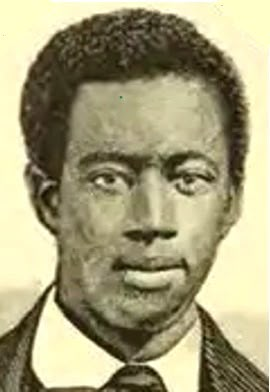
At the time of Liberia’s independence on July 26, 1847, the new republic’s population celebrated with the national anthem “All Hail, Liberia, Hail!” The lyrics were written by Daniel Bashiel Warner, a 32-year-old native of Baltimore, Maryland, who later served as Liberia’s third president.
What is not well known is that from 1847 to 1861, the anthem either had a completely different melody than the one Liberians sing today, or it was performed as a spoken-word patriotic poem.
Enter Cleveland Olmstead Luca. He composed a melody that the republic presumably adopted sometime after his arrival in Monrovia in 1861 – 14 years after independence.
Cleveland was born in New Haven, Connecticut, circa 1838. While the exact day and month of his birth has yet to be found, the U.S. Census in 1850 shows he was 12 years old. He was the son of musically talented parents Alexander Luca and Luzetta (or Lesset) Lewis, both of mixed heritage, who were married on Dec. 21, 1830.
Alexander, born in 1805 in Milford, Connecticut, was a shoemaker. His father was born in France and his mother in Maryland. His excellent voice and musical training earned him a position as chorister in the Temple Street Congregational Church (renamed Dixwell Avenue Congregational Church in 1886) in New Haven.
The couple had five sons (John W., Alexander C. Jr., Simeon G., Cleveland O., and Amos Theodore) and three daughters (Mary G., an unnamed girl who died at the age of 14 months in 1840, and an unnamed daughter who died at the age of 6 in 1848). Cleveland was the fourth oldest son.
In the 1840s, Alexander Sr. organized a quartet including Dinah Lewis, his wife’s sister and a gifted singer, and his first two sons. He taught his sons the shoemaker’s trade, and with the help of Dinah, they were educated in music. Alexander taught his children to sing in his choir at the church. All members were highly gifted, and “Cleve” as he was then called, was a piano prodigy by the age of 7. By the age of 10, he had a repertory of masterpieces and the ability to play difficult music by sight, a talent he frequently proved in public performance.
At some point, the Luca Family Singers consisted of Simeon, who sang first tenor; Alexander Jr., second tenor; Cleveland, soprano; and John, bass-baritone. Simeon played first violin; Alexander Jr., second violin; John, cello or bass; and Cleveland, piano. Their father was musical director and manager as well as vocalist. They traveled the midwestern and eastern United States performing secular as well as religious music, including anti-slavery hymns and benefit concerts. One of their more popular songs was the anti-slavery hymn “Car of Emancipation.”
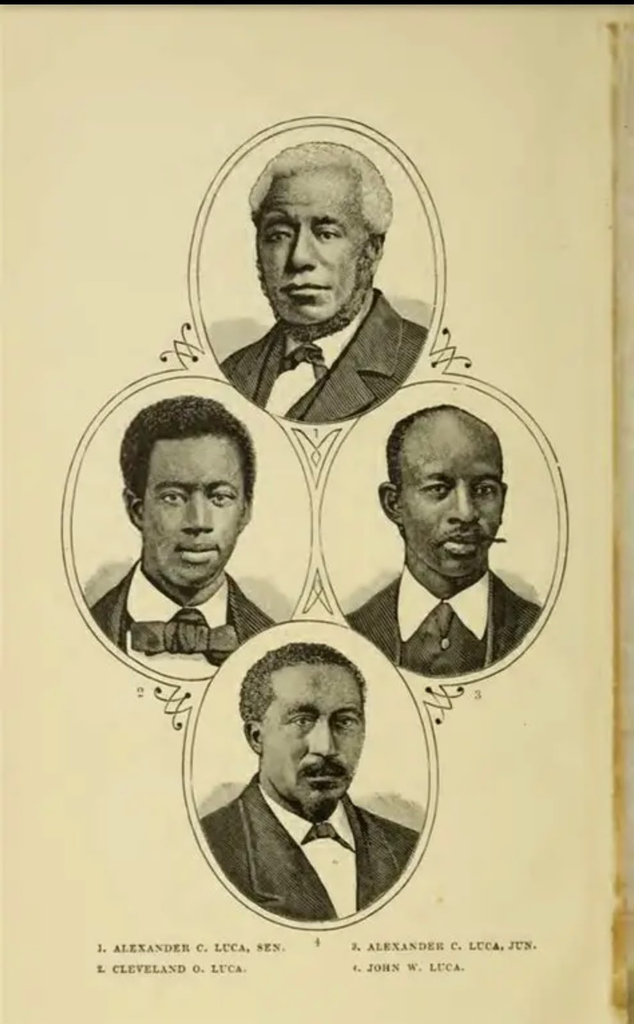
Wherever they went they earned a reputation of refinement, intelligence, and superb musicianship. In their May 1853 debut in the Old Tabernacle on Broadway in New York City, as guests of the New York Anti-Slavery Society, they thrilled an audience of 5,000 people. “In witnessing the display of genius by the wonderful pianist, and listening to the sweet strains of classical harmony formed by the tuneful voices and skillfully played instruments of this troupe of colored artists, they found their claims for the race so fully sustained,” wrote medical historian James Monroe Trotter in his book Music and Some Highly Musical People in 1878.
“As the ‘wonderful boy pianist,’ [Cleveland] everywhere created quite a furore (sic). The ladies in the audiences were especially delighted with him; and forgetting often, in their enthusiasm, that he was black, it seemed that they would certainly carry him away.” Trotter wrote that it was “doubtful whether he had an equal in this country.” Trotter described how the “prejudiced or incredulous” would hear the “exquisite charm of the music, as well as to the gentlemanly, graceful manners of the young virtuoso,” and then become “his warm admirer and friend.”
Trotter wrote that one of the Luca boys credited his mother for instilling the “musical and general culture of the family: “Our earlier taste for music was especially encouraged by our mother, who thought that the study of it would claim us from the bad influences which idle hours and mischievous associations engendered.” Cleveland’s mother died circa 1852 in New Haven.
Trotter’s book was the first comprehensive history of American music. He included engraved portrait plates featuring illustrations of the artists, using numbers next to their faces to correspond with their biographical sketches. The illustration of Cleveland, his father, and two brothers is the primary, definitive visual likeness of them known to history. This rare image may be the first time most Liberians see the face of the man who composed the melody for “All Hail, Liberia, Hail!”
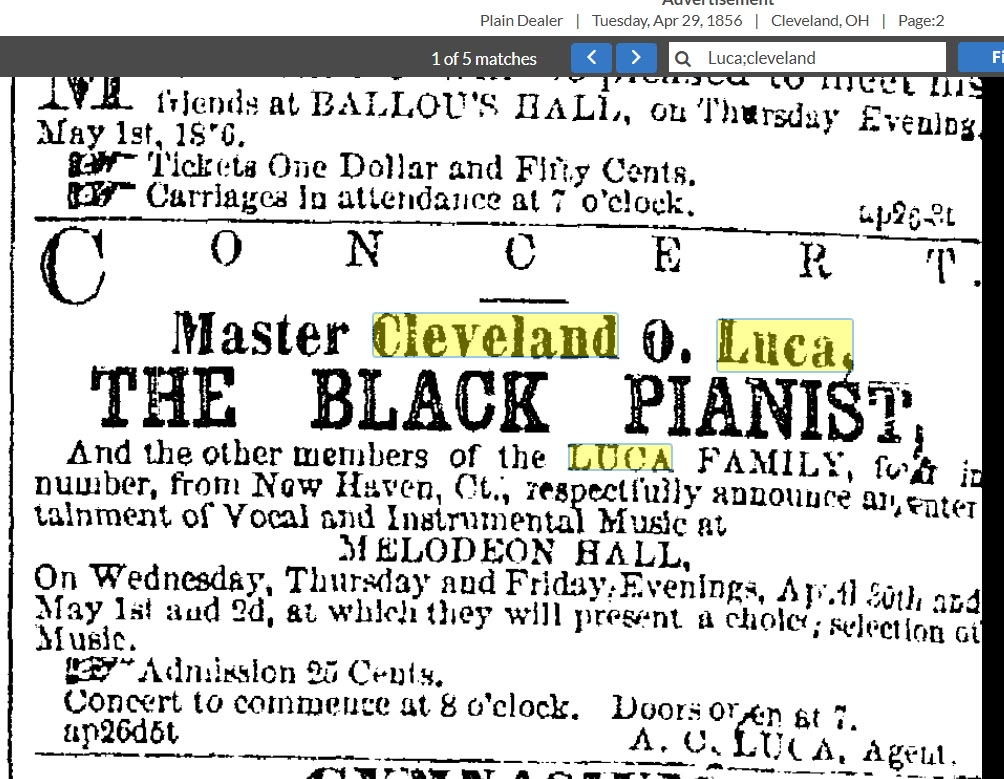
Trotter singled out Cleveland with the utmost praise. “Never satisfied to rest alone upon his fine natural endowments, our young artist pushed his studies, entering the classical, the technical domain of the great master composers, and playing with easy, graceful, magnetic touch, and delightfully winning expression, any of their works. As a reader at sight of compositions the most difficult, it is doubtful whether he had an equal in this country.” Public notices of the Luca family concerts referred to him as the “Wonderful Pianist.”
The American press was almost unanimous in praising the family’s concerts as they performed in Ohio, Pennsylvania, New York, and New England. “The Luca Family, in the quiet and ostentatious display of their musical powers, are doing more to secure position for the colored man than all the theorists and speculators about the rights of man have yet accomplished in America,” according to a review in the Niagara Courier of Lockport, New York, on September 2, 1857.
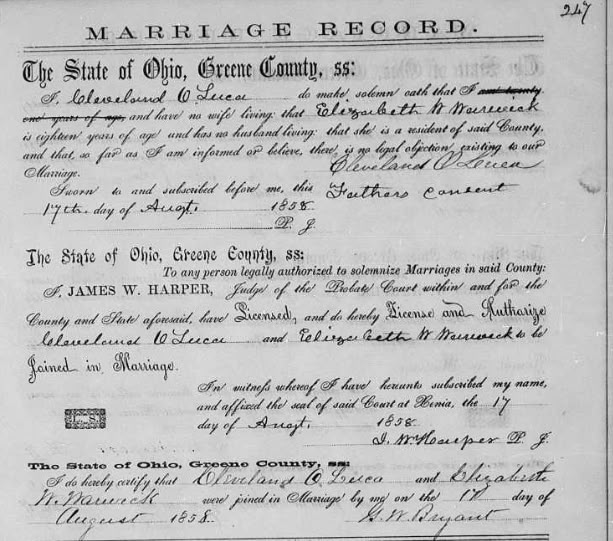
On August 17, 1858, Cleveland married 18-year-old Elizabeth W. Warwick in Xenia, Ohio, according to the marriage record in Greene County. It appears the Luca family were drawn to Xenia and the neighboring Wilberforce community, a major cultural and musical hub for free African Americans and abolitionist organizers in the late 1850s and early 1860s.
In 1859, the Luca family teamed with a white family troupe, the Hutchinsons, abolitionist musicians in their own right. Both groups drew from an eclectic repertoire, combining comic and temperance songs with classical European arias. Another highly popular abolitionist track, “The Fugitive’s Song,” dramatized the escape of enslaved individuals to freedom.
After the Luca tour with the Hutchinsons, Cleveland, “with a noble aim, resolved to go to Africa,” Trotter wrote. An unverified source claims he went at the invitation of the president of Liberia. Stephen Allen Benson was serving as Liberia’s second president at the time. The troupe temporarily disbanded but its members continued to pursue music individually.
According to The African Repository, the official publication of the American Colonization Society (ACS), which promoted the relocation of free African Americans to Liberia, Cleveland and his spouse Elizabeth sailed from New York to Monrovia on Wednesday, April 24, 1861. Unlike other emigrants to Liberia, however, their travel was not sponsored by the American Colonization Society. Instead, they sailed on the Bark Edward, a private commercial vessel chartered by a pioneering, all-Black mercantile partnership of Johnson, Turpin & Dunbar, of Liberia that was detached from the ACS and the New York-based African Civilization Society founded by Henry Highland Garnet and Martin Delany.
The seven emigrants on the Edward were listed as being from New York and Williamsburgh (now part of Brooklyn): Peter W. Downing, 29 years; Clementia S. Downing, 23 years; Mrs. Sarah Luca, 21 years; Miss Annie Paulson, 22 years; Cleveland O. Luca, 25 years; Elizabeth Warwick Luca, 20 years; Clarence Chase Luca, 3 years.
Cleveland and his family left New York amid escalating tensions as the bombardment of Fort Sumter on April 12 marked the official beginning of the Civil War. They arrived in Monrovia on June 7, 1861, according to the New York Herald.
Sarah, who was Cleveland’s sister-in-law, was an exceptionally talented contralto who toured with the family. Clarence was most likely Cleveland and Elizabeth’s son and was almost certainly named in honor of Salmon P. Chase, who served as the Governor of Ohio from 1856 to 1861. Chase was a fiercely prominent, outspoken anti-slavery leader who actively defended runaway slaves in court. Naming their newborn after Ohio’s premier political champion of Black freedom makes sense. If Clarence survived the childhood fevers of Monrovia, he would have grown up as the son of Liberia’s national composer. Ohio did not pass a statewide law requiring the government to record births until 1867. Because Clarence was born circa 1858, an official civil or government-issued birth certificate from Greene County does not exist.
A fellow passenger on the Edward, Peter Downing was the son of Thomas Downing, owner of New York City’s famous Downing’s Oyster House, a high-society hub and a central station on the Underground Railroad. His brother George was one of the most prominent Black abolitionists and businessmen in America. The Downings’ move to Liberia could be interpreted as showing the voyage was backed by some of the wealthiest and most influential African American families at that time. That said, the Downings returned to the United States by the 1870s.
Perhaps not surprisingly, Cleveland and Sarah gave a concert in Monrovia soon after their arrival. The African Repository in June 1861 wrote that it was “densely crowded with a highly respectable audience. President Benson, ex-President Roberts, and other distinguished persons, were present. Bouquets of flowers were showered upon both of them, and the spontaneous bursts of enthusiasm at the conclusion of each piece attested the satisfaction and appreciation of the audience. Mr. Luca is now engaged in teaching our ladies the piano, and I understand he is likely to have a large class.” One of his students was Emma Ernestine Armenia, who later became the First Lady of Liberia in 1884, as the wife of Hilary R.W. Johnson, the 11the president of Liberia.
The African Repository reported in May 1862 that Cleveland and Sarah gave a second grand concert in the hall of the House of Representatives. “The concert passed off to the satisfaction of all concerned.” A few nights later, in the Senate Chamber, ex-President Roberts, several senators, Judge B.R. Wilson of the Court of Quarter Sessions and Common Pleas, and other elites was “enlivened by the presence of several ladies, and some exquisite piano music.”
Cleveland’s name appeared a few more times in The African Repository. In December 1863, his name was recorded as a member of the Teachers Convention held at the Monrovia Academy. That same month, he performed during the 41st anniversary of the settlement of Monrovia. The venue was changed from Government Square to the Presbyterian church because of “the ground being too damp to hold the celebration…following a hard shower of rain” earlier in the day. The Liberia Herald noted that “The singing, under the direction of Professor C.O. Luca, was all that could be desired.” Finally, in January 1864, Cleveland was at the wedding “of Miss Aphia, the youngest daughter of Judge B.R. Wilson with Edward F., oldest son of E.J. Roye. “Professor Luca presided at the piano, and interspersed the pleasures of the evening with music of the rarest description.”
That would be the last mention of Cleveland in The African Repository. In fact, the publication contains no mention of his writing the score for the national anthem during the period from 1859 to 1873, covering a period two years before his arrival in Monrovia and a year after the date of his death reported by Trotter.
The single accomplishment for which he is most famous in Liberia surely would have been recorded in government documents. Did the government, in fact, invite him to Liberia for the purpose of writing the score for the national anthem? Had he already written it while still in the United States? When was the score officially adopted?
One explanation for Cleveland completely vanishing from The African Repository pages after 1864 is that the ACS only meticulously tracked individuals while they were active pioneers or public officials within Liberia. He was a private citizen, a secular musician, and a teacher. He broke the “permanent pioneer” narrative by traveling back and forth to the United States. The ACS designed its records to promote a unidirectional story, not the story of an international commuter. He didn’t fit their propaganda profile.
In 1866, the Colored Citizen newspaper in Cincinnati, Ohio, reported that he was an organist at an English Cathedral in Sierra Leone, “a position which commands a salary from the government.” That indicates he was not always living in Liberia.
The 1872 volume of The African Repository described the anthem being played on the occasion of a Sunday school banquet for Episcopalian and Wesleyan schools organized in December 1871 by merchant W.F. Nelson, Esq. in Monrovia with many elites among the guests. There was no mention of Cleveland.
At some point, Cleveland returned to the United States to resume performing with his family. The Toledo Blade (Ohio) newspaper on February 18, 1872, announced that the “celebrated Luca Concert family” was to give a concert at Wheeler’s Opera House. “This company is composed of Mr. O. Luca, the great pianist; Mr. A. A. (Alexander Jr.) Luca, tenor and violinist; Madame A. A. Luca, contralto and soprano; and Mr. Tino Luca, bassoon.” Simeon Luca died in 1854 and Jennie Allen, a contralto from New York, joined the group. “The Luca family are not strangers to many of our readers, and those who have recollections of the pleasure afforded by their really excellent music will find cause for rejoicing in this announcement. The Lucas have been received everywhere by large audiences, and as they present an attractive programme here, we may look for a general coming together of music-loving people of Toledo, on Saturday evening next.”
The Toledo Blade went on to cite the Liverpool Courier in England as follows: “The debutante of the evening was Olmstead Luca, pianist, from the west coast of Africa, whose performance was truly marvelous. Directly he struck the keys, you realized the fact that you were in the presence of a genius. He chose two pieces full of the most formidable difficulties, [Antoine] de Kontski’s “Le Réveil du Lion” and Chopin’s second Scherzo, both of which were rendered with the utmost precision and elicited enthusiastic applause.” (Note to readers: Listen to the first minute or so of “Le Réveil du Lion” and you may hear similarities with “All Hail, Liberia, Hail!”). Luca’s performance at the Philharmonic Hall in Liverpool in April 1871 was captured in the musical periodical The Orchestra, which reported that Luca was “encored.”
The Cincinnati Daily Enquirer on March 4, 1872, published an article that praised the Luca family while also commenting on racial attitudes at the time. “The Luca Brothers have high musical talent.” The newspaper acclaimed Cleveland as the finest pianist in the country. “In Europe he was extensively bespattered with praise. But Olmstead Luca and Olmstead Luca’s brothers and wife are all colored – real Negroes, every one of them, and that is where the failure comes in. Had they pretended to be darkies, not been real ones, their success would have been assured. Scarce a single (unreadable)-loving Republican attended the concert, not because the music was not good, for it was excellent, but merely because the performance had a visible admixture of African blood in the (unreadable), and that fact settled their hash.”
Shortly after these newspaper reports, the pianist extraordinaire and composer of the Liberian national anthem apparently returned to Liberia and caught a fever. Trotter’s book specifically noted that he died on March 27, 1872, at the age of 45, although his age would have been closer to 34 based on earlier U.S. Census data.
These newspaper reports of Cleveland’s performances in the United States as late as March 1872 counter all other narratives that placed his death in 1869. If he died in Monrovia, he was probably interred in Palm Grove Cemetery, but there are no records confirming this, and family members back in Ohio likely recounted the date to Trotter from memory.
In 1875, three years after Cleveland had passed away, Asa Hutchinson recalled the collaboration with the Luca family. Trotter’s book contained this quote: “Our dear lamented Cleveland was a thoroughly educated pianist, and won the enthusiastic admiration of the scientific musicians in every city and town we visited. He executed most rapidly, at sight, any and all of the difficult and new compositions that were presented to him by his friends, to their astonishment and our mutual joy; and when the three brothers, “Alex.,” John, and Cleveland, united their respective instruments and voices in one grand choral, the effect was intensely thrilling and electrical. In some of our concerted pieces, where they united with us, we carried our reformatory sentiments and songs to a successful termination; and, notwithstanding the then great and bitter prejudice of our audiences against us all for daring thus publicly to associate together, they cheered our combined efforts with loud applause and frequent encores.”
Trotter lived in Cincinnati, taught music in the region, and personally knew the musical networks of the era. His book has been the best narrative about the Luca family for nearly 150 years. But Trotter evidently did not know that Cleveland was almost a dozen years younger, did not specify the year Cleveland traveled to Liberia, did not write about how Cleveland came to write the score of the Liberian national anthem, and did not describe what became of Cleveland’s wife and other family members who had traveled to Liberia with him.
Did Elizabeth and her sister-in-law Sarah return to the United States after Cleveland’s death and rely on their family networks back home in Ohio, Connecticut, or New York? Did Elizabeth remarry? Or did one or both women stay in Liberia? In Liberia, Sarah obtained a divorce from her husband John. The wills, probate records, or land inheritances of the Warwick family in Greene County have revealed nothing yet, nor have U.S. Customs passenger lists.
Cleveland’s father, Alexander Sr., moved west to Ohio following the death of his first wife. By the 1860s, he had fully integrated into the musical and religious life of Zanesville, a town in Muskingum County, Ohio. County archives show that he remarried in 1866 to Anna M.W. Myers in Muskingum County. The 1870 Census shows a household consisting of Alexander, 65, a shoemaker, Ann M., 48, Amos Theodore, 24, also a shoemaker, and Mary, 25, teaching school. A decade later, the Census showed A.C. Luca, 74, Ann M., 58, Amos T., 34, a shoemaker, and Maggie, 12, a daughter at school.
Warner’s original lyrics and Luca’s original handwritten score are considered lost to time. Furthermore, it is historically impossible for any audio recordings to exist from the Luca family concerts. Thomas Edison did not invent the phonograph – the very first machine capable of both recording and reproducing sound – until 1877.
Liberia’s anthem received praise decades later in an article published on Dec. 1, 1918, in The Sunday Sentinel, a newspaper in Milwaukee, Wisconsin. “She has the sonorous and thrilling “All Hail, Liberia, Hail!” The article’s author wrote that the composition is “notable for the rich chords and march movement of the first part and the graceful and flowing melody of the second. The words and music were written for each other and blend most perfectly.” Those who have heard the anthem with its powerful harmonies “will cheerfully accord it a high rank among the national anthems of the world.”
About the author: Joel Maybury served as the U.S. Embassy’s Deputy Chief of Mission from 2021 to 2023 during which time he began researching facets of Liberia’s history and its unique ties to the United States. His published works include an article about Liberia’s first First Lady Jane Rose Roberts, another article about a church bell manufactured in New York and still ringing in Monrovia, and he has given public lectures on the years President Joseph Jenkins Roberts lived and worked in Virginia before immigrating to Liberia.
[Updated on August 30, 2026]