MONROVIA – Low sanitation coverage remains an issue as Monrovia faces major problems. There have been lots of programs implemented to improve sanitation in Monrovia by the Government of Liberia (GOL) from international partners including the
By George John Flomo, Contributing Writer
United States Agency for International Development (USAID), United Nations International Children’s Emergency Fund (UNICEF), and others to eradicate
open defecation in Monrovia, yet the problem continues to swell leaving the community susceptible to health issues such as air pollution and other water-borne diseases among community’s dwellers.
About 42% of Liberia’s population practices open defecation according to the Joint Monitoring Programme (JMP 2017). It is the human practice of defecating outside rather than into a toilet.
The People’s United Community (PUC) is no exception to the widespread practice of open defecation that is prevalent throughout most of Liberia. The
community has a little over 350 households which falls in the confines of the
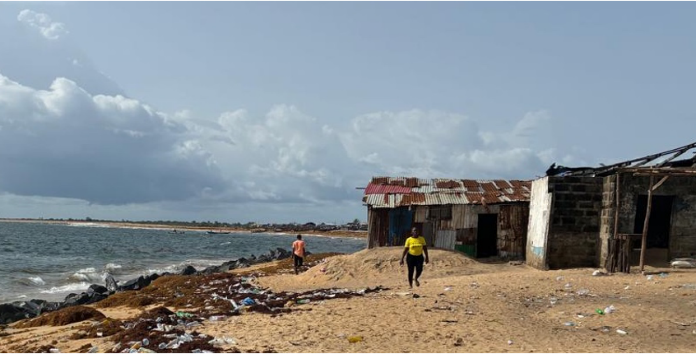
Monrovia City Cooperation (MCC) and is situated around the Atlantic Ocean’s coast and includes 19th-24th street Sinkor, in the capital city of Liberia (MCC). With a population of approximately 25,000 people, only a small portion of this total—including households—have their own latrines or utilize latrines; the rest find the beach as a public latrine.
Several locals held the view that the main reason for open defecation in their neighborhood was the absence of latrines. According to Mr. Emmanuel Yee Kilikpo, the community’s chairman, “This is a slum neighborhood, because of the constraints of latrines and lack of education, you will always find people using the beach.”
Most intriguingly, kids continue to play soccer and other games on the beach despite its unhealthiness. The chairman stated that “UNCHR built eight latrines on the beach in this community in 2008 as a project to improve sanitation but the sea took it away. The community currently has two latrines operating that were built in 2014 by a senatorial candidate Hon. Robert Sirleaf in 2014 during the senatorial election.
As ghettos and other indecent gatherings from disadvantaged youth commonly known as Zogos continue to assemble on the beach, many residents believed that they are the main cause of bad sanitation practices because of uncovered feces.
“We always see more toilets on the beach in our community because those ghetto boys who live on the street only come here to toilet and leave”, Mr. Karmue a resident of the community asserted. Also speaking to a group of men (three as counted on the day of the interview) on a similar situation on this issue, one member from the group which is a resident of the community identified as Romeo Gaye commented “ People are very uncivilized they just openly defecate on the beach without covering it with sand”.
This poor sanitary condition causes more harm to the community as the increase in mosquitoes, unhealthy well-being, bad odors, and poor livelihood.
Charles M. Slocom who is a resident of the community frowned on the unhealthy living conditions “ I live here 12 years now and is affected by the scent of the toilet if you can’t smoke or drink you can’t sit or stand by the African Christian Fellowship International (ACFI ) church on 20th street because of the heavy toilet scent.” Beautiful girls and boys who don’t live closer to the beach discharged their feces early morning or midnight not to be seen because they are shy, and that is when the scent comes out heavily.
In finding a remedy for the community’s old age problems, the only project that is still ongoing in the community is the beach clean up which is usually done three times a week by Liberia Maritime Authority but is now monitored by the Ministry of Youth and Sports. This project seems unsustainable because of the delay and low compensation to workers.
“ The beach cleanup is usually maintained and sustained by community residents under a group called MANO workers, because of the delay or no payment for the MANO workers the beach remains dirty” Zoway P. Kokulo lamented.
The community has tried its best possible way in finding solutions for this problem yet it keeps getting worse because of the lack of governmental regulations and residents’ refusal to abide by the community’s policies.
According to Chairman Kilikpo, they have set some policies concerning open defecation “ if you have an apartment with five, six, bedrooms or above at least one room should be used for the bathroom but most house owners don’t follow this law because it’s not a law written by the government. When we take this to City Hall which is responsible for the city’s ordinance, they do not look into the matter for this to be enforced therefore; violators can not be penalized.”
Like Chairman Kilikpo, Several residents have shared their frustrations about the lack of government enforcement of these policies on open defecation in their community.
Romeo Gaye who live in the community for about 22 years suggested that Government should provide policies that will be implemented by the community’s leadership in every slum community including the People’s United Community.
“Anybody who goes against these laws or policies by toileting on the beach with available latrines will bear the penalties,” Zoway recommended.
Support Independent Journalism
Your support helps FrontPage Africa continue delivering independent, credible, and impactful journalism. Every contribution strengthens our ability to investigate, inform, and hold power accountable while keeping quality journalism accessible to our readers.
Support our journalism or subscribe to receive the latest FrontPage Africa stories and updates.