MONROVIA – The head of the Civil Service Agency, Dr. Josiah F. Joekai, Jr., has argued that the country cannot build strong institutions without also building emotionally mature, honest, and courageous individuals to run them.
By Selma Lomax, [email protected] & Patience M. Jones
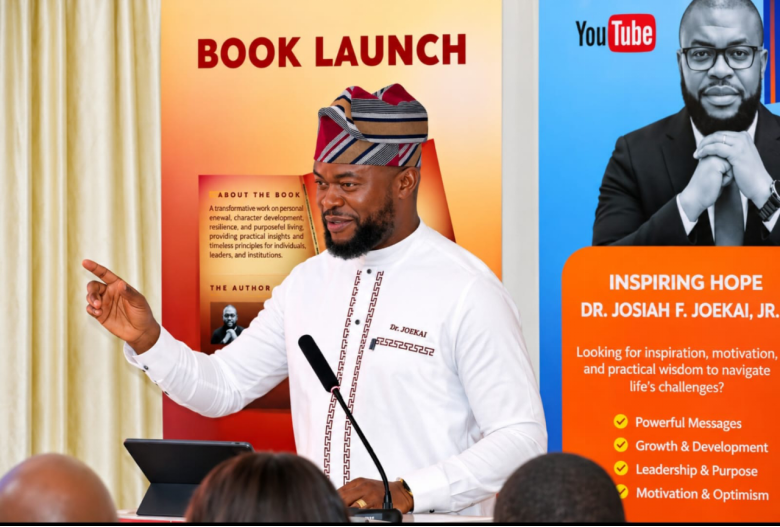
Dr. Joekai the argument on Saturday, November 21, at the official launch of his book, Self-Cleansing and Renewal for Successful Living: A Journey to Inner Healing, Purpose, and Lasting Fulfillment. The event was held at the Sinkor Palace in Congo Town, Monrovia.
Government officials, representatives of academic institutions, members of the diplomatic community, family members, and friends attended the program, during which the author presented the book’s contents, introduced a conceptual framework he developed, and appealed to education authorities to consider the book for use in schools.
Success Without Peace
Dr. Joekai opened his presentation with what he described as one of humanity’s greatest contradictions: people invest enormous effort in their external lives while neglecting the internal foundations those lives rest on. “We pursue education, wealth, influence, recognition, and professional advancement,” he said. “Yet, sometimes, the higher we rise, the heavier the invisible burdens we carry.”
He told the audience that a person can be successful in the eyes of the world and still remain deeply unsettled within. According to him, this realization sits at the center of the two books he has published in 2026, which he said are united by a single conviction: human progress requires transforming both the institutions that shape opportunities and the individuals who shape those institutions.
He stressed that he was not simply launching a book. “I am sharing a journey, advancing an intellectual conversation, and inviting each of us to reconsider what it truly means to succeed in life,” he said.
From the Workplace to the Inner Life
The Director General connected the new book to his earlier work, a doctoral dissertation titled The Effect of Gender Inequality in Liberian Workplaces: Implications for Employee Performance and Well-Being, which he launched earlier this year.
That study, he explained, is an empirical investigation of how workplace gender inequality affects employee performance and psychological and professional well-being. It was driven by a question he said continues to concern him: how can Liberia achieve meaningful national development if unequal workplace experiences prevent capable people from reaching their full potential?
Dr. Joekai said the research emphasizes equitable opportunity, fair treatment, institutional accountability, and inclusive leadership. He offered an example. Two employees with similar qualifications, competence, and commitment are in the same workplace, but one has better access to professional development, recognition, and promotion because of gender. The harm, he said, does not stop with the disadvantaged employee.
“Such inequalities can weaken motivation, undermine institutional confidence, and diminish the productive potential of the organization,” he said. He described gender equality as more than social justice, calling it “a question of organizational effectiveness, human dignity, and national productivity.”
To make sure the study does not gather dust, he said, he has formally presented it to the Ministry of Gender, Children and Social Protection, the Ministry of Education, and several academic institutions, urging its consideration in gender policy and framework development, academic research, personnel administration, and workplace decisions.
“I wanted the research to move beyond university shelves and inform decisions that affect real people in real institutions,” he said. The new book, he explained, picks up where the dissertation leaves off. “One examines the environment around us. The other examines the environment within us,” he said.
Why He Wrote It
Dr. Joekai said Self-Cleansing and Renewal for Successful Living grew out of a personal experience. There was a time, he said, when his career progress and public recognition suggested all was well, yet he was carrying unresolved disappointments, emotional burdens, and expectations that quietly affected his sense of fulfillment.
That period forced him to ask hard questions: What was he holding on to that no longer served his growth? Which past experiences were still driving his reactions? Was he living by his deepest values, or merely responding to what others expected of him?
“I eventually discovered that achievement and inner peace are not necessarily the same thing,” he said. He was careful to describe the limits of the book. It does not claim that successful people are free of problems, he said, and it does not suggest that hardship can be wished away. Instead, it asks readers to face their internal struggles, understand how those struggles shape them, let go of destructive patterns, and deliberately build a more meaningful life.
The book has ten chapters, opening with an introduction and continuing through three connected parts. Each is supported by practical illustrations, reflective questions, and exercises that let readers apply what they learn.
Facing the Self
The first part, titled “The Path to Self Cleansing,” covers the chapters Unveiling the Layers, Breaking Chains, and Embracing Authenticity. Dr. Joekai said it focuses on the courage to examine oneself and on how childhood experiences, social expectations, limiting beliefs, and unresolved insecurities quietly steer a person’s life.
He illustrated the point with a talented young woman who keeps turning down leadership roles because she has absorbed the belief that she is not capable. Her real barrier, he said, may not be a shortage of ability but a deep-seated feeling of inadequacy. Transformation begins when she identifies that belief, questions whether it is true, and finds the confidence to act beyond it.
He said the same pattern appears in leaders who read criticism as hostility, workers who measure their worth by their job titles, and people who chase approval at the expense of being themselves. “We cannot meaningfully transform what we refuse to acknowledge,” he said.
Letting Go
The second part, “Letting Go and Healing,” includes the chapters Releasing the Past, Healing Wounds, and Cultivating Resilience. It deals with forgiveness, emotional recovery, self-compassion, support systems, and turning hardship into growth.
Dr. Joekai said many of life’s heaviest burdens cannot be seen. “They are the disappointments we never discuss, the betrayals we keep revisiting, and the resentment we carry long after the original experience has passed,” he said.
He disclosed that the book includes his own story of forgiving someone who never apologized. The decision, he said, did not erase what happened or excuse the wrongdoing, but it gave him back the emotional freedom he needed to grow.
He offered a workplace example as well: an employee who was treated unfairly at one job may approach every supervisor at the next with suspicion. Unless the emotional effects of the earlier experience are dealt with, he said, the past will keep shaping the future.
He drew a clear distinction. “Healing does not mean denying injustice,” he said. “It means refusing to allow painful experiences to permanently control our identity and possibilities.”
Dr. Joekai also noted that the book recognizes that serious emotional and psychological difficulties may call for professional help, and that seeking such help is a sign of strength. People cannot always control what happens to them, he said, but they can work toward determining what those experiences become within them.
Building a Renewed Life
The third part, “Cultivating Renewal,” moves from healing to purposeful living through the chapters Mindset and Growth, Habits of Success, and Building Meaningful Connections. Dr. Joekai said it looks at the attitudes, routines, relationships, and commitments that sustain change over time.
Renewal, he argued, is not just the absence of pain but the intentional construction of a life guided by values, discipline, meaningful relationships, and purpose. He gave two examples. A student who fails an examination can treat the result as proof of inability, or as a prompt to improve study habits and seek academic help. A public servant who makes a professional mistake can hide it, or admit it, learn from it, and become more accountable.
“The defining issue is not simply what happened, but how the individual responds and grows,” he said. This section, he said, urges readers to replace temporary motivation with steady discipline, harmful relationships with meaningful ones, and the endless chase for external approval with a more genuine understanding of success. Renewal, he added, “is not simply about becoming better at what we do. It is about becoming more intentional in who we are.”
The Joekai Model
The intellectual core of the book, Dr. Joekai said, is a framework he calls the Joekai Model of Self Cleansing and Renewal, or JMSR. Drawing on psychology, sociology, anthropology, and moral philosophy, it describes personal transformation as an ongoing process with four linked phases.
The first, Awareness, involves honestly recognizing one’s beliefs, emotions, behavior, and the experiences behind them. The second, Release, means addressing resentment, fear, and emotional wounds that block growth. The third, Reconstruction, involves rebuilding healthier beliefs, strengthening resilience, forming productive habits, and finding renewed purpose. The fourth, Integration, is reached when growth shows up in daily decisions, relationships, professional conduct, and contributions to society.
He emphasized that the model is a cycle, not a straight line, because Integration can generate fresh awareness and allow a person to go through the process again with greater maturity.
Three reinforcing dimensions support the phases: Conscious Intention, which is a deliberate commitment to change; Emotional Stability, the ability to regulate emotional responses; and Spiritual Transcendence, alignment with moral values and a deeper sense of meaning.
The book expresses these relationships through what the author calls the Joekai Self Cleansing Equation. Dr. Joekai was open about its limits, saying it provides a basis for further research and possible measurement and is not a clinically validated diagnostic tool.
He showed how the model might work in an institution using a university administrator who notices a pattern of unfair decision-making. Awareness means seeing the problem. Release means confronting the assumptions or prejudices behind it. Reconstruction means designing fairer procedures and better leadership habits. Integration comes when fair treatment becomes standard practice. “That is how personal transformation can contribute to organizational improvement,” he said.
A Request to the Education Sector
A major moment of the program came when Dr. Joekai formally called on the Ministry of Education, the National Commission on Higher Education, universities, colleges, and other institutions to consider adopting the book as prescribed or recommended reading in relevant academic and professional programs, subject to proper academic review.
He said education must go beyond building intellectual ability. “It must also cultivate character, emotional intelligence, ethical judgment, resilience, and social responsibility,” he said.
He identified several fields where he sees the book as relevant, among them psychology and counseling, education and teacher development, sociology and anthropology, public administration and leadership, human resource management, peace and conflict studies, and philosophy and ethics. Its reflective exercises, he said, make it suitable for classroom discussion, guided learning, leadership training, and academic inquiry.
Dr. Joekai also invited scholars to put the Joekai Model to the test by researching its proposed relationships and checking whether it holds across different populations, institutions, and cultures. “I am not asking academic institutions to accept every proposition without examination,” he said. “I am inviting them to investigate, critique, develop, and apply the ideas where they prove educationally useful.”
He pointed out that a university should not only produce graduates who know how to earn a living, but also graduates who know how to live responsibly, handle adversity, respect human dignity, and contribute to society. “We must educate the mind, cultivate the character, and strengthen the human spirit,” he said.
Personal Renewal and the Nation
Dr. Joekai linked the book directly to Liberia’s development challenges. The country needs effective institutions, sound policies, capable leaders, and responsible citizens, he said, but every institution is made up of people whose values, emotions, and decisions affect how it performs.
He offered three illustrations. A leader who cannot admit personal shortcomings may struggle to accept institutional accountability. A manager who cannot control anger may create fear instead of confidence. A citizen consumed by resentment may find reconciliation difficult even when chances for peace exist.
On the other hand, he said, people who develop self-awareness, emotional stability, integrity, and compassion are better placed to contribute to healthier families, more productive workplaces, and stronger communities.
He made clear that individual change is not a substitute for systemic reform. “Personal transformation must never become an excuse for institutional injustice, just as institutional reform cannot eliminate the need for individual responsibility,” he said. “We need both.”