MONROVIA — Civil Society Organizations (CSOs) and Community-Based Organizations (CBOs) have called on the Government of Liberia to allocate at least 25 percent of the national budget to women’s and youth empowerment, job creation, and increased support for grassroots organizations.
By Patience M. Jones
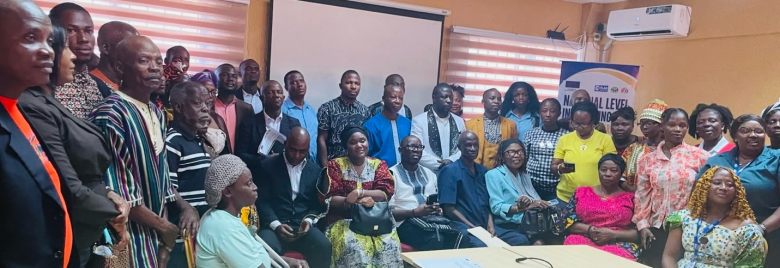
The call was made during a national-level roundtable discussion on strengthening civic space, human rights, and democratic participation in Liberia, where civil society representatives also urged government institutions to recognize grassroots organizations as critical partners in addressing human rights violations and promoting inclusive national development.
The discussion, held recently at the Corina Hotel in Sinkor, Monrovia, brought together government officials, civil society organizations, community leaders, and other stakeholders to examine the roles of state and non-state actors in protecting human rights, strengthening democratic participation, and promoting accountability.
The roundtable was hosted by Plan International Liberia, the Center for Justice and Peace Studies (CJPS), and the Independent National Commission on Human Rights, with funding from the European Union under the Civil Society Empowerment for Human Rights and Democracy (CSEH&D) project.
Presenting key lessons and experiences from grassroots interventions in Bomi and Nimba counties, community representatives Boima Q. Sando, Joseph Menlor and Paulstina Gbalazeh stressed that sustained investment in community-based organizations is essential to ensuring that human rights awareness and protection extend beyond major cities.
They said the project had helped bring human rights education directly to local communities, enabling residents to better understand their rights and take initiatives to address concerns affecting them.
However, they cautioned that the gains could be undermined if financial and technical support for grassroots organizations ends with the project.
The representatives therefore called on government institutions to increase budgetary allocations for grassroots organizations and referral services in Bomi and Nimba counties, while ensuring that public buildings are accessible to persons with disabilities.
They also recommended that the government dedicate at least 25 percent of the national budget to women’s and youth empowerment, including job creation opportunities.
Beyond government support, the community representatives appealed to international donors and development partners to expand capacity-building initiatives for CSOs, CBOs, and grassroots organizations, particularly in institutional management, organizational development and financial sustainability.
They further called for the expansion of the initiative beyond its pilot communities in Bomi and Nimba to additional communities and counties across Liberia.
Speaking at the opening of the roundtable, Madam Rebecca A. Saah, Acting Head of Programmes Implementation at Plan International Liberia, acknowledged concerns about the venue’s limited accessibility for participants with disabilities and apologized to those affected.
She said the organization recognizes the importance of inclusion and would take the concern into consideration when organizing future engagements.
Madam Saah described the gathering as the project’s final national roundtable discussion, noting that the initiative is scheduled to conclude in January 2027.
She emphasized that addressing the challenges confronting women, young people, and marginalized communities requires collective action and stronger partnerships among government institutions, civil society organizations, and grassroots actors.
According to her, meaningful development cannot be achieved when organizations operate independently without engaging communities and other stakeholders.
She encouraged participants to use the platform to identify challenges affecting different population groups and develop practical recommendations that could be implemented within their respective institutions and communities.
Also delivering a special statement, Robert Komakech, Interim Country Director of Plan International Liberia, underscored the importance of protecting civic space and ensuring that marginalized populations have meaningful opportunities to participate in national decision-making.
Komakech thanked the European Union for funding the civil society empowerment initiative and acknowledged the contributions of CJPS, the Independent National Commission on Human Rights, the Ministry of Justice, and other government and civil society partners.
He disclosed that the project had supported consultations with civil society organizations, during which women, young people, and persons with disabilities contributed to shaping the draft National Human Rights Action Plan.
He also highlighted support for the National Policy on Human Rights Defenders Day in November 2025, as well as the provision of small grants to 16 grassroots associations in Bomi and Nimba counties, with eight organizations benefiting from each county.
Additionally, he said radio talk shows had been used to increase human rights awareness in communities across the two counties, with participating radio stations committing to continue hosting monthly discussions.
Komakech stressed that participation should go beyond physical presence at meetings, arguing that the voices of women, girls, young people, persons with disabilities, and marginalized communities must be heard, respected, and reflected in decisions affecting their lives.
He described a vibrant civic space as a cornerstone of good governance rather than a challenge to be managed.
He further called for the roundtable to become a regular platform for engagement and urged development partners to continue supporting grassroots organizations to ensure that achievements recorded under the project are sustained beyond its lifespan.
Providing an overview of the EU-funded initiative, Luckie Gibson, Project Manager at the Center for Justice and Peace Studies, said the project was designed to strengthen civil society organizations and promote human rights, inclusive democracy, and community-level accountability.
Gibson explained that the initiative deliberately integrated grassroots structures because human rights concerns often emerge within communities and require locally driven responses.
He said bringing national stakeholders, county-level actors, women’s rights organizations, civil society groups, and institutions working in governance and the rule of law together provides an opportunity to share experiences and develop collective approaches to strengthening democratic participation.
The national roundtable concluded with renewed calls for sustained partnerships, increased investment in grassroots structures, and stronger institutional commitment to protecting human rights and ensuring that all citizens, particularly women, young people, and persons with disabilities, can participate meaningfully in Liberia’s democratic and development processes.