https://www.facebook.com/share/r/18Wor8sGdo/
https://www.facebook.com/share/v/14rq8YWMZjF/
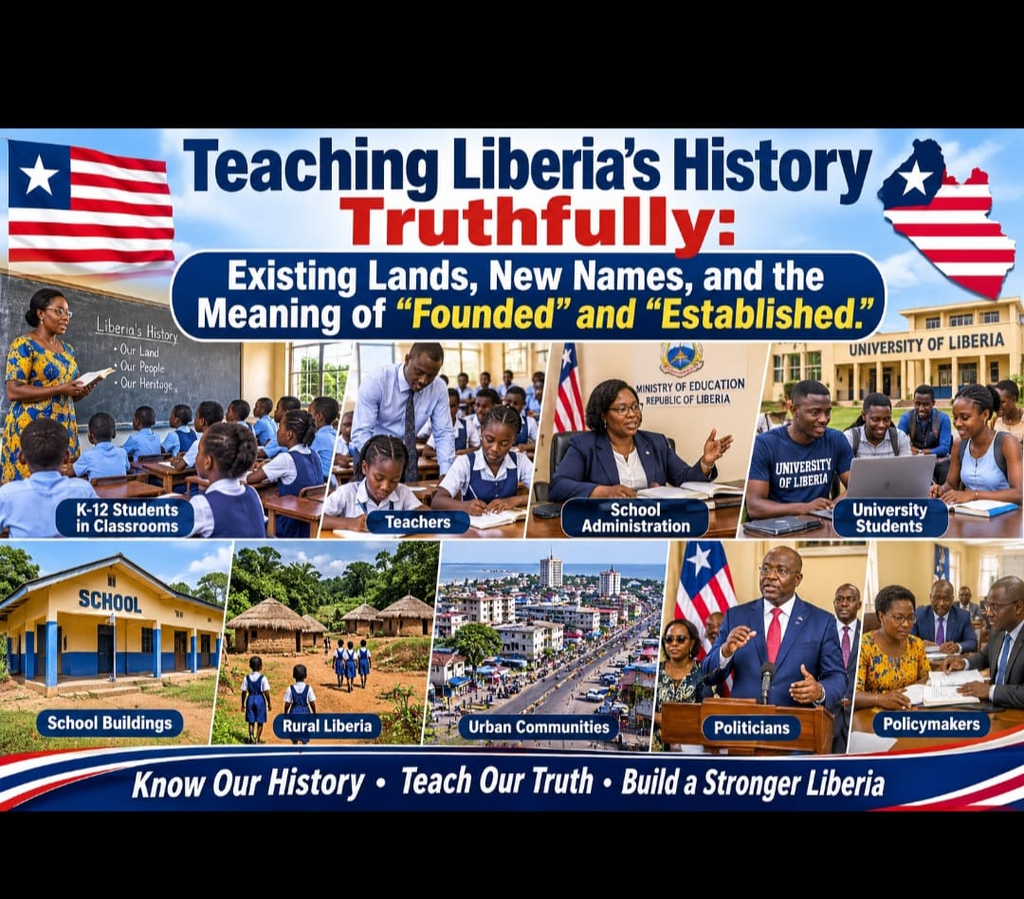
Liberia’s history must be taught with care, honesty, and respect for the people who lived on its land long before foreign settlers arrived.
By: Austin S Fallah – A True Son of the Planet Earth Soil:[email protected]
Too often, historical language suggests that Liberia was an empty place waiting to be discovered, founded, established, or created by outsiders.
That impression is false.
Before settlers sponsored by the American Colonization Society arrived in the nineteenth century, the land now called Liberia was home to many African peoples and communities.
These included, among others, the Kpelle, Bassa, Vai, Gbandi, Kru, Sarpo, Belleh, Grebo, Gio, Mano, Gola, Loma, Kissi, Krahn, Mandingo, Dei, and others.
They had towns, families, languages, trade networks, leadership systems, cultural traditions, and connections to the land.
Therefore, Liberia’s history should never begin with the arrival of settlers as if nothing existed before them.
At the same time, history should be taught precisely.
It is important to distinguish between a land, a people, a settlement, a government, a county, and a modern nation-state.
The territory existed before settlers came.
Indigenous communities existed before settlers came.
However, some new settlements, political institutions, administrative boundaries, and government systems were later formed under new names.
Understanding this difference is essential if Liberia is to teach its current and future generations a history that is both accurate and fair.
The central question is this: What is the difference between an area that already existed but was described as “established,” an area that existed but was described as “founded,” and an area that existed but was described as “being founded”?
The answer depends on what exactly one is discussing.
If the word refers to the land and its original inhabitants, it can be misleading or disrespectful to say newcomers founded or established the land.
Land that already had people, villages, political authority, and history was not “created” by the arrival of settlers.
But if the word refers specifically to a new settlement, a colonial administration, a county government, or a republic under a new constitutional system, then words such as “established” or “founded” may be appropriate, as long as the wording makes clear that these institutions were created on land where people already lived.
The word “founded” usually means that a person or group started something new.
For example, a school may be founded in a town that has existed for centuries.
The school’s founding does not mean the town did not exist before the school.
Likewise, settlers may have founded a new settlement, such as Monrovia, in a particular historical sense.
But saying they “founded Liberia” without explanation can create the false idea that the entire land and all its people began with them.
A more truthful statement would be: “In the nineteenth century, settlers sponsored by the American Colonization Society founded new settlements and later helped name the Republic of Liberia on lands already inhabited by diverse Indigenous peoples.”
This language is more accurate because it identifies what was actually founded: new settlements and later a republic with a particular government and constitutional structure.
It does not erase the people who were already there.
It recognizes that settlers did not create the rivers, forests, villages, languages, customs, or identities of the region’s peoples.
Nor did they create the territory’s human history.
They entered an existing world and became part of a complicated historical process involving cooperation, trade, conflict, negotiation, land disputes, political change, and cultural interaction.
The word “established” is similar, but it often refers to organizing, setting up, or formally putting something in place.
A government may be established.
A county administration may be established.
A mission station may be established.
A court, port, school district, or military post may be established.
Yet an existing place itself should not casually be described as “established” if the statement implies that no one lived there before the new administration arrived.
If a colonial or national government created a new county boundary, then it is accurate to say the county government or administrative unit was established at a certain time.
But it is inaccurate to suggest that the land, communities, or people inside that boundary began at that moment.
For example, when discussing Liberia’s counties, teachers and writers should explain that counties are administrative divisions of the modern Liberian state.
Their official boundaries, names, and governmental structures developed over time.
Some counties were created or reorganized at different dates as the Liberian state expanded its administrative control.
However, the areas within those county boundaries were not empty or without history before they received English or official governmental names.
The people living there already knew their rivers, mountains, towns, paths, farms, sacred places, and communities.
They had names for places long before official maps and government documents assigned English names or formal county designations.
Naming a place is not the same as creating it.
This is one of the most important lessons Liberia must teach.
When a foreign explorer, settler, government, or mapmaker gives a place an English name, that act may be historically important, but it does not mean the place was newly born.
It means someone with power recorded, translated, renamed, or officially recognized the place under a new language or political system.
In many cases, the original inhabitants already had their own names for the place.
Their names may have reflected the land’s features, the community’s ancestry, local events, spiritual meaning, or traditional authority.
The distinction becomes clearer through a simple comparison.
Imagine a family has lived in a village for generations.
The family knows the village by its traditional name.
Later, a government builds an office there, draws a map, and gives the area an official English name.
It may then establish a district or county office.
The government has established an administrative system, but it has not established the land itself.
The land existed.
The village existed.
The people existed.
Their history existed.
What is new is the official government designation and perhaps the English name used in formal documents.
Similarly, saying that an area was “being founded” suggests an action in progress.
It means people were creating a settlement, institution, or political entity.
For instance, one could say that in the 1820s, settlers were founding a settlement that became Monrovia.
But one should not say that the territory was “being founded” if that phrase suggests the territory had no prior history.
The difference is not merely about grammar. It is about historical truth and moral responsibility.
Liberia’s history includes the arrival of former settlers from America, the Caribbean, and other places who sought a new home in West Africa.
Their story deserves serious study.
Many settlers came from painful backgrounds shaped by slavery, racism, exclusion, and the difficult politics of colonization.
Some hoped to build a free Black republic where people of African descent could govern themselves.
Their courage, struggles, religious institutions, schools, businesses, and political achievements are part of Liberia’s national story.
The 1847 declaration of independence was a major event in African and global history.
Liberia became one of the first modern independent republics in Africa and maintained its sovereignty during an era when much of the continent was colonized by European powers.
However, honoring the settlers’ achievements must not require silencing Indigenous Liberians.
A mature national history can recognize both truths at once.
It can say that settlers created new political institutions and that Indigenous peoples had lived in the territory for centuries.
It can celebrate the independence of the Republic of Liberia while also examining the unequal power relations that developed between the settlers of the ruling class and many Indigenous communities.
It can honor the dreams of freed people seeking liberty while also acknowledging that land acquisition, political control, taxation, forced labor controversies, cultural pressure, and exclusion created deep tensions in the country’s history.
A nation becomes stronger when it refuses to build its identity on incomplete stories.
When children are taught that Liberia began only in 1822 or 1847, they may unconsciously learn that the peoples who lived there before that time were less important or somehow outside the nation’s beginning.
This is harmful.
It weakens national unity because it suggests that some citizens are original owners of the national story while others are only secondary characters.
In truth, Liberia belongs to all its peoples.
Its history is not the history of one group arriving and creating a country from nothing.
It is the history of many peoples whose lives, conflicts, alliances, languages, cultures, and sacrifices contributed to the country that exists today.
Therefore, textbooks should use careful language.
Rather than saying, “Liberia was founded in 1822,” a textbook could say: “In 1822, settlers associated with the American Colonization Society began establishing settlements along the coast in territory already inhabited by Indigenous peoples.”
Rather than saying, “The counties of Liberia were founded,” a textbook could say: “Liberia’s counties were created, organized, or what was founded or recognized as administrative units at different times by the Liberian government; the regions included communities with much older histories.”
Rather than claiming that an English name proves a place began with English-speaking settlers or officials, teachers should explain that official names often exist alongside older local names and memories.
This approach does not destroy patriotism.
It improves patriotism.
Real love of country is not based on repeating simplified stories.
It is based on knowing the country deeply enough to respect everyone who belongs to it.
A Liberian child should be able to learn about Joseph Jenkins Roberts, the declaration of independence, the role of Monrovia, and the constitutional development of the republic.
That same child should also learn about the histories of the Kru, Vai, Bassa, Kpelle, Grebo, Gio, Mano, Gola, Dei, Krahn,Gbandi, Sarpo, Belleh, Loma, Kissi, Mandingo, and other peoples whose ancestors lived, worked, traded, governed, and raised families on the land long before the republic was declared.
Teachers should encourage students to ask important questions: Who lived in this area before it received its official name?
What local names existed before English names appeared on maps?
What forms of leadership did communities use?
How did settlers and Indigenous communities interact?
Who benefited from new boundaries and government systems?
Whose voices were included in official records, and whose voices were ignored?
These questions do not divide Liberia.
They help Liberians understand one another and prevent the mistakes of historical erasure.
The land now known as Liberia was not empty before settlers arrived, and its people were not without history until English names or modern government boundaries were introduced.
The territory existed. The communities existed.
Their identities existed.
What settlers and later governments established were particular settlements, political institutions, administrative systems, and official names.
What was founded, in a political sense, was given the name Republic of Liberia and certain settlements associated with its development, not the land itself or the human history already present upon it.
Liberia must teach this distinction clearly to current and future generations.
A truthful history should recognize Indigenous ownership of memory and place, acknowledge the settlers’ important role in building a republic, and explain how counties and official names developed without pretending that they created the communities within them.
By teaching the full story, Liberia can build a more united, informed, and respectful nation, one in which every group sees itself not at the edge of history, but at its heart.
Support Independent Journalism
Your support helps FrontPage Africa continue delivering independent, credible, and impactful journalism. Every contribution strengthens our ability to investigate, inform, and hold power accountable while keeping quality journalism accessible to our readers.
Support our journalism or subscribe to receive the latest FrontPage Africa stories and updates.