Finance Minister says 2027 spending plan prioritizes healthcare, education, infrastructure and public-sector reforms, while debt obligations climb to US$275.5 million
Monrovia — Finance and Development Planning Minister Augustine Kpehe Ngafuan has defended the Boakai administration’s proposed US$1.539 billion national budget for Fiscal Year 2027, outlining plans for salary adjustments benefiting more than 17,000 public workers, increased investment in healthcare and education, and major infrastructure projects.
By Emmanuel Weedee-Conway
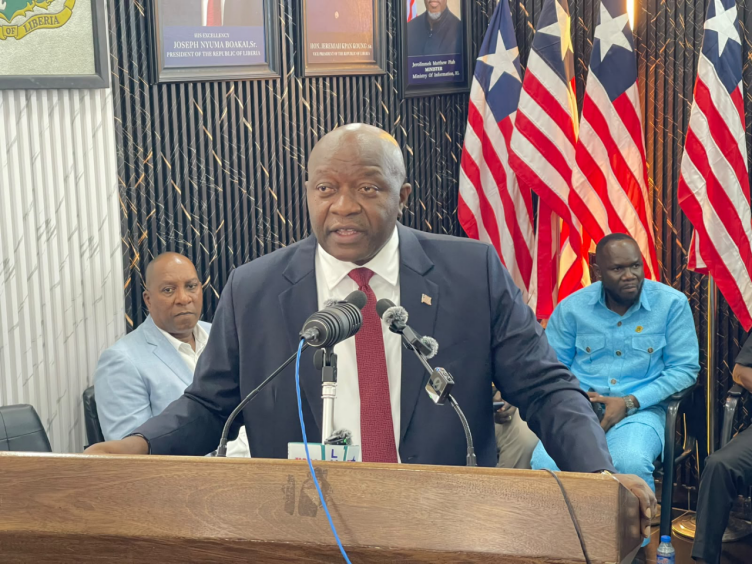
Ngafuan made the disclosure Monday, November 9, during his first major press briefing since submitting the draft budget to the House of Representatives on November 6. The briefing was held at the Charles Gbenyon Conference Hall at the Ministry of Information in Monrovia.
The proposed budget, themed “A Growing Budget for Bigger Impact: Accelerating the Implementation of the ARREST Agenda for Inclusive Development,” represents an approximately 18 percent increase over the approved 2026 national budget.
However, the Finance Minister acknowledged that competing demands from government institutions far exceed available resources, revealing that spending entities submitted funding requests totaling approximately US$3 billion.
He said the government had to make difficult choices in allocating available resources, emphasizing that the growing budget must translate into measurable improvements in public services and the lives of ordinary Liberians.
“This is a draft budget. It is before the Legislature for scrutiny, public hearings, and approval. The allocations I will discuss remain subject to that process,” Ngafuan cautioned.
Domestic Revenue to Finance 94 Percent of Budget
Ngafuan said approximately US$1.447 billion, representing 94 percent of the proposed budget, is expected to come from domestic resources, including an estimated US$55 million carried forward from 2026. The remaining US$92 million, or 6 percent, is projected from external budget support.
He disclosed that Liberia crossed the US$1 billion mark in domestic revenue collection by September 2026 for the first time in the country’s history, attributing the achievement to taxpayers’ contributions and improvements in revenue administration.
The minister thanked taxpayers and the Liberia Revenue Authority for contributing to the milestone, while stressing that increased domestic financing comes with greater responsibility to ensure accountability and value for public money.
The revenue forecast also factors in the proposed transition from the Goods and Services Tax to a Value Added Tax system.
However, he disclosed that US$40 million of the projected revenue has been classified as contingent, meaning corresponding expenditures would only be released if the funds materialize. Basic salaries, debt obligations, social benefits and the Public Sector Investment Program are excluded from this arrangement.
Beyond the funds captured in the national budget, development partners are expected to provide approximately US$195.4 million for off-budget development programs.
Health and Education Receive Increased Allocations
Healthcare and education are among the major beneficiaries of the proposed spending plan.
The health sector is expected to receive US$135.83 million, up from US$110.9 million in 2026, representing an increase of approximately US$24.93 million, or 22.5 percent.
Ngafuan said the allocation would support staffing, medical equipment and the full operationalization of the New Redemption Hospital in 2027.
The proposal also includes US$5.3 million for improvements at the John F. Kennedy Medical Center, including initial support for new facilities, cancer treatment capacity, dialysis services and other critical medical equipment.
Additional allocations include US$1.3 million for upgrading the Jackson F. Doe Memorial Hospital, US$1.5 million for the ongoing renovation of C.H. Rennie Hospital, and US$800,000 to strengthen the country’s response to Hepatitis B.
The government has also proposed an initial US$1.23 million toward construction of a National Children’s Referral Hospital.
Education is allocated approximately US$163.55 million, representing an increase of about US$20 million over the previous year’s allocation.
The proposed funding includes US$7 million for continued renovation, furnishing and equipping of the University of Liberia, alongside support for the Monrovia Consolidated School System, Grand Kru Technical College, Booker Washington Institute and Margibi University.
The budget also earmarks US$800,000 for a secure examination-printing facility for the West African Examinations Council and US$2.5 million for expanded school feeding and school health initiatives.
Over 17,000 Public Workers Targeted for Salary Adjustments
One of the major announcements from the briefing was the government’s plan to introduce compensation interventions expected to benefit more than 17,000 public-sector workers through salary adjustments, recruitment and the regularization of volunteers.
Ngafuan said the proposed interventions build on reforms initiated in 2025 to address salary disparities, improve conditions of service and bring additional workers onto the government payroll.
He cited the reversal of salary harmonization at the Judiciary, General Auditing Commission and Liberia Anti-Corruption Commission, as well as salary increases and top-ups for engineers, health workers and other public servants.
Under the 2027 proposal, qualified teachers in government schools, including those under the Ministry of Education and the Monrovia Consolidated School System, would receive salaries based on common qualification-related minimums.
The proposed adjustments would also cover 358 health workers across 146 health facilities and offices.
Additionally, 1,934 police officers are expected to benefit from upward salary adjustments as an initial step toward aligning compensation with their respective ranks.
The proposal also includes a 15 percent salary increase for 616 officers of the Liberia Drug Enforcement Agency.
Certain civil service directors, deputy directors and assistant directors are also expected to benefit from increases in their monthly minimum salaries.
Ngafuan said the Civil Service Agency would subsequently provide detailed information on the specific salary adjustments and their implementation.
“We cannot resolve every compensation problem in one year, but we can make steady, affordable progress,” he said.
The minister also disclosed that the government has acknowledged nearly US$60 million in accumulated and unremitted employer contributions owed to the National Social Security and Welfare Corporation (NASSCORP).
He said the government intends to provide the statutory 6 percent employer contribution while progressively settling the outstanding arrears through an amortization schedule.
US$142.5M for Infrastructure, US$40M for Electricity
Infrastructure and basic services are allocated US$142.56 million under the proposed budget.
The amount includes US$49.1 million through the National Road Fund and counterpart funding for major road corridors, including Karloken-Fish Town, Sanniquellie-Loguatuo and Fish Town-Kelipo.
Ngafuan said the investments are intended to improve transportation, connect farming communities to markets and make access to hospitals, schools and other essential services easier.
The budget also proposes US$40 million for expanding electricity generation and distribution, including support for the Liberia Electricity Corporation’s efforts to reduce commercial losses through the introduction of smart metering.
Rural renewable energy, water facilities, sanitation and climate resilience initiatives are also expected to receive funding.
In agriculture, the government plans to support the operationalization of mechanization hubs, strengthen agricultural value chains and recruit personnel for technical and agricultural extension services to improve productivity and farmers’ incomes.
1,400 Young Liberians to Join Security Forces
The proposed budget also outlines several interventions targeting youth employment, skills development and enterprise.
Ngafuan said the government intends to continue recruiting 1,400 young Liberians into the security sector, comprising 800 personnel for the Armed Forces of Liberia and 600 for the Liberia National Police.
The proposal further includes US$2 million for motorcyclist empowerment initiatives, including the establishment of rest stops.
The Lone Star national football team is earmarked to receive US$3 million, while US$650,000 is proposed to engage former national team players in youth sports development.
The Ministry of Gender, Children and Social Protection is also expected to receive a 77 percent increase in its allocation to strengthen social protection programs, responses to sexual and gender-based violence, safe homes and assistance to vulnerable populations.
Additional interventions are planned to support rural women’s communal farming and women-led enterprises.
Tourism is another sector targeted for increased investment. The proposed allocation to the Liberia National Tourism Authority rises from US$4.07 million to US$7.72 million, with support expected for tourism promotion and destinations, including Providence Island and Robertsport.
Debt Obligations Rise to US$275.5M
Despite the proposed increase in public spending, Ngafuan acknowledged that rising debt obligations will consume a significant portion of the government’s available resources in 2027.
He disclosed that debt service and related obligations are projected to increase from approximately US$232 million in 2026 to US$275.5 million in 2027, representing an increase of US$43.5 million, or nearly 19 percent.
The minister said the obligations include payments to commercial banks, local businesses and international creditors, including the World Bank and African Development Bank.
The proposal also includes approximately US$12 million to service Afreximbank financing secured in previous years for the Roberts International Airport (RIA) road project.
Ngafuan described debt servicing as a legal obligation that the government must prioritize, while emphasizing the need for responsible borrowing and ensuring that loans contracted for development projects deliver value.
Accountability Institutions Get More Funding
The proposed budget increases allocations to transparency and accountability institutions from approximately US$37.9 million to US$49.13 million.
The increase is expected to strengthen institutions, including the General Auditing Commission, and expand anti-corruption services.
Ngafuan also announced plans to make six additional county treasuries operational in 2027, bringing the total number to 10 facilities serving Liberia’s 15 counties.
On tax reform, he clarified that under the proposed Value Added Tax framework, rice would remain exempt, while petroleum products would also be excluded from VAT but continue to attract other applicable taxes, fees and levies.
He said public education would be important to ensuring that citizens understand the proposed tax changes.
Government Proposes Used Vehicles for Spending Entities
In another policy shift, Ngafuan announced that beginning January 2027, spending entities would be allowed to use 25 percent of their budgetary allocations for vehicle purchases to acquire used vehicles, subject to standards and guidelines to be issued by the General Services Agency.
The government is also proposing changes to procurement procedures to allow preliminary procurement activities before the beginning of a fiscal year, although binding contracts would remain contingent on the passage of the national budget.
Multi-year commitments would also require confirmation from the Ministry of Finance and Development Planning that funding is available.
Ngafuan said the measures are intended to improve budget execution, strengthen procurement planning and ensure more responsible use of public resources.
Concluding his remarks, the minister called on the Legislature, civil society organizations, businesses, the media and ordinary citizens to scrutinize the proposed budget and participate constructively in the approval process.
He maintained that while the proposed increase reflects progress in the government’s revenue mobilization efforts, the real test would be whether the allocations translate into tangible improvements in the lives of Liberians.
The US$1.539 billion draft budget is now before the Legislature for review, public hearings and approval before it can take effect for the 2027 fiscal year.
Support Independent Journalism
Your support helps FrontPage Africa continue delivering independent, credible, and impactful journalism. Every contribution strengthens our ability to investigate, inform, and hold power accountable while keeping quality journalism accessible to our readers.
Support our journalism or subscribe to receive the latest FrontPage Africa stories and updates.