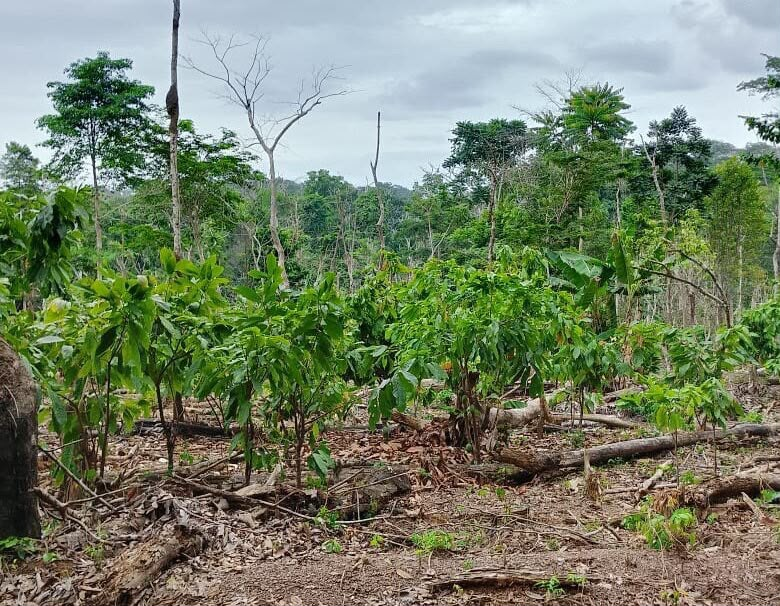
Monrovia – A new investigation released Friday warns that a “cocoa rush” spilling across the border from Côte d’Ivoire is driving deforestation into Liberia’s protected forests, and that the encroachment, though still at an early stage, could repeat the devastation already seen on the Ivorian side if left unchecked.
The report, produced by Fern, a Brussels-based NGO that campaigns on forests and EU forest policy, in collaboration with Liberian NGO Save My Future Foundation (SAMFU) and Ivorian NGO l’Association Initiatives pour le Développement communautaire et la conservation de la Forêt (IDEF), focuses on the Taï–Grebo-Krahn landscape, which straddles both countries and forms one of the largest remaining blocks of the Upper Guinean Forest, a globally significant biodiversity hotspot.
Field teams carried out the investigation between May and July 2026, shortly after a sharp fall in global cocoa prices at the end of 2025. Despite the price drop, investigators found that deforestation pressure remained high.
Depleted Soils Driving Farmers Across the Border
According to the report, depleted soils and land scarcity in Côte d’Ivoire have pushed cocoa cultivation into Grand Gedeh and neighbouring counties, including protected areas where land clearing and farming are illegal. The expansion has brought a substantial influx of migrant labourers, mainly from Côte d’Ivoire and Burkina Faso.
Declining cocoa productivity in Côte d’Ivoire, combined with limited livelihood opportunities in Liberia, is sustaining the expansion into forested areas, including national parks, the report says. It warns that the long-term trend is for deforestation in Côte d’Ivoire to shift into Liberia, “potentially with equally devastating consequences.”
The investigation describes cocoa expansion, migration, land governance and cross-border trade as parts of “a single transnational system.” It found evidence of a structured network linking labour recruitment, land allocation, farm establishment and cocoa marketing across national borders.
‘No Problem, There’s Plenty of Forest’
The report notes that many people in affected communities do not see the expansion as a threat. One elder in Garleo, Liberia, told investigators: “no problem, there’s plenty of forest,” adding that “if animals aren’t comfortable here they can go [to neighbouring counties].”
Investigators found that forest land is often allocated to people who sponsor migrants to travel, promising them work on cocoa farms. The land is handed over through weak verbal agreements, while unclear boundaries between community land and protected areas create openings for encroachment and disputes.
The report cautions that relying solely on enforcement of forest, land and immigration laws is unlikely to work unless accompanied by stronger land governance, livelihood support and infrastructure development.
EU Rules Raise the Stakes
The findings come as Liberia’s cocoa sector faces growing international scrutiny. The European Union, which imports most of the world’s cocoa, will begin enforcing its Deforestation Regulation (EUDR) in 2027, banning cocoa linked to deforestation after 2020 or produced in violation of the producing country’s laws. The United Kingdom is expected to introduce similar legislation.
The report says this creates “a large economic incentive” for governments, companies and smallholders to ensure cocoa is deforestation-free and respects human rights. It also flags significant traceability challenges for governments, exporters and buyers trying to prove their supply chains are clean.
In Liberia, SAMFU’s team researched the north-west section of Grebo-Krahn National Park, the adjoining Konobo Community Forest and nearby farming communities. In Côte d’Ivoire, IDEF worked in communities around Taï and at Cavally River crossing points near Tempo. Interviewees included chiefs, women’s and youth leaders, farmers, security personnel and Granex, a major cocoa trader operating in Liberia. All were anonymised for safety reasons.
Fern, which marked its 30th anniversary in 2025, has long pressed for stronger EU forest protections, policies it says are now under concerted attack in Europe.
What Liberia Is Being Urged to Do
The report calls on the Government of Liberia to:
- Join international initiatives: Partner with countries implementing the African Regional Standard for Sustainable Cocoa (ARS 1000) and the EU Sustainable Cocoa Initiative.
- Enhance cross-border tracking: Strengthen a joint Liberia–Côte d’Ivoire monitoring mechanism for cocoa expansion, migration, and cross-border trade.
- Improve institutional coordination: Better the coordination among land, forestry, protected-area, agriculture, immigration, customs, and mining authorities.
- Map boundaries clearly: Better demarcate and publicise protected-area boundaries.
- Accelerate land reforms: Advance customary land reforms, including participatory mapping, community land governance committees, and land title registration.
- Target enforcement: Prioritise enforcement efforts in cocoa expansion hotspots around Grebo-Krahn National Park.
- Deploy technology: Use satellite and remote sensing tools to monitor at-risk areas.
- Update management plans: Integrate cocoa and mining risks into protected-area management plans.
The report also urges the EU and UK to support deforestation-free cocoa supply chains and inclusive dialogue, stressing that encroachment in Liberia “can still be stopped” if governance and traceability gaps are addressed through long-term cooperation between the two countries.
Support Independent Journalism
Your support helps FrontPage Africa continue delivering independent, credible, and impactful journalism. Every contribution strengthens our ability to investigate, inform, and hold power accountable while keeping quality journalism accessible to our readers.
Support our journalism or subscribe to receive the latest FrontPage Africa stories and updates.