MONROVIA — Former Foreign Minister Dee-Maxwell Saah Kemayah Sr. has called for a fundamental shift in global climate governance, urging governments and international institutions to move young people beyond symbolic participation and give them a meaningful role in climate negotiations, policymaking and implementation.
By Gerald C. Koinyeneh
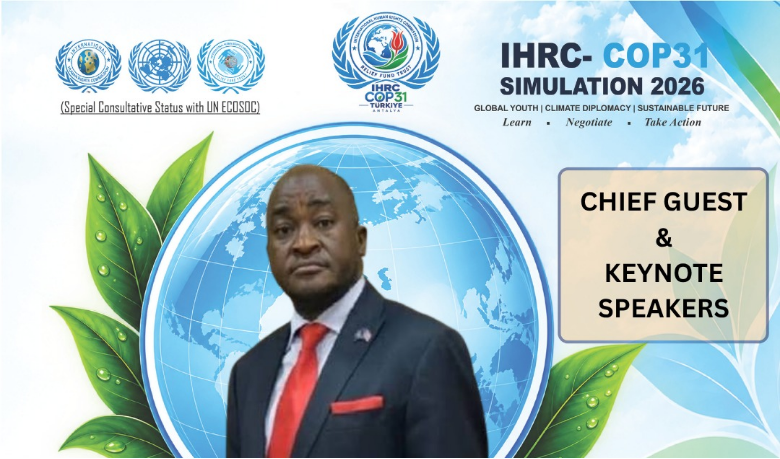
Delivering the keynote address at the opening of the International Human Rights Commission (IHRC)-COP31 Simulation Conference 2026 on Saturday, October 24, Kemayah argued that young people must be recognized as active partners in addressing climate change rather than treated merely as future leaders who will inherit its consequences.
“The future of our planet is being shaped by decisions we make today, and young people must have a meaningful voice in those decisions,” Kemayah told participants at the two-day online conference held under the theme, “Global Youth, Climate Diplomacy, and a Sustainable Future.”
The conference brought together students, young professionals, diplomats, scholars and civil society representatives to explore international climate negotiations and the challenges of reaching agreements on climate finance, technology transfer, energy security and climate-related displacement.
Kemayah, who served as Liberia’s Minister of Foreign Affairs and Dean of the Cabinet, said climate change had evolved beyond an environmental concern into a global development challenge affecting food security, public health, livelihoods, economic growth and human dignity.
Quoting former United Nations Secretary-General Ban Ki-moon, he reminded delegates: “There is no Plan B because there is no Planet B.”
He said the interconnected nature of climate risks requires coordinated international action, adding that no country or generation can afford to ignore the consequences of a warming planet.
Climate Justice for Vulnerable Countries
Kemayah placed particular emphasis on the challenges facing developing countries, many of which must confront climate vulnerability while struggling with poverty, unemployment, inadequate infrastructure and limited financial resources.
He cited changing rainfall patterns, droughts, coastal erosion, flooding and extreme weather events as threats to agricultural productivity, infrastructure, water supplies and public health systems.
For vulnerable countries, he argued, responding effectively to climate change requires more than commitments to reduce greenhouse gas emissions. It also demands adequate financing, access to technology, stronger adaptation programs and international cooperation that reflects differences in national circumstances.
He pointed to the principles of equity and common but differentiated responsibilities and respective capabilities under the international climate framework, including the Paris Agreement.
These principles recognize that countries differ in their historical contributions to greenhouse gas emissions, financial and technological capacity, and exposure to climate risks.
“A fair international response must therefore combine environmental ambition with development needs,” Kemayah said, emphasizing that climate justice should provide vulnerable countries with a realistic pathway toward sustainable development.
His argument reflects a longstanding challenge in international climate diplomacy: how to reconcile the urgency of reducing emissions with developing countries’ demands for financing and support to adapt to climate impacts and pursue economic growth.
Youth Inclusion Must Go Beyond Conferences
A central theme of Kemayah’s address was the gap between inviting young people to climate conferences and giving them the power and resources to influence decisions.
He identified young people as researchers, entrepreneurs, community organizers, technical professionals and emerging diplomats whose contributions could strengthen climate planning and implementation.
University students, he said, could investigate local climate risks, while young entrepreneurs could develop renewable-energy solutions and sustainable businesses. Young diplomats and professionals could contribute technical expertise and help bridge differences among countries during negotiations.
However, he warned that meaningful participation requires more than representation at international gatherings.
Governments and international institutions, he said, must provide young people with access to information, technical training, mentorship, financing and opportunities to participate in national climate consultations, international negotiations and environmental research.
He also stressed the importance of including rural youth, young people with disabilities, economically disadvantaged students and those living in climate-vulnerable communities.
“The principle is straightforward: young people should not simply inherit the consequences of climate decisions. They should help shape those decisions,” he said.
Climate Diplomacy Must Produce Results
Kemayah also challenged governments to measure the success of climate diplomacy by tangible outcomes rather than the number of declarations signed or promises announced.
He acknowledged that international negotiations are complicated by competing national interests, different energy systems, economic priorities and unequal financial capacities.
Some countries prioritize rapid emissions reductions, while others must balance climate commitments against the need for affordable electricity, industrial development, employment and poverty reduction.
Effective diplomacy, he argued, must recognize these differences without weakening the urgency of climate action.
He outlined four essential requirements for effective climate negotiations: sustained dialogue and mutual understanding, credible scientific evidence, equity in international cooperation, and stronger implementation and accountability mechanisms.
The ultimate test, he said, should be whether agreements produce cleaner energy, stronger climate resilience, protected ecosystems, effective adaptation and improved access to climate finance.
“The ultimate purpose of climate diplomacy is not simply to reach agreement. It is to reach agreements that make a measurable difference,” Kemayah said.
He described the IHRC-COP31 Simulation Conference as an opportunity for participants to develop negotiation skills, understand competing national interests and explore solutions that are equitable, practical and capable of implementation.
Five Priorities for Youth-Led Climate Action
To translate climate commitments into practical results, Kemayah proposed five strategic priorities for governments, educational institutions, development partners and young people.
The first is strengthening climate education and research. He called on schools, universities and professional institutions to equip young people with the knowledge and skills needed to assess climate risks, evaluate evidence and develop solutions.
Second, he urged greater investment in renewable energy and sustainable innovation, including affordable energy systems, energy-efficient technologies, sustainable agriculture and improved waste management.
Third, he called for stronger protection of forests, water resources and biodiversity through reforestation, watershed protection, ecosystem restoration and community environmental education.
Fourth, he emphasized investment in climate-resilient communities, including early-warning systems, resilient infrastructure, improved water management, disaster preparedness and climate-resilient agriculture.
Fifth, he called for transparency and institutional accountability, urging governments to report progress on climate commitments, businesses to assess their environmental impacts and institutions to monitor how climate resources are used.
He said young people could contribute to these efforts through research, responsible advocacy, public consultations and civic engagement.
According to Kemayah, the five priorities are interconnected: education builds knowledge, innovation develops solutions, conservation protects natural systems, resilience reduces vulnerability, and accountability helps ensure that commitments deliver results.
Stewardship and Responsibility to Future Generations
Beyond policy and diplomacy, Kemayah framed climate action as an ethical responsibility to protect the natural environment and preserve opportunities for future generations.
He argued that forests, water, energy, agriculture and infrastructure must be managed with consideration for their long-term effects on human well-being and environmental security.
Referring to environmental protection as a responsibility to care for God’s creation and one’s neighbors, he said sustainable development should not be treated as a choice between economic progress and environmental preservation.
Instead, he argued, development must be pursued in ways that protect human dignity while sustaining the ecological systems on which life depends.
“Environmental stewardship is an expression of our responsibility to care for God’s creation and our neighbors,” he said.
Focus Turns to COP31 in Türkiye
The IHRC-COP31 Simulation Conference was held online on October 24–25, 2026, ahead of the 31st United Nations Climate Change Conference, commonly known as COP31, scheduled for Antalya, Türkiye, from November 9–20, 2026.
According to the conference background materials, the simulation was designed to give university students, youth leaders, young professionals and civil society representatives practical experience in international negotiations.
Participants were assigned roles representing countries, international organizations, businesses and civil society groups to discuss issues expected to shape the global climate agenda.
The simulation featured four negotiation areas: fossil fuel transition and energy security; critical minerals and green industrial competition; climate finance and adaptation; and loss and damage and climate displacement.
The exercise aimed to strengthen participants’ understanding of global climate governance, international cooperation and climate justice while developing their negotiation and public-speaking skills.
Kemayah urged participants to use the opportunity to move beyond theoretical discussions and develop practical proposals that could inform international climate action.
He concluded with three central messages: climate change requires international cooperation and responsible governance; young people must have meaningful influence in climate policymaking; and commitments must translate into measurable improvements in environmental protection and human well-being.
“Let us learn with intellectual discipline, negotiate with integrity, and take action with determination,” he said.
For Liberia and other climate-vulnerable countries, the issues raised in the address carry particular significance. The challenge extends beyond participating in international discussions to ensuring that global commitments translate into resources, policies and practical interventions that strengthen communities against climate risks.
As the world prepares for COP31, Kemayah’s message was that young people must be equipped not only to understand the climate crisis but also to influence the decisions, negotiations and investments that will determine how countries respond to it.
Support Independent Journalism
Your support helps FrontPage Africa continue delivering independent, credible, and impactful journalism. Every contribution strengthens our ability to investigate, inform, and hold power accountable while keeping quality journalism accessible to our readers.
Support our journalism or subscribe to receive the latest FrontPage Africa stories and updates.