Monrovia- Every Sunday, pastors across Liberia climb into pulpits to comfort the grieving, counsel the broken and lift the weary. Few in the pews stop to ask who comforts the preacher.
By: Rodney D. Sieh
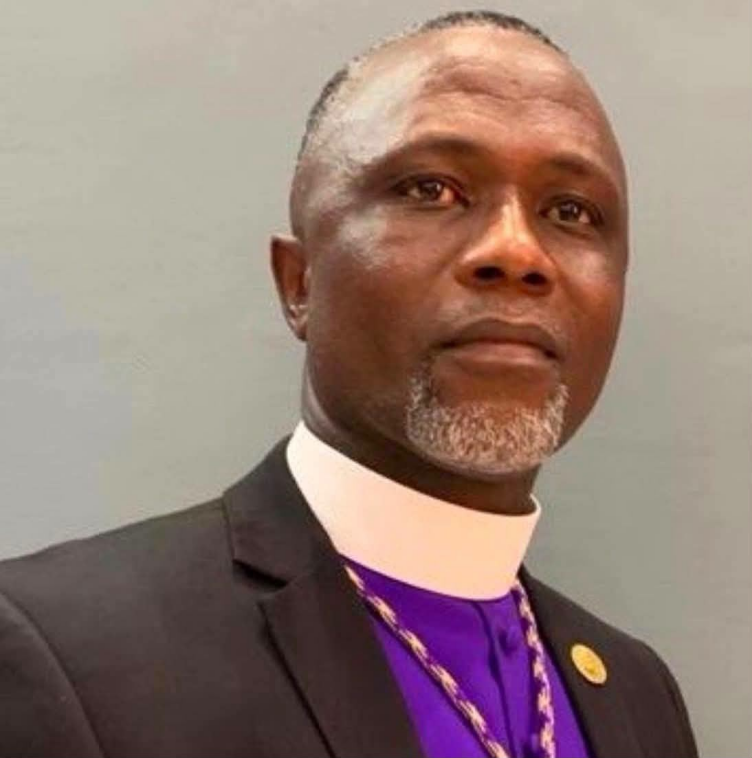
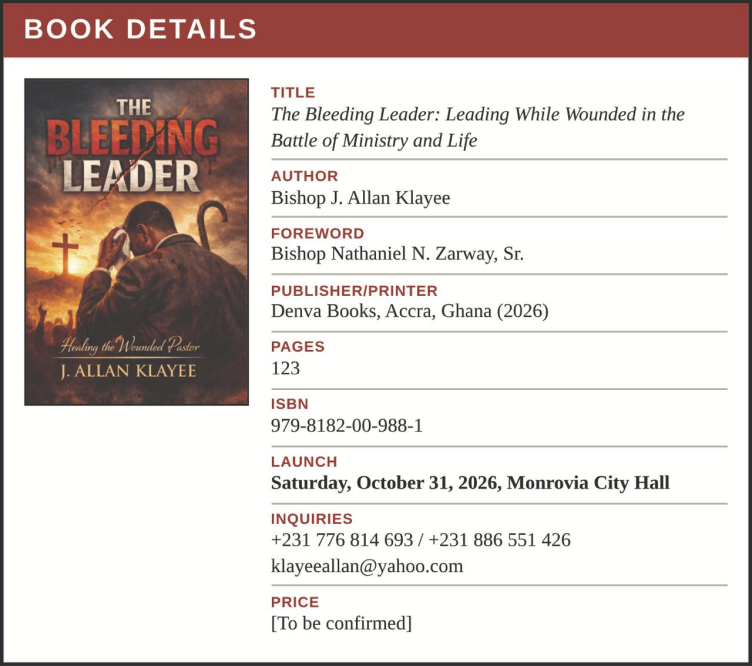
That question is the heart of The Bleeding Leader: Leading While Wounded in the Battle of Ministry and Life, the new book by Bishop J. Allan Klayee of Jubilee Ministries International.
Published in 2026 and printed by Denva Books in Accra, the 123-page work makes a case that is simple to state and hard for many churches to accept: leaders bleed, and a ministry culture that forbids them to say so is setting them up to collapse.
The book will be officially launched this Saturday, October 31, at the Monrovia City Hall.
“Followers see the polished sermon, the steady hand guiding a congregation through crisis,” the book’s introduction says. “They see the fruit. They see the confidence. What they rarely see is the bleeding.”
The foreword is written by Bishop Nathaniel N. Zarway, Sr., Diocesan Bishop of the Church of Our Lord Jesus Christ of the Apostolic Faith in Liberia, who calls the author his “son in the gospel” and recommends the book “to every leader who has ever shed tears in private while standing strong in public.”
Although it is written mainly for pastors, the author insists its reach is wider. “The book is not only for the church but speaks to every leader in every sector,” Bishop Klayee said.
Twelve chapters, one wound at a time
Across twelve chapters, Bishop Klayee takes the hidden injuries of leadership one by one. There is the bite from inside the flock (“When Sheep Bite, It Hurts”), the betrayal of trusted friends, the loneliness of being “surrounded by people, known by none,” the weight of carrying other people’s burdens, and the danger of suffering in silence. The final chapters turn toward healing, and toward the idea that a scar can become a source of wisdom rather than shame.
His guides are the great figures of Scripture, chosen, he writes in the preface, “precisely because they were not” invincible. Moses tells God the burden is too heavy and asks to die. Elijah sits under a broom tree days after his triumph on Mount Carmel and prays for death. David writes psalms from caves and flees his own son Absalom. Peter weeps in a courtyard. Paul admits the “daily pressure” of his concern for the churches.
The second chapter, “Protecting the Bleeding General,” turns the lens on congregations. Using the image of Aaron and Hur holding up Moses’ tired arms during the battle with the Amalekites, the author argues that the church has been “far more practiced at expecting protection from its leaders than at providing protection to them.” He calls protecting a pastor “the most self-interested thing a community can do for its own future.”
Where the book is strongest
The book’s greatest service is that it names something many church cultures prefer to keep quiet. It rejects outright the teaching that suffering is proof of weak faith. That kind of “false comfort,” the author writes, adds “a layer of shame and spiritual self-condemnation” to people who are already struggling.
Some of its readings of familiar passages are fresh and memorable. When Moses breaks down in Numbers 11, the author notes, God does not rebuke him. He appoints seventy elders to share the load. When Elijah collapses in the wilderness, the first thing God sends is not a sermon but food and sleep. “The body had to be addressed first,” Bishop Klayee writes, a line that every overworked pastor and every demanding church board should read twice.
The chapter on why
congregations turn on their leaders is wise and generous. The author identifies three causes: misunderstanding, because leaders often cannot explain decisions built on confidences; displaced pain, where a member’s own suffering is aimed at the nearest authority figure; and disappointment when a pastor fails to live up to an idealised image. He urges leaders to ask what may be happening in the life of an attacker, so that an attack becomes “information” rather than only a wound.
The book also offers practical warning signs that a leader is running on empty: emotional flatness, sharpness out of proportion to events, and a quiet withdrawal from prayer and Scripture. And it has lines that stay with the reader, none sharper than this: “The prayer meeting that prays for everyone in the congregation except the person leading it has missed the most obvious application of the very theology it is practicing.”
Importantly, the call to protect leaders is not a call to shield them from scrutiny. Bishop Klayee treats accountability as protection, arguing that “the leader who operates without accountability is not free. They are exposed.” At a time when public trust in institutions, including churches, is fragile, that balance matters.
Where it falls short
The book is not without flaws. The most noticeable is repetition. Elijah under the broom tree appears in at least four chapters. Moses’ plea in Numbers 11 and Paul’s “daily pressure” of concern for the churches are each worked through twice. Galatians 6:9 both opens and closes the argument, and a full passage about the congregation that watches its pastor suffer faithfully appears almost word for word in both the first and last chapters. A firmer edit would have tightened the book considerably.
The prose, while clean and readable, leans heavily on certain words. “Genuine” and “genuinely” appear about 170 times, and “specific” is not far behind. In places, the sentences grow long and abstract, circling an idea rather than landing it. More significant is what is missing.
In the preface, the author says the book grew from years of walking with wounded pastors and from “my own seasons of wounding.” Yet readers hear almost nothing of those stories. Beyond the biblical figures, there are few real cases, no Liberian pastor who burned out and recovered, no congregation that learned to care for its leader.
Those stories would have given the book a local heartbeat and made its lessons easier to apply.
The practical guidance is also thinner than the diagnosis. The book briefly names compassion fatigue and clinical depression but says little about when a pastor should seek professional counselling, how a church might arrange rest or sabbatical time, or how to build the kind of shared leadership Moses received. Readers looking for a step-by-step plan will find encouragement more than instruction.
Verdict
The Bleeding Leader is a sincere, pastoral and timely book. Its central message, that a wounded leader is not a disqualified leader, needs to be heard in Liberian churches and beyond, in boardrooms, ministries and public offices where leaders are expected never to break. Its repetitions and missing personal stories keep it from being the definitive work on the subject. But for the pastor preparing a message of hope on Saturday night while privately feeling hopeless, it offers what its author promises: the assurance that “you are seen. You are not alone.”
It should be read by pastors, and perhaps even more by the deacons, elders and church members who sit in front of them every Sunday.
Support Independent Journalism
Your support helps FrontPage Africa continue delivering independent, credible, and impactful journalism. Every contribution strengthens our ability to investigate, inform, and hold power accountable while keeping quality journalism accessible to our readers.
Support our journalism or subscribe to receive the latest FrontPage Africa stories and updates.