MONROVIA – Liberia’s House of Representatives has ordered a sweeping review of salaries and benefits across government, days after a rare public disclosure of a senior official’s pay reignited anger over the cost of running one of the world’s poorest countries.
By Emmanuel Weedee-Conway
In a unanimous vote on Tuesday, the lower house of the national legislature instructed two of its committees, on Ways, Means and Finance and on Public Accounts, to examine the pay and perks of government officials and report back within two weeks. The motion was brought by Representative Alex S. Noah of Sinoe County.
Lawmakers argued that they are wrongly blamed for the country’s swollen wage bill, while ministers and the heads of state-owned enterprises earn far more.
The disclosure that lit the fuse
The vote came less than a week after Euphemia G.T. Swen-Monmia, President Joseph Boakai’s nominee for Deputy Governor for Economic Policy at the Central Bank of Liberia, appeared on October 22 before the Senate Committee on Banking and Currency for her confirmation hearing.
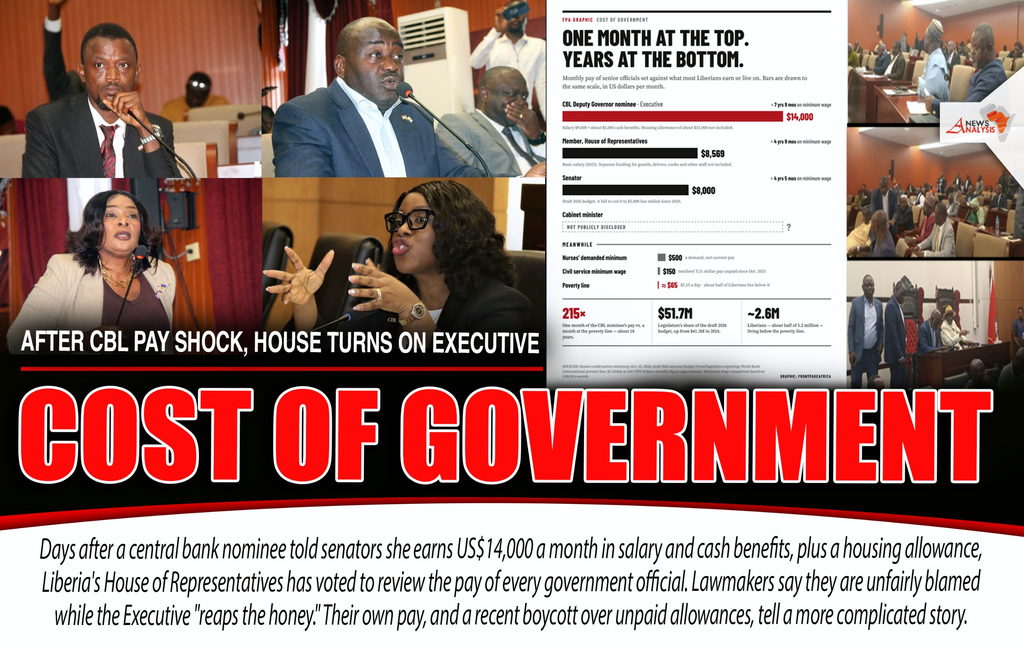
Asked about her pay, she did something Liberian officials rarely do: she gave the numbers. She testified that her monthly salary is US$9,000, that she receives around US$5,000 in cash benefits on top of that, and that her housing allowance should be about US$15,000. She has served in an acting capacity since August 12.
That amounts to roughly US$168,000 a year in salary and cash benefits before housing is counted. A civil servant on the government’s US$150 monthly minimum would need more than seven and a half years of uninterrupted work to earn what she receives in a single month.
Swen-Monmia is a career central banker who joined the bank in 2010 as a management trainee and rose to director of its Financial Markets Department. The controversy is not about her qualifications but about what her testimony revealed: pay at the top of Executive agencies is generous, and almost never made public.
No lawmaker cited her testimony by name during Tuesday’s debate. But the timing, and the focus of the two letters that triggered it, on officials earning more than US$5,000 a month, suggest the disclosure handed fresh ammunition to a chamber long cast as the main villain in Liberia’s debate over official pay.
‘We are suffering’
On the floor, several members described their own compensation as “peanuts” compared with Executive officials and argued the legislature deserves more because representatives serve larger numbers of constituents.
Representative Moima Briggs-Mensah of Bong County said a US$2,000 budget line meant for constituents’ school scholarships often never arrives, and that lawmakers lack the insurance enjoyed by Executive officials.
“We don’t even have Social Security benefits. We are suffering and people in the Executive are making mockery of us,” she said.
Representative Anthony Williams of Maryland County said lawmakers were being “falsely crucified” by the public while benefits such as fuel arrive months late.
“The Executive, especially SOEs are reaping the honey, while we are being falsely crucified,” he said, demanding that state enterprises disclose their gross and net pay and benefits to the House.
The numbers tell a different story
Lawmakers’ complaints sit uneasily with the figures. Senators earn US$8,000 a month each, according to the draft 2026 budget, and a bill to cut that to US$5,000, first introduced by Senator Abraham Darius Dillon in 2020, has stalled for years. In 2025, House members’ basic salary was put at roughly US$8,569 a month, with additional funding for security guards, drivers, cooks and other support staff.
The legislature as a whole has also grown more expensive. The draft 2026 budget gave lawmakers US$51.7 million, up from US$41.3 million in 2024.
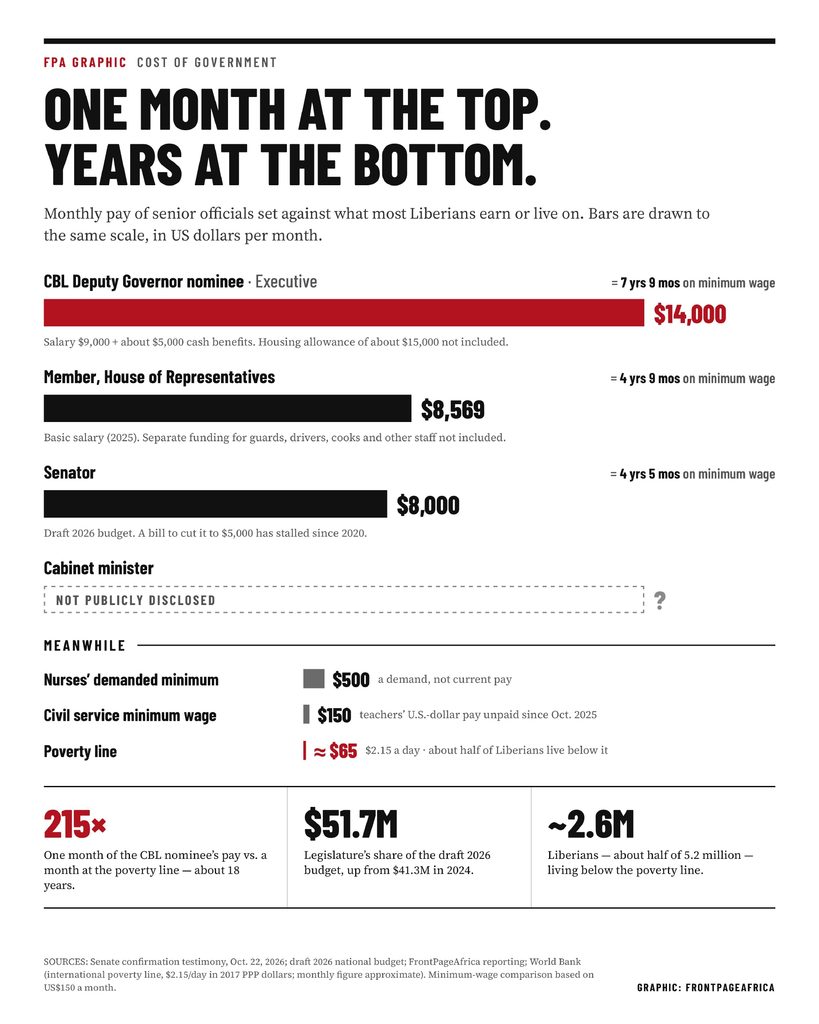
That is in a West African nation of about 5.2 million people still rebuilding from 14 years of civil war that ended in 2003, whose national budget crossed US$1 billion for the first time this year. About half the population lives below the poverty line.
Meanwhile, front-line public servants struggle to get paid at all. Teachers’ U.S.-dollar pay has gone unpaid since October 2025, and nurses are demanding a monthly minimum of US$500.
A chamber in revolt
Tuesday’s vote follows weeks of turmoil inside the House over lawmakers’ own money. More than 40 members boycotted the legislature’s reopening session on October 9 in protest over unpaid benefits and allowances, including constituency visits, district projects, fuel and medical allowances. Calling themselves “Reformists,” they accused the chamber’s leadership of withholding benefits and legislative support funds.
The Senate faces its own scrutiny. A proposal from its Committee on Rules, Order and Administration, reported by FrontPageAfrica, seeks US$792,552 in the 2027 budget to raise salaries for 224 Senate staff, with some increases as high as 71 percent. The Senate has disputed the reporting and demanded a retraction; FrontPageAfrica stands by its story.
Two letters, two tones
The review was triggered by letters from two lawmakers who framed the problem very differently from their colleagues on the floor.
Representative Sumo Kollie Mulbah of Montserrado County asked the House to hold up the national budget until the Finance Ministry reports all salaries and benefits above US$5,000 a month for ministers, directors, county governors and commissioners. The central bank deputy governor’s testimony would place her nearly three times above that threshold.
Mulbah singled out housing allowances, fuel and phone-credit coupons, and overseas medical treatment on top of health insurance.
“While these elite benefits are sustained, critical national priorities like the increment of the minimum wage are continuously set aside,” he wrote.
Representative Musa Hassan Bility of Nimba County called for a special committee to review salaries, allowances, wasteful spending, duty-free privileges and tax exemptions across all branches of government, and insisted the legislature go first.
“We cannot continue to demand sacrifices from ordinary Liberians while protecting our own excessive privileges,” Bility wrote. “This must not be another selective exercise intended to embarrass particular officials for public applause.”
What to watch
The two-week deadline lands as the Executive prepares to send the 2027 budget to the legislature by October 31. The government projects total spending will fall to US$1.02 billion next year, meaning any gains for one group of officials will likely come at someone else’s expense.
The test is whether the committees follow Bility’s call to start with the legislature, or whether the review becomes, as he warned, a selective exercise aimed at the Executive. Liberians have heard promises of pay cuts before. A proposal to cut senators’ pay to US$5,000 has been on the table for six years without passing.
Support Independent Journalism
Your support helps FrontPage Africa continue delivering independent, credible, and impactful journalism. Every contribution strengthens our ability to investigate, inform, and hold power accountable while keeping quality journalism accessible to our readers.
Support our journalism or subscribe to receive the latest FrontPage Africa stories and updates.