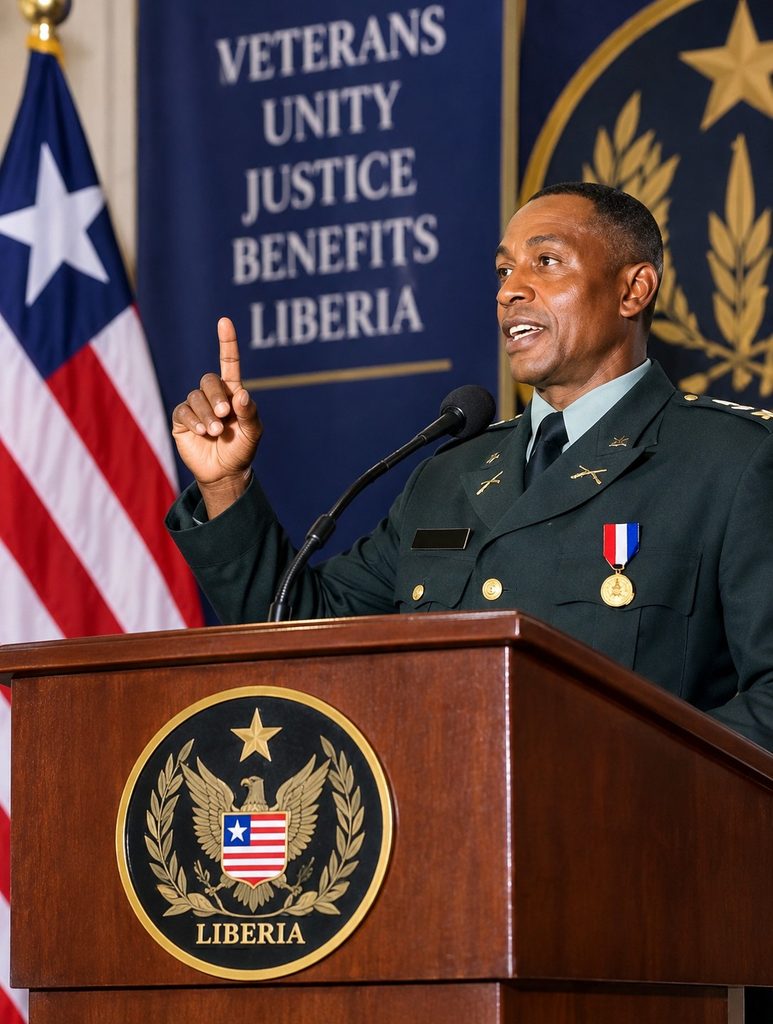
Retired Captain Anderson plans a 10,000-signature petition seeking legislative action on veterans’ welfare, historical compensation claims, and a proposed role for former soldiers in national development.
By Willie N. Tokpah
MONROVIA — Retired soldiers of the Armed Forces of Liberia (AFL) are preparing to converge on the Samuel K. Doe Sports Stadium on Thursday, October 15, for a constitutional assembly aimed at mobilizing support for a petition demanding legislative action on what their leadership describes as decades of unresolved grievances over pensions, salaries, and the treatment of former military personnel.
Led by Retired Captain William Phillip Anderson, who identifies himself as National Chairman Commander of the AFL Veteran Soldiers, the group intends to collect 10,000 signatures for a petition to the National Legislature seeking a review of the Veterans Act, an investigation into historical military compensation arrangements, and reforms to the pension system.
The petition is also expected to demand what Anderson describes as 36 years of retroactive salary payments, alongside a revised compensation framework that takes into account former soldiers’ ranks, years of service, and historical salary arrangements.
Beyond financial compensation, the veterans are proposing an expanded role for former military personnel in national development, including contributions to engineering, agriculture, medical services, and border security.
The planned assembly comes amid broader questions about Liberia’s obligations to former members of its armed forces, the legal framework governing their retirement benefits, and the potential use of their experience in civilian development and national security.
Anderson insists that the gathering is intended to be peaceful and constitutional, emphasizing that the veterans want their grievances addressed through established government institutions rather than through confrontation.
“We are not assembling to threaten the peace of Liberia. We are assembling to demand justice through constitutional means. Our grievances must be heard, investigated, and addressed through the institutions of government,” is the central message of his position.
The scale of participation, the government’s response, and the organizers’ ability to maintain discipline will help determine whether Thursday’s assembly becomes the starting point for substantive engagement or another episode in the long-running debate over veterans’ welfare.
A Longstanding Grievance Over Pensions
At the heart of the veterans’ demands is what Anderson describes as a longstanding failure to adequately recognize and compensate former AFL personnel following the restructuring of the country’s armed forces.
The veterans argue that the treatment of former soldiers, particularly the determination of their retirement benefits, has left many dissatisfied with the government’s compensation arrangements.
One of their principal complaints concerns a reported monthly pension of LD$7,000, which they say does not adequately reflect differences in military rank, responsibilities, and years of service.
According to Anderson, the uniform payment raises questions about whether the existing pension structure fairly accounts for the varied responsibilities performed by personnel during their service.
The veterans want lawmakers to investigate the legal and administrative foundations of the pension arrangement, identify the legislation and budgetary provisions supporting it, and examine the criteria used to determine eligibility and payment levels.
They are also calling for a review of the circumstances surrounding the disbandment and restructuring of the former AFL, including the treatment of personnel who were not incorporated into the restructured force and the subsequent determination of their retirement benefits.
These claims have yet to be established through an independent review of the relevant records. Their verification would require examination of applicable laws, military payroll documents, retirement instruments, government financial records, and testimony from former military and government officials.
For Anderson and the veterans’ leadership, however, the issue extends beyond the amount received each month. They argue that the government must account for the service rendered by former soldiers and explain how their benefits were determined.
The proposed legislative inquiry is intended to establish whether the existing framework adequately addresses the veterans’ circumstances and whether changes are necessary.
The 36-Year Back-Pay Demand
Perhaps the most contentious element of the proposed petition is the demand for 36 years of retroactive salary compensation.
Anderson traces the grievance to historical salary arrangements, changes in currency administration, and the depreciation of the Liberian dollar.
He maintains that before the civil war, a private soldier earned approximately US$60 and that the exchange rate was treated as one Liberian dollar to one United States dollar.
According to his account, subsequent currency changes and the introduction of newly printed Liberian-dollar notes during the conflict contributed to arrangements that, he argues, failed to adequately reflect the currency’s declining purchasing power.
Anderson contends that salary conversions based on nominal exchange-rate assumptions left military personnel receiving compensation that did not correspond to the actual value of their earnings.
He has cited cases in which general-grade officers allegedly received approximately LD$1,000 monthly, an amount he says represented less than US$20 under the economic conditions at the time.
The veterans argue that their compensation failed to reflect their responsibilities and the economic realities confronting the country while they continued serving the Republic under difficult conditions.
However, the proposed demand for 36 years of back pay raises complex legal and financial questions that cannot be resolved solely through the veterans’ account.
A credible assessment would require a detailed reconstruction of historical salary scales, exchange-rate policies, applicable payment arrangements, individual service records, and any legal obligations established during the relevant periods.
The calculation would also need to distinguish between historical salary differences, pension entitlements, currency-related losses, and any compensation that may already have been paid.
The veterans want the National Legislature to initiate that examination and determine whether additional payments are legally justified.
If the demand advances, the government would face questions about the scale of any potential liability, the legal basis for payment, the availability of documentary evidence, and the implications for public finances.
For Anderson, the proposed inquiry is necessary to establish what former soldiers were entitled to receive and whether outstanding obligations remain unresolved.
Anderson Urges Discipline and Constitutional Action
Anderson has framed the planned assembly as an exercise of constitutional rights, emphasizing peaceful mobilization, discipline, and institutional accountability.
He argues that former soldiers should not be expected to remain silent about grievances they believe have persisted for decades.
The planned petition invokes Article 17 of Liberia’s Constitution, which protects citizens’ rights to assemble and petition the government. The veterans also associate their initiative with Article 91, although the precise legal basis and procedures applicable to the proposed petition would need to be established under the relevant constitutional provisions and legislative rules.
Anderson has called on participants to remain disciplined, avoid intimidation, respect public officials, and refrain from conduct that could endanger civilians or disrupt public order.
The choice of the Samuel K. Doe Sports Stadium, he says, reflects a desire to provide an organized venue for the gathering while minimizing disruption to residents and other members of the public.
The assembly presents responsibilities for both the organizers and the government. The veterans must ensure that their activities remain peaceful and lawful, while the authorities must respect the constitutional rights of participants and maintain appropriate public-safety arrangements.
For the veterans’ leadership, the objective is to channel their grievances into a structured petition supported by signatures and proposals for legislative review.
Their position is that peaceful constitutional advocacy should lead to meaningful engagement rather than dismissal without substantive consideration.
The government’s response will help determine whether the initiative opens a credible channel for dialogue between the veterans and the institutions responsible for addressing their claims.
Beyond Pensions: A Proposed Civil Workforce
The veterans’ proposed agenda extends beyond retirement benefits to the possible establishment of a structured civil workforce involving former AFL personnel.
Anderson argues that veterans possess technical knowledge, military training, administrative experience, and practical skills that could contribute to national development if properly organized.
He points to specialized units that existed within the former AFL, including an Engineer Battalion, a Medical Unit, and an Agriculture Battalion, which he says contributed to functions beyond combat operations.
The veterans believe their accumulated experience could support infrastructure development, agricultural programs, medical services, and other government initiatives.
Their proposal seeks to transform what they consider an underutilized national resource into a structured public-service arrangement.
Such a program could provide opportunities for qualified former military personnel to contribute to civilian projects, but its implementation would require a clear legal framework, defined responsibilities, transparent recruitment criteria, sustainable financing, and appropriate civilian oversight.
The proposal also raises questions about how veterans would be selected, whether participation would be voluntary, and how the program would relate to existing public-sector employment structures.
Anderson’s broader argument is that retirement should not prevent former soldiers from contributing their knowledge and experience to national development.
Veterans Propose Border Patrol Role
Another component of the proposed petition calls for the establishment of a Border Patrol Battalion to support the Liberia Immigration Service and the Armed Forces of Liberia in protecting the country’s territorial borders.
The veterans argue that their military experience could help strengthen border management and national security.
However, the proposal would require careful consideration of the respective mandates of existing security institutions, operational command, training requirements, funding, accountability, and the legal status of participating personnel.
Any arrangement involving retired soldiers in security-related functions would also need to distinguish between civilian public-service duties and activities requiring formal authorization within the country’s security architecture.
The veterans’ proposal therefore represents a policy recommendation for government consideration, rather than an existing mandate or approved security arrangement.
Whether the idea could be implemented would depend on a detailed assessment of national security priorities, institutional capacity, legal requirements, and the potential benefits of incorporating qualified former personnel into authorized programs.
A Controversial Push for Leadership Positions
Among the most politically sensitive provisions of Anderson’s proposed agenda are demands for greater representation of veterans in the leadership and training of Liberia’s defense and security institutions.
According to the proposed agenda, the veterans want legislation requiring the Minister of National Defense, deputy and assistant ministers, and directors to be former soldiers. They also propose that national security advisers be veterans.
Another provision calls for veterans to occupy 50 percent of the General and Special Staff positions within the Armed Forces of Liberia.
The group further proposes that military training officers be veterans and that qualified former AFL personnel provide training support to the Armed Forces, Liberia National Police, Liberia Drug Enforcement Agency, and Liberia Immigration Service.
Anderson argues that experienced veterans could help strengthen institutional memory, professional discipline, operational preparedness, and the transfer of military knowledge to younger personnel.
The proposals, however, raise significant questions about merit-based recruitment, professional qualifications, constitutional appointment powers, civilian oversight, and the distinct requirements of military and civilian leadership positions.
A blanket requirement reserving specified public offices for veterans would need to be assessed against existing laws, constitutional principles, and the qualifications required for each position.
Military experience may provide valuable expertise, but it does not automatically establish eligibility for every civilian or security-sector leadership role.
The National Legislature would therefore need to consider the proposals individually, weighing their potential benefits against the need to preserve professional standards, equal access to public employment, and effective civilian governance.
The veterans’ demands remain proposals that would require legislative scrutiny and, where necessary, legal review.
A National Security Question That Cannot Be Ignored
The planned assembly also raises broader questions about the relationship between veterans’ welfare, national security, and public confidence in state institutions.
Former military personnel can possess valuable institutional knowledge and technical skills. Their concerns about retirement security, recognition of service, and the treatment of former colleagues warrant serious consideration.
At the same time, the presence of a large gathering of former soldiers calls for responsible coordination, clear communication, and respect for lawful public-safety arrangements.
The veterans’ leadership says the stadium will provide an organized location for the assembly and reinforce its commitment to peaceful action.
The government, meanwhile, has a responsibility to protect the participants’ right to assemble while maintaining public order and ensuring that emergency services and surrounding communities are not exposed to unnecessary risks.
Constructive engagement could include communication with the organizers, clarification of safety arrangements, and an established process for receiving and evaluating the petition.
The assembly should not, by itself, be treated as evidence of a security threat simply because its participants are former soldiers. Equally, the organizers have a responsibility to ensure that their activities remain peaceful and comply with applicable law.
The central question is how Liberia can address legitimate veterans’ concerns while maintaining a professional, accountable, and constitutionally governed security sector.
Why the Legislature Matters
Anderson is directing the petition to the National Legislature because the proposed demands extend beyond individual pension payments.
They include a review of the Veterans Act, an investigation into historical compensation arrangements, possible amendments to existing laws, a revised salary framework, and proposals for a civil workforce and expanded participation in national development.
The veterans want lawmakers to examine the laws governing their benefits, determine how the current pension arrangements were established, review historical salary records, and establish whether further legislative action is warranted.
The proposed collection of 10,000 signatures is intended to demonstrate broad support for the initiative.
However, the legal sufficiency of that number and the procedures governing the petition must be determined under the applicable constitutional provisions and legislative rules.
Lawmakers would also need to distinguish between issues that can be addressed through ordinary legislation, matters requiring amendments to existing laws, and questions that may require judicial interpretation.
The legislature’s role would not necessarily be to accept every demand. Rather, it would be to establish the facts, examine the legal framework, evaluate the financial implications, and determine which proposals merit action.
For the veterans, the critical test will be whether their petition receives a substantive response rather than being treated as a ceremonial submission.
A Test of Government Accountability
Thursday’s Constitutional General Muster Assembly could become a significant moment in the debate over Liberia’s obligations to former military personnel.
At stake are claims involving pensions, historical compensation, the restructuring of the former armed forces, veterans’ welfare, and proposals to deploy retired soldiers’ experience in national development.
The demands are broad and, in some cases, controversial. Their legal and financial implications require independent examination rather than automatic acceptance or dismissal.
Several questions will be central to that process: How were the historical salary arrangements established? What laws and regulations govern current veterans’ benefits? Do records establish that additional compensation is legally owed? Could a revised pension structure be developed transparently and sustainably? And how can qualified former military personnel contribute to civilian development without compromising the constitutional and professional requirements of Liberia’s security institutions?
These questions require documented answers and a process that allows the veterans, relevant government agencies, and lawmakers to examine the available evidence.
As Anderson prepares to lead the initiative, his message to participating veterans is one of discipline, restraint, and determination.
The veterans want their service recognized, their claims investigated, and their proposals considered by the institutions empowered to act on them.
Ultimately, the significance of the October 15 assembly will not be determined solely by the number of signatures collected or the strength of the rhetoric surrounding the gathering. It will depend on whether the veterans present verifiable evidence, whether the government and legislature respond transparently, and whether a credible process emerges for resolving any legitimate outstanding obligations.
For Liberia, the assembly offers an opportunity to demonstrate that longstanding and politically sensitive grievances can be examined through peaceful constitutional action, with due regard for the rule of law, public finances, and the professional standards of the country’s security institutions.
Editorial note: Before publication, verify the reported LD$7,000 monthly pension, the historical salary figures, the legal basis for the 36-year back-pay demand, and the references to Articles 17 and 91 of the Constitution. The story should also include a response from the Ministry of National Defense or the relevant veterans’ affairs authorities, if available.
Support Independent Journalism
Your support helps FrontPage Africa continue delivering independent, credible, and impactful journalism. Every contribution strengthens our ability to investigate, inform, and hold power accountable while keeping quality journalism accessible to our readers.
Support our journalism or subscribe to receive the latest FrontPage Africa stories and updates.