
When the Land Is Divided, the People Can Be Divided: “A criminal land cartel does not merely sell land it does not lawfully own; it sells suspicion, conflict, poverty, and division. Every fraudulent transaction creates another family dispute, another community grievance, and another wound in the national conscience.”
By: Austin S Fallah – A True Son of the Planet Earth Soil: [email protected]
“The deepest danger of land cartelism is that it can make citizens strangers on their own soil. Drug trafficking attacks the health and future of society; drug cartels seek organized power through illicit wealth; land-sale cartels seek wealth and influence through the unlawful control or transfer of territory and property. When such practices split brothers and sisters, turn neighbors against one another, displace legitimate owners, and corrupt public officials, the result is more than a property dispute—it is the erosion of social integrity. A nation that fails to protect lawful land ownership risks creating a society where wealth determines who belongs, power determines who owns, and corruption determines who receives justice.”
African proverb-inspired wisdom: “A house divided against itself cannot stand.” Liberia must therefore treat systematic land fraud as a national governance problem, not merely as a private disagreement between individuals.
President Boakai’s Warning on Land Governance:
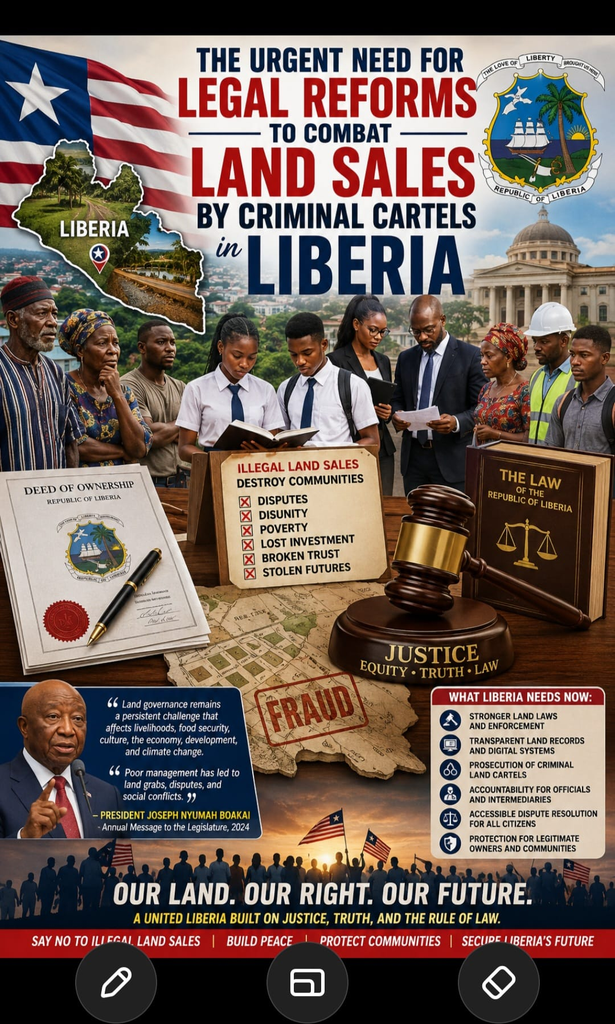
“Land governance remains a persistent challenge that affects livelihoods, food security, culture, the economy, development, and climate change.”
President Joseph Nyumah Boakai further acknowledged that “Poor management has led to land grabs, disputes, and social conflicts.”
The lesson is unmistakable: when illegal land sales are allowed to flourish, they do not simply create individual disputes—they can undermine communities, weaken confidence in government, discourage investment, and deepen economic hardship.
Land Theft Is Nation-Building in Reverse: “When land is stolen through fraudulent deeds, multiple sales, intimidation, or criminal networks, the damage is not merely financial—it tears at the social fabric of the nation. A nation cannot build lasting peace when its soil becomes a marketplace for deception and conflict.”
African proverb-inspired wisdom: “When two elephants fight, it is the grass that suffers.” When powerful interests manufacture land conflicts, ordinary Liberians often suffer the greatest economic and social consequences.
The Law Must Protect the Soil and the Citizen: “When the law is weak, the dishonest become landowners on paper while the rightful owners become strangers on their own soil. Legal reform must therefore close every loophole that allows criminal networks to manipulate deeds, duplicate transactions, dispossess citizens, and profit from confusion.”
President Boakai’s broader rule-of-law position provides an important standard for this principle. He has stated: “We will identify you, we will pursue you, we will find you, and we will deal with you in accordance with the rule of law.”
Applied to land governance, that principle means that organized land fraud must be investigated and prosecuted through lawful institutions rather than tolerated as an ordinary property dispute.
Land Is a Trust for Generations: “The land of Liberia is not merely a commodity for today’s profit; it is an inheritance held in trust for tomorrow’s children. When criminal cartels turn land into an instrument of fraud, they steal not only property from citizens but opportunity from future generations.”
African proverb-inspired wisdom: “The earth was not given to us by our parents; it is lent to us by our children.”
In recent years, Liberia has faced a grave crisis that threatens the very foundation of its society: the rampant illegal sale of land by criminal land cartels.
These ruthless groups have exploited the absence of landowners, particularly during times of political turmoil and civil unrest, to unlawfully sell parcels of land that do not belong to them.
This phenomenon has resulted in extensive social and economic hardship for the Liberian populace, exacerbating disunity and conflict.
To rectify this dire situation, the national legislature must enact severe legal consequences akin to those mandated for drug trafficking and its associated criminal enterprises.
Such consequences should include substantial prison terms, life imprisonment without the possibility of parole, no bail options, mandatory restitution for victims, and significant fines payable to the government.
This disquisition will explore the necessity of these legal reforms, drawing parallels to global examples, and arguing for the urgency of these measures in safeguarding land rights and fostering a cohesive society in Liberia.
The illegal sale of land presents a multifaceted issue, with severe implications for Liberia’s social cohesion and economic development.
Land is not merely a commodity; it is a fundamental element of identity, culture, and livelihood for many Liberians.
Ongoing civil conflicts have created a void in land ownership and legal rights, leaving millions vulnerable to predatory practices by criminal organizations.
These cartels operate with impunity, often using intimidation and violence to assert control over land that is rightfully owned by others.
With this environment of fear and uncertainty, trust within communities deteriorates, leading to fragmentation and disunity.
The necessity for severe legal consequences to deter such criminal activity mirrors the stringent laws implemented against drug trafficking in Liberia.
Just as the government recognized the need for harsh penalties to combat the insidious nature of drug cartels, the same level of urgency must be applied to the issue of illegal land sales.
An effective legal framework that punishes perpetrators accordingly can serve as a powerful deterrent.
Proposing a minimum sentence of 50 years for those convicted of illegal land sales, coupled with life imprisonment without parole for the most egregious offenses, creates a clear message: this behavior will not be tolerated.
Furthermore, denying bail rights for individuals charged with offenses related to illegal land sales is essential.
Such a measure ensures that those accused of perpetrating these crimes cannot evade justice or intimidate witnesses.
By instituting this rigorous standard, the Liberian government can begin to restore faith in the legal system, demonstrating to the public that protecting land rights is a priority.
Additionally, mandating full restitution for victims of illegal sales, including those who have lost their homes and livelihoods, reinforces the moral imperative to prioritize justice and accountability.
The financial ramifications of illegal land sales are also significant.
Imposing a substantial fine, such as US$100,000, on those convicted not only serves as a punitive measure but also functions as a potential revenue stream for government services.
This revenue could be directed towards community development initiatives and social welfare programs aimed at alleviating the economic burden faced by victims of these crimes.
The retroactive application of such laws would further ensure justice for past victims, restoring a sense of fairness to affected communities.
Liberia’s case is not isolated; the plight of land ownership and the threat of illegal sales is a global issue that transcends borders.
Consider the situation in Brazil, where the expansion of illegal land grabbing in the Amazon rainforest has not only destroyed valuable ecosystems but has also led to violence against indigenous land defenders.
The Brazilian government has faced significant challenges in combating these cartels, yet implementing strict laws and penalties against unauthorized land sales has begun to yield results.
Similar actions in Liberia could serve as a model for progressive change, demonstrating that legal frameworks can effectively dismantle power structures that exploit vulnerable populations.
In Kenya, the fight against illegal land sales has also led to violent conflicts, with criminal organizations taking over land to the detriment of legitimate landowners.
The Kenyan government has enacted various land reforms, including penalties for fraudulent sales, to address these issues.
Such reforms have shown promise in stabilizing communities and restoring rights to rightful owners.
Liberia can learn from these international examples, tailoring its legislative responses to address its unique circumstances while borrowing successful strategies that have proven effective elsewhere.
Over 30 years ago, the United Nations adopted the Universal Declaration of Human Rights, which emphasizes the right to property and the protection of legal ownership.
The spiraling crisis of illegal land sales in Liberia undermines this fundamental principle and reinforces the need for a robust legal response.
The absence of strong legislative measures leaves the door wide open for criminal cartels to thrive and perpetuate cycles of violence, poverty, and displacement.
By following the precedents set by other nations and enacting strict regulations against illegal land sales, Liberia can take critical steps toward protecting its citizens, fostering a sense of security, and rebuilding its society.
In addition to enacting these necessary reforms, the government must invest in public awareness campaigns to educate citizens about their land rights.
Empowering individuals with knowledge enables communities to act against fraudulent practices and promotes social responsibility.
Such initiatives can foster a culture of vigilance and collaboration, enabling citizens to work together to combat illegal activities and safeguard their collective rights.
The gravity of the land crisis in Liberia can not be overstated.
The lives of many depend on the government’s ability to restore justice and security in the realm of land ownership.
Severe legal consequences, including long prison sentences, fines, and restitution, are not merely punitive measures but essential tools for reestablishing trust in the legal system and reinforcing the sanctity of property rights.
When communities are assured that their land is secure and their rights are respected, social and economic stability can flourish.
The severe consequences proposed to deter illegal land sales in Liberia are not only urgent but also a moral obligation.
By taking decisive action against these criminal cartels, the ational legislature can fulfill its responsibility to safeguard its citizens and promote a just society.
The time for debate has passed; the call for comprehensive legal reform is necessary to protect the lands, livelihoods, and futures of countless Liberians.
As Liberians stand at this pivotal juncture, they must act swiftly and decisively to rewrite the narrative of land ownership in Liberia, a narrative that fosters unity, hope, and resilience.
The journey toward justice begins with every Liberian, as stakeholders, and through concerted legislative action, they can usher in a new era of stability and prosperity for all Liberians.
Support Independent Journalism
Your support helps FrontPage Africa continue delivering independent, credible, and impactful journalism. Every contribution strengthens our ability to investigate, inform, and hold power accountable while keeping quality journalism accessible to our readers.
Support our journalism or subscribe to receive the latest FrontPage Africa stories and updates.