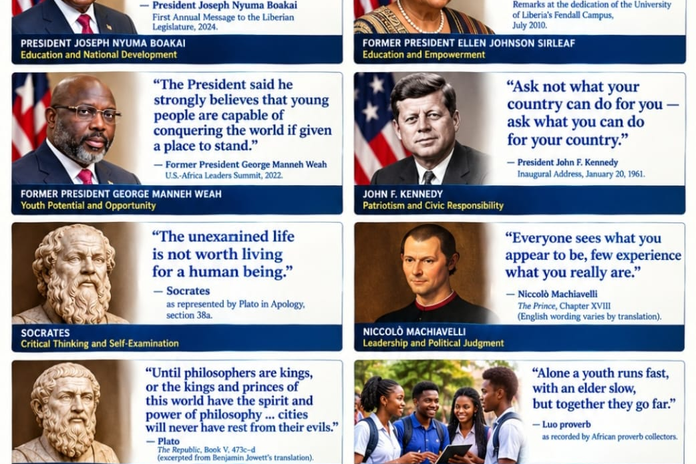
Machiavelli: https://www.facebook.com/share/r/1CL4Lyj7KM/
Marcus Aurelius:https://www.facebook.com/share/r/1CtkpnGUYA/
“Liberia’s future cannot be built on political noise, social-media propaganda, or empty promises. Let every Liberian—especially our youth—learn to question, verify, and think beyond political slogans. A strong democracy begins when citizens refuse to be manipulated and demand leaders who speak the truth, accept accountability, and put Liberia before personal ambition.”
“Do not allow political confusion to steal your ability to think. When leaders use complicated words, misleading narratives, or emotional rhetoric to conceal their intentions, ask questions and seek the facts. Liberia needs citizens who can think independently and leaders who can be held accountable. Our national future must never be surrendered to political manipulation.”
“Liberia will move forward when we stop choosing leaders based solely on political loyalty, propaganda, or promises, and start demanding competence, integrity, vision, and results. Let us build a political culture where truth matters more than party, national interest matters more than personal ambition, and the future of Liberia matters more than the politics of today.”
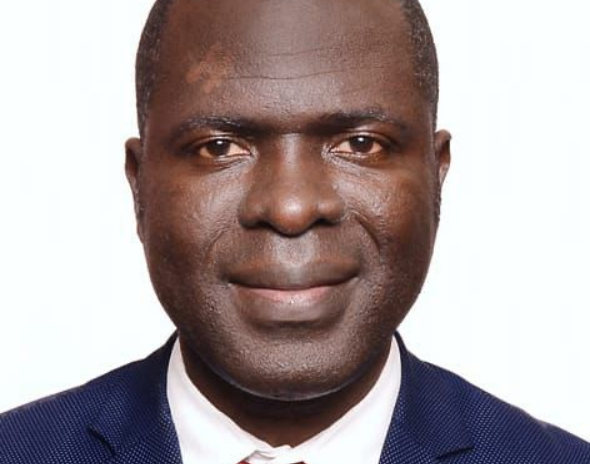
By: Austin S Fallah – A True Son of the Planet Earth Soil: [email protected]
Liberia stands at a critical juncture in its political history, engulfed in a climate where trust is a fragile commodity and clarity is a rare find.
Politicians rove the landscape like chameleons, adapting to the whims of power while leaving a trail of confusion and despair.
This adda argues that Liberia’s political environment is plagued by a new breed of politicians who prioritize personal gain over national progress.
As citizens of this resilient nation, it is imperative that we recognize and reject the manipulation of our political landscape, refuse to be swayed by superficial gestures of goodwill, and forge a path toward genuine leadership that prioritizes the welfare of all Liberians.
To understand the current political climate in Liberia, we must first acknowledge the role of certain politicians who can only be described as “confusionists” or “political hoppo-joes.”
These individuals exploit the sincere hopes and aspirations of their constituents, confusing them with promises that mask their true intentions. Driven by self-interest, these politicians often lead with short-term motivations that further entrench the socioeconomic divide in our society.
Instead of empowering the downtrodden, they perpetuate a cycle of dependency that keeps the marginalized trapped in the gutters of poverty.
Liberians need to stand firm and discern who among them is a true nationalist devoted to uplifting the nation.
The long history of political manipulation in Liberia has bred an environment of skepticism and disillusionment.
Many voters, particularly in economically vulnerable communities, find themselves caught in a cycle of political patronage where their votes can be bought for a mere USD $25.00, a 25-50-100 pound rice bag.
This transactional approach to democracy undermines the very fabric of our political system.
Political engagement should not be commodified; rather, it ought to be seen as a sacred trust, a contract between the electorate and their representatives that demands accountability and transparency.
By accepting these handouts, Liberians are granting permission for their leaders to continue neglecting their responsibilities to the people.
The reality is that these temporary financial incentives do not address the root causes of their challenges.
Liberians are not liberated by a mere $25.00, 25-50-100 lbs bag of rice; they need comprehensive solutions that tackle poverty, lack of education, and healthcare deficiencies.
Their future, and the future of their children, hinges on the decisions they make today.
Thus, they must engage in a paradigm shift, a movement from a transactional mindset to one of principled engagement, where they actively seek leadership that embraces the long-term welfare of their nation.
Liberians must reflect on what type of society they want to build for future generations.
If they continue to support leaders who are oblivious to the plight of their constituents, they risk sentencing their children to inherit a legacy of hardship.
The leadership they choose today will shape Liberia tomorrow.
Instead of casting their votes based on the momentary surplus of dollars offered in exchange for allegiance, voters must educate themselves on the policies and visions of their candidates.
A true nationalist seeks to unite a nation rather than further exacerbate divisions for personal gain.
A leader should inspire hope, not confusion; they should be visited not only by the wealthy elite but also by the common citizens, whose needs often go overlooked.
As constituents, they must play an active role in scrutinizing the credentials and commitments of those vying for political office.
Engaging in town hall meetings, participating in debates, and sharing information via social media platforms are essential for fostering civic awareness.
The more informed the electorate, the harder it becomes for politicians to manipulate the narrative.
By showing an unwavering commitment to transparency and accountability, they can cultivate a political environment where leaders understand that they are responsible for serving the public interest above their own ambitions.
Furthermore, citizens must articulate their expectations for political candidacy outwardly.
They should demand that aspiring leaders present comprehensive, actionable plans aimed at sustainably uplifting marginalized communities.
This involves creating an accountability framework in which all elected officials are held liable for their promises and actions.
The Liberian electorate must take ownership of the political process, using grassroots movements and collective action to foster change.
Only then will they be able to send a powerful message to self-serving politicians that enough is enough.
We must also encourage the younger generation to become increasingly engaged in the political process.
They hold the potential to redefine the political landscape by advocating for systemic change that benefits the entirety of society.
By fostering conversations about the importance of civic participation and voting, they empower their children to challenge the status quo.
Equally, by integrating political education into their schools, they can instill a sense of responsibility and urgency in young Liberians, teaching them the power of their voice and the importance of participating in democracy.
Beyond these educational efforts, they must also work to create an environment that promotes political integrity.
This includes advocating for stringent anti-corruption measures and ensuring that public resources are allocated equitably.
They must demand transparency in government spending and operations, safeguarding against the rampant corruption that plagues our institutions.
Additionally, the positive civil society must play an active role in monitoring the behavior of politicians, ensuring they adhere to ethical standards.
This collaborative approach will create a feedback loop between the electorate and government officials, promoting a culture of accountability.
Liberians must also recognize the need for socio-economic reforms that create an equitable landscape in which all citizens can thrive.
These reforms must focus on access to quality education, healthcare services, and opportunities for economic development.
They should create a social safety net that not only addresses the immediate needs of the poorest among us but also empowers them to become active participants in the economy.
Additionally, there should be an emphasis on local governance, allowing communities to have a say in decisions that affect their lives.
Empowering local governments to allocate resources can lead to a sense of ownership among community members and foster a culture of responsible governance.
If ordinary citizens are involved in governing their own communities, it becomes decidedly more difficult for disingenuous politicians to override their interests.
Liberia finds itself at a crossroads, where the choices we make today will reverberate for generations to come.
The persistent presence of political confusionists and self-serving opportunists threatens to obscure the nation’s potential.
Liberians must reject the transactional nature of political engagement and demand transformative leadership focused on collective advancement.
This moment calls for a reawakening among the electorate, a push for informed citizenship, grassroots organizing, and systemic reform that prioritizes the welfare of all Liberians.
By actively engaging in the democratic process and holding those in power accountable, they create the foundation for a vibrant society where equality, prosperity, and justice are the cornerstones of their national identity.
The time to act is now, not just for ourselves, but for the generations that will follow.
The challenge is great, but together, we can forge a brighter future for Liberia.
Support Independent Journalism
Your support helps FrontPage Africa continue delivering independent, credible, and impactful journalism. Every contribution strengthens our ability to investigate, inform, and hold power accountable while keeping quality journalism accessible to our readers.
Support our journalism or subscribe to receive the latest FrontPage Africa stories and updates.