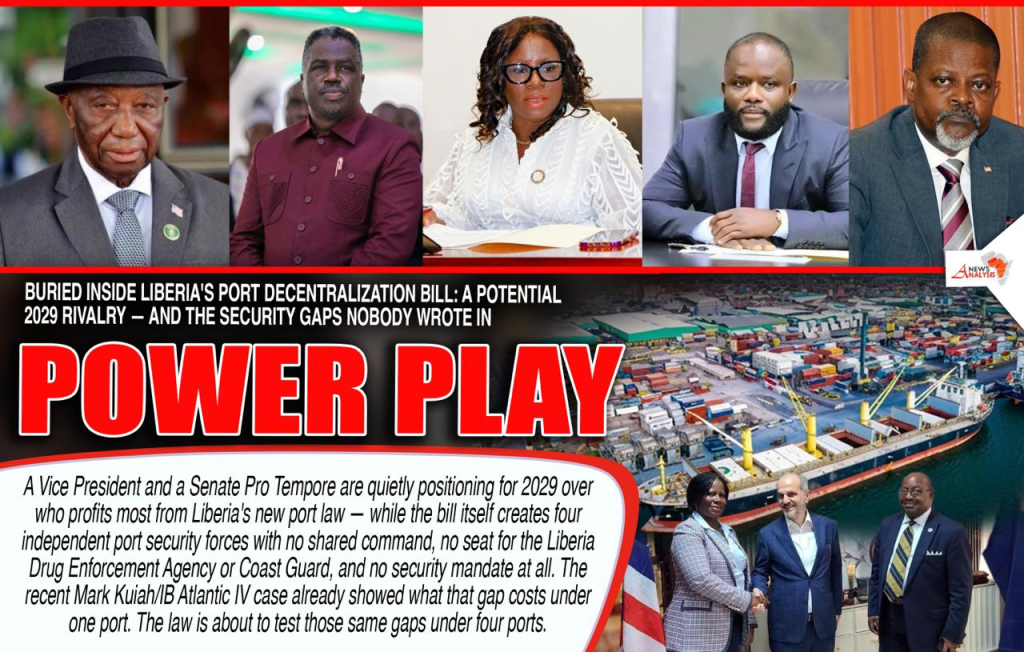
A Vice President and a Senate Pro Tempore are quietly positioning for 2029 over who profits most from Liberia’s new port law — while the bill itself creates four independent port security forces with no shared command, no seat for the Liberia Drug Enforcement Agency or Coast Guard, and no security mandate at all. The recent Mark Kuiah/IB Atlantic IV case already showed what that gap costs under one port. The law is about to test those same gaps under four ports.
By Rodney D, Sieh, [email protected]
Monrovia – There was a ceremony, a signature, and the kind of applause that photographs well. What the cameras did not catch is the quieter dogfight that has been building in the corridors of power for months underneath President Boakai’s decision to sign away the National Port Authority’s roughly seven-decade monopoly — one some insiders describe as a strategic, if premature, political play that could yet derail the president’s broader development agenda. In one corner stands Senator Nyonblee Karnga-Lawrence, architect of the legislation and a lawmaker hoping it transforms her home county, Grand Bassa, into something it has never quite been allowed to become. In the other stands Vice President Jeremiah Koung, from vote-rich Nimba County, watching a bill he has never publicly endorsed hand a rival exactly the kind of political win he cannot easily match.
The two have circled each other since the 2023 presidential campaign, when Boakai narrowed his running-mate shortlist to the pair before settling on the man from Nimba. It was a decision that left one camp elevated and the other, by most accounts, quietly stung. Their relationship has been strained ever since, and while recent speculation about a rift stems largely from prior positioning and legislative influence rather than any open, formal feud, the pattern is hard to miss for anyone watching Monrovia’s political class closely: two ambitious officials, both plausible 2029 contenders, each watching for the moment the other overreaches.
A Port City, and a Turkish Delegation
For Karnga-Lawrence, port decentralization is an unambiguous win: a path toward economic growth and “port city” status for Grand Bassa. After the president’s signature, she publicly praised House Speaker Richard N. Koon and the House for passing the Port Authority and Port Autonomy Bills, declaring flatly, “Grand Bassa will surely be a port city.” She has since announced that a special economic zone in the county is set to be contracted to a new company, a move she says will transform the local economy and add value to agricultural products.
That is also where the story gets murkier. Karnga-Lawrence’s posture and evident personal interest in the outcome have drawn public concern that she stands to benefit directly from decentralization. In January 2025, a visiting delegation from the Albayrak Group — an Istanbul-headquartered multinational conglomerate with interests spanning port operations, fleet rental and tourism — paid a courtesy visit to the Senate Pro Tempore in Monrovia. Both Karnga-Lawrence and Montserrado Senator Abraham Darius Dillon, who chairs the Senate Foreign Affairs Committee, have already faced public criticism over concerns about improper interactions with foreign entities regarding national assets like ports and infrastructure.
Vice President Koung, for his part, has favored a strong and efficient port system generally under the ruling Unity Party government’s ARREST Agenda, but has not publicly voiced support for decentralization specifically. Government insiders describe the bill’s signing as a clear edge for Karnga-Lawrence over a man widely seen as her most likely 2029 rival — a read reinforced by reports that the Albayrak Group is already positioned to take over the Buchanan port once the bill’s transitional clause restrictions are satisfied.
And all this depends on whether President Boakai eventually decides he will seek a second term.
What the Law Actually Creates
Set the politics aside and the legislation itself is straightforward on paper. In place of the National Port Authority, four autonomous, county-based port authorities — the Freeport of Monrovia, and the ports of Buchanan, Greenville and Harper — become independent bodies corporate, each with its own board, management team, budget, and power to sue, borrow, contract and set tariffs (§51, §53, §54). A companion law creates the National Ports Regulatory Commission, a three-member, presidentially appointed body meant to license, supervise and, if necessary, dissolve these autonomous ports. The National Port Authority does not vanish overnight; it continues operating for 18 months while a seven-member presidential committee plans its dissolution and divides its assets, liabilities and contracts among the four new authorities (§57). The new structure does not go live until 2028.
That is the reform on paper. Whether it is a safe reform depends on provisions the text simply does not contain — and this summer’s cocaine investigation has already produced a live case study of exactly where those gaps sit.
The Gap Critics Are Pointing To: Four Security Forces, No Unifying Framework
Section 54(5) of the Act gives each of the four autonomous ports the power to “operate its own security force which will have adequate police powers to enforce compliance with its regulations and by-laws.” Section 54(6) gives each port its own Harbor Master to “direct and regulate the movement of vessels within said port.”
Read those two provisions together and the structural problem becomes clear: the law creates four separate port security apparatuses, each answerable to its own board and its own Managing Director (§56.1), with no provision anywhere in either act establishing a shared command structure, a joint maritime domain-awareness system, or a mandatory information-sharing protocol between them — let alone with the Liberia Drug Enforcement Agency, the Liberia Maritime Authority, the Liberia Coast Guard, the Armed Forces of Liberia, or the National Security Agency.
Nowhere in the regulatory act’s list of Commission functions (§3) does the word “security,” “trafficking,” “narcotics” or “smuggling” appear. The Commission’s mandate — licensing, tariffs, technical, economic, transportation, logistical, health and safety standards — is explicitly about commercial and operational regulation. Counter-narcotics and maritime security are not written into either bill as anyone’s job. This is not a hypothetical concern. It is close to a description of what already happened this summer under the single, centralized system the bill is dismantling.
The Case Study: How a Docking Request Became a Five-Agency Pileup
The clearest evidence that these are not abstract worries did not come from a hearing room or a think tank. It came from a single letter, sent on July 13, while the port and airport system was still fully centralized under the very structure this bill just dismantled. Mark Egon Kuiah — then a sitting Deputy Director for Operations at Roberts International Airport — wrote to the Liberia Maritime Authority that day, not in his government capacity but as “registered agent” for a company called Madris Group of Companies Incorporated, a firm business records would later show he owned outright. The letter described a vessel, later identified as the IB Atlantic IV, as being in distress with propeller damage and requested docking privileges at the Freeport of Monrovia. LiMA rejected the request — the vessel was still in Sierra Leonean waters and had not docked anywhere yet was already being described as needing emergency access.
That rejection should have been the end of it. Instead, the vessel spent the better part of a week drifting in and around Liberian waters while three different institutions — LiMA, the National Security Agency, and the Armed Forces of Liberia — each told reporters a different piece of the story and pointed to one another when asked who oversaw the response. This newspaper’s editorial board has noted that the government’s own account of its response was that officials tracked which side of the Sierra Leone–Liberia maritime line the ship was on, day by day, and waited for it to drift fully into Liberian waters before ordering it searched, rather than intercepting it while the outcome was still in doubt. By the time an interception was ordered, the vessel had moved into deep water; Liberia’s Coast Guard, under-resourced for long-distance pursuit, could not catch it, and the country had to request help from Ivory Coast and Guinea before the ship was finally detained in Abidjan. Investigators are still examining reports that a smaller boat approached the vessel at sea in the days after it first drew scrutiny and attempted to pass something aboard it.
Kuiah was dismissed by presidential order on July 30, in the same sweep that removed a police intelligence commissioner and an NSA deputy director and recalled a fourth official from an LDEA secondment — four people, three separate institutions, one signature. He has not been charged in connection with the July 13 letter, and the presumption of innocence still applies; but his case is now cited by this newspaper’s editorial board as the clearest illustration yet of a vulnerability the port bill does nothing to close: a single well-placed insider, operating through a private company rather than his official title, was able to seek preferential port access for a vessel later at the center of a trafficking investigation — and it took a public records search, not any institutional safeguard, to surface the conflict. That is what a security lapse looks like inside one centrally managed port and maritime system, with a comparatively small number of institutions to hold accountable. The port bill does not explain what happens to that same vulnerability once there are four separately governed ports, each issuing its own docking approvals, each running its own security force, with no shared vetting standard or disclosure requirement written into either act.
Other Structural Gaps in the Bill Itself
Ironically, the board composition includes no security or maritime agency.
Each port board consists of two members per relevant county, a chairperson, and the Ministers of Justice, Finance, and Development Planning and Transport as statutory members (§55.2). There is no seat, standing or advisory, for the LDEA, the Liberia Maritime Authority, the National Security Agency, or the Coast Guard. Justice sits on the board; the agencies that issue docking clearances, track vessels and interdict drugs do not — the same gap the Kuiah case exposed at a single facility, now proposed to be replicated across four independent ones.
Private ports and concessions have almost no vetting criteria
Section 58 of the Act is one sentence: “The Government of Liberia shall utilize its power to grant concession(s) for private port operations in Liberia.” No security clearance standard, no ownership-transparency requirement, no counter-narcotics compliance obligation attaches to that concession power. That gap is not abstract — Kuiah’s own company, formed in 2018 for “fishing, fisheries, cold-storage and related import-export business,” is exactly the kind of private entity such a concession structure could touch, and the Act gives regulators no explicit tool to screen for exactly that overlap between a private commercial identity and a public port official.
Territorial radius creates jurisdictional seams — the same kind that let the IB Atlantic IV run
Section 52 gives each port a 30-mile radius of territorial control from its existing base. Liberia’s four ports are not evenly spaced along its roughly 350-mile coastline; a 30-mile radius from each leaf stretches of coast that fall inside no port’s jurisdiction at all. The IB Atlantic IV chase turned in large part on exactly this kind of jurisdictional ambiguity — Liberian forces reportedly held back for days because the vessel sat on the Sierra Leonean side of a maritime boundary, and by the time it crossed into unambiguous Liberian jurisdiction, it had drifted into deep water the Coast Guard could not follow. A law that creates four new, smaller jurisdictional zones without a unifying maritime security mandate risks multiplying that same “whose water is this” problem rather than resolving it.
The offenses section is about property and unpaid dues, not contraband
Section 60 of the Act — the only enforcement and penalties section in either law — criminalizes willful damage to port property, evading tariffs, discharging firearms in port, and giving false vessel information. “Contraband” is defined in the terms section (§50), but no offense in §60 attaches to it. Enforcement against smuggling and trafficking through the ports is left entirely to laws outside this Act, with no integration or cross-reference built in.
The 18-month runway is unassigned
The transition clause (§57) is, as FrontPageAfrica has previously noted, either the most responsible feature of the law or the most convenient. It buys time to build the missing security framework — but nothing in the text obligates the administration to use it that way. The Act requires the dissolution committee to produce an asset-and-liability plan within six months (§57.2); it does not require a maritime security plan on any timeline at all.
Why the Near-Term Risk Is Not Theoretical
The backdrop against which this bill was signed is not background color; it is the closest thing Liberia currently has to a live-fire test of the system the law proposes to replicate four times over. Since June, Liberia has processed a $19.2 million cocaine seizure at Roberts International Airport, where cargo was falsely declared as food seasoning and textiles — the case that first named Mark Kuiah in a writ of arrest while he was still a sitting deputy director.
It has processed a record $317 million cocaine seizure in Duazon, Margibi County — nearly four metric tons, found in a warehouse raid that investigators say followed more than a year of surveillance into networks active since 2018. It has processed a convoy escort scandal in which, according to Liberia’s own police chief, cocaine was allegedly moved through the capital escorted by two of his own senior commanders in marked police cruisers.
It has processed a presidential purge removing or suspending ten officials across five different agencies in a single week, after the country’s own inspector general said the trafficking had been “definitively sanctioned by state actors at very, very senior level” — without saying who. And it still has not resolved the IB Atlantic IV case, in which a single vessel exposed, in this newspaper’s own words, “a government that cannot yet tell its own citizens what is moving through its waters.”
Against that record, FrontPageAfrica’s editorial board argued directly that the sequencing of the port bill was “close to indefensible”: a country that cannot yet explain who let two record shipments through a single, centrally managed port and airport system has not demonstrated it can secure four independently managed ones. The board’s proposed fix — pause final passage, or at minimum write a single, unified maritime security and counter-narcotics authority with clear jurisdiction across all four ports into the bill before signing — was not adopted. The law as signed does not contain that authority.
President Boakai vetoed earlier versions of this legislation twice, citing exactly this category of concern — risks to Liberia’s international maritime security obligations, in his own language returning the bill to the Legislature. Minister of State Samuel Stevequoah has said the president signed this week on the advice of the Minister of Justice. What specifically changed, on security grounds, between the rejected versions and the one now law has not been publicly detailed by the administration. The version signed still contains the same core architecture — four independent port security forces, a Commission with no security mandate, no interagency coordination requirement — that the earlier vetoes flagged, and that this summer’s cases have since tested in miniature.
The Bottom Line
The reform’s economic logic — ending decades of Monrovia-centered control that left Buchanan, Greenville and Harper starved of investment and local authority — is a legitimate policy goal on its own terms, and nothing in the bill’s text undermines that case. But the Act and its companion regulatory law, read on their own words, do not answer the question now being asked publicly: who is responsible for stopping traffickers from simply choosing whichever of the four newly independent ports has the weakest security posture, and what compels those four ports to coordinate before the structure goes live in 2028. This summer already produced a preview of what happens when that question goes unanswered inside a single port system. As written, the law creates the autonomy. It does not, on its face, create the safety net — and the 18 months before the new structure takes effect is, at this point, the only remaining window to write one in. Whether that window closes on a fixed vulnerability or a political victory lap for whichever camp, Karnga-Lawrence’s or Koung’s, comes out ahead by 2029, is a question this bill’s text alone cannot answer.
Support Independent Journalism
Your support helps FrontPage Africa continue delivering independent, credible, and impactful journalism. Every contribution strengthens our ability to investigate, inform, and hold power accountable while keeping quality journalism accessible to our readers.
Support our journalism or subscribe to receive the latest FrontPage Africa stories and updates.