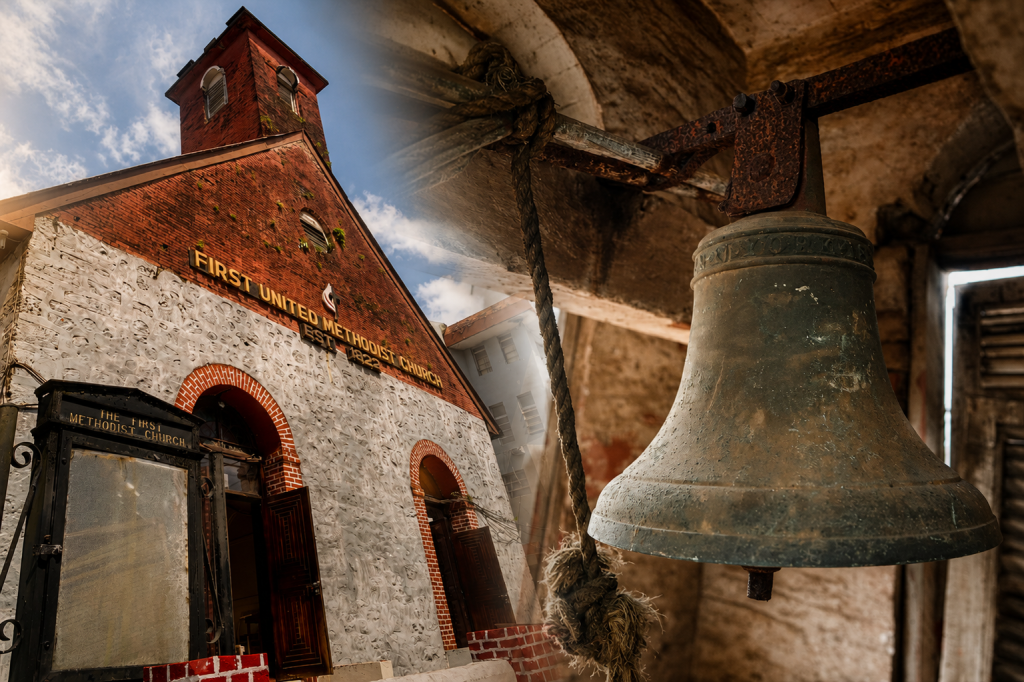
An 1835 bronze church bell at First United Methodist Church offers a rare surviving link between Liberia’s early Methodist community and 19th-century New York.
By Joel Maybury
On a Sunday morning in downtown Monrovia, an old church bell on Ashmun Street offers more than a familiar call to worship. It carries a direct sound from 19th-century New York—and a remarkable link to Liberia’s past.
The discovery begins with three of Monrovia’s most historic congregations.
Providence Baptist Church and First United Methodist Church were founded in 1822. First Presbyterian Church, also on Broad Street, followed in 1833. Together, they form a historic trio in Monrovia’s old quarter and remain central to remembering the arrival of the first free Black men, women, and children from the United States at Providence Island—then known as Dozoe—on January 7, 1822.
While researching Monrovia’s Historic Quarter during the bicentennial four years ago, I pondered whether the bells in these older churches might have stories of their own.
My Google search turned up Carl Scott Zimmerman, a St. Louis, Missouri campanologist, a person skilled in ringing bells, particularly in a church setting, and in researching bell history. Here was his initial response to my email inquiry: “Every week I respond to a variety of inquiries about bells, but yours is certainly unlike any I have previously encountered.”
Carl gave me a quick lesson about church bells. “Church bells are either cast bronze or cast steel. It’s usually easy to tell the difference, because bronze will usually weather to a greenish-gray color, while steel will rust to a brownish color.”
Then came the part that got me even more excited. “Furthermore, it has long been the custom of established makers of bronze bells to cast them with raised lettering that identifies the bellfounder, the city where he worked and the year in which the bell was cast. Since most bronze bells were individually custom made, there may also be a custom inscription requested by the buyer. The larger the bell, the more likely this is to be true. Conversely, the smaller the bell, the less likely it is to carry an inscription, and some are entirely anonymous. Steel bells, being generally mass produced using a different process of molding and casting, are highly unlikely to bear an inscription. However, their fittings are typically cast iron, and may at least bear an inscription identifying the maker. But they are much more likely to be completely anonymous than are bronze bells.”
I remember being excited at the prospect that the bells in Monrovia’s old churches could be made of bronze and that it would be possible to see the identifying information Carl mentioned. He urged me to send him photos of the bells to assist him in telling me more about the bells.
The church pastors shared my excitement. We talked about the tourism potential of historic bells. After all, the Liberty Bell in Philadelphia draws a crowd.
The first of the church pastors to send someone up a ladder of his church’s belfry to take some photos of the bell was then-First United Methodist Church Pastor Julius Yzk Williams. First Pres Presbyterian reported that their bell was of more recent origin and did not have inscriptions. Providence Baptist Church’s bell similarly had no inscriptions.
As soon as I received photos of the bell and the exterior of the church showing the belfry, I could make out what looked like F. FORCE, N. YORK, and 1835. I immediately forwarded them to Carl in St. Louis.
A few days later, Carl wrote back confirming that the inscription on the Methodist church bell should be read as E. FORCE, as it was made by Ephraim Force (1782-1857) of New York City. “He was a bell and brass founder, who worked at several different addresses in that city between 1807 and 1848. Several surviving bells by him are known; all are cast bronze.”
That wasn’t all. “New York City has always been a major port, and in 1835 the city also housed three major Methodist offices, one of which was the Missionary Society of the Methodist Episcopal Church. So, it is not surprising that the Liberian settlers would have communicated through that city to obtain a church bell. Unfortunately, there are no surviving records from the E. Force foundry, so that is not available as a source of historical information about this bell.”
The mid-1830s marked a period of heavy infrastructure building by the American Colonization Society (ACS) and the Methodist, Baptist, and Episcopal mission boards in Liberia’s coastal settlements like Monrovia, Bassa Cove, and Cape Palmas. Because West Africa lacked specialized bell-metal foundries, everything from church bells to ship bells and fire engine components had to be ordered from New York of Philadelphia merchants and shipped across the Atlantic.
Carl found it interesting to see that the Methodist church was able to acquire a bronze bell just 13 years after the congregation was organized. “Even a smallish bronze bell would be relatively expensive, so I can’t help but wonder whether the congregation raised the money for it or whether it was a gift, perhaps from (or via) the Missionary Society,” he wrote.
In 1835, the prominent figure coordinating New York-to-Monrovia missions was Reverend John Seys, who arrived in Liberia in late 1834 to oversee the expanding Methodist missions. He frequently petitioned the New York board for hardware, building materials, and church essentials. Funding came from targeted congregation donations to the Methodist Missionary Society, paired with logistics support from the ACS. Heavy materials like a church bell cast in mid-1835 were typically dispatched on the ACS-chartered supply voyages leaving the Port of New York. Prime candidates from that exact window would have been the brig Ruth or the ship Jupiter, both of which operated regular supply runs carrying emigrants, provisions, and church/school materials.
The campanologist offered this evaluation: “Bronze bells can last forever (barring fire, war, or other disasters), so except for a little internal wear from its clapper, this one should be in good shape. The various fittings and supports, being made of iron and timber, typically do not last as well.” Carl shared that this bell “looks very much like the only other E. Force bell I have seen. And it is in good condition as I expected. The tang-and-crossbolt mounting is an indication that this is a relatively small bell. The ironwork from which it hangs appears to have been made by a blacksmith, possibly local; I doubt that it is original.”
Carl’s final observation had to do with the church door and added an interesting social twist. “The twin-doored building could well be as old as the bell. In the early to middle 1800s, Protestant churches in America were often built that way to provide separate entrances for men and women; once inside, they sat in gender-segregated seating, i.e., families were not together. I doubt that practice still holds.” He was right about that.
Ephraim Force’s foundry suffered after 1835. On the night of December 16-17, 1835, the historic Great Fire of New York decimated the Wall Street and East River merchant districts, consuming over 600 buildings. Brass and bell foundries located in lower Manhattan’s slip areas suffered immense disruptions due to ruined inventory, lost ledgers, and shattered supply pipelines. Force survived the immediate financial panic and continued working out of the lower East Side, but the rise of massive, centralized operations – like the nearby Meneely Bell Foundry (established in Troy, NY) and West Troy works – began to heavily outcompete smaller Manhattan shops.
Force dissolved his regular foundry operations by the late 1840s. He died on Feb. 5, 1857, in Oyster Bay, Nassau County, New York, aged 74 or 75, and was buried in Hillside Cemetery in Madison, New Jersey.
When I shared Carl’s analysis and the story of Ephraim Force with the church, Pastor Williams told me he would conduct additional research about how the bell got to Liberia. I suggested that the church contact the Liberia National Museum to explore creating a photo exhibit about the historic bell.
Until then, the bell founded in New York City in 1835 may be the oldest object with a date and place marking anywhere in Liberia.
About the author: Joel Maybury served as the U.S. Embassy’s Deputy Chief of Mission in Monrovia from 2021 to 2023 during which time he began researching facets of Liberia’s history and its unique ties to the United States. His published works include articles about Liberia’s first First Lady Jane Rose Roberts, and about Cleveland Olmstead Luca, the celebrated African American pianist who wrote the score for Liberia’s national anthem, “Hail, Liberia, Hail!” He has given public lectures on the years President Joseph Jenkins Roberts lived and worked in Virginia before immigrating to Liberia.
Support Independent Journalism
Your support helps FrontPage Africa continue delivering independent, credible, and impactful journalism. Every contribution strengthens our ability to investigate, inform, and hold power accountable while keeping quality journalism accessible to our readers.
Support our journalism or subscribe to receive the latest FrontPage Africa stories and updates.