INTRODUCTION
In the intricate dance of international relations, the concept of spheres of influence offers a captivating lens through which we can explore how countries interact, compete, and collaborate on a global stage. Essentially, a sphere of influence denotes the territory or region where a powerful nation wields considerable authority or sway over the policies, economies, or security of neighboring, typically less powerful, states. This authority may not always be visibly enforced through invasions or formal treaties; rather, it often surfaces through methods such as political maneuvering, economic dominance, and military presence. Delving into the relationships between states through these varied spheres reveals a complex web where power dynamics are both uneven and interlinked.
By: Student Margaret Wewee Wright, Master’s candidate, Global Affairs Department, Cuttington University School of Graduate and Professional Studies.
Political Dimensions
At the political level, spheres of influence play a crucial role in shaping alliances, governmental structures, and diplomatic relationships. Take the Cold War era, for instance, when the world was starkly divided into two influential camps: the United States championing liberal democracy on one side and the Soviet Union advocating communism on the other (Gaddis, 2005). Each superpower endeavored to extend its ideological grasp by backing governments that mirrored its values, often creating ripples in the domestic politics of other nations. Fast forward to today, and we still see political influence actively at play. Organizations like the European Union (EU) and the African Union (AU) illustrate this dynamic well, where more powerful member states such as Germany in the EU and Nigeria in the AU tend to dominate decision-making processes (Nugent, 2017; Murithi, 2005). Weaker nations often align their foreign policies with these influential states, seeking political legitimacy, development assistance, or diplomatic security, thereby reinforcing the hierarchical structure within global politics.
Economic Interactions
Economically speaking, the idea of spheres of influence is reflected in the web of trade networks, investment flows, and financial dependencies linking nations. Major economic players like the United States, China, and the European Union command significant power over global markets. Consider China’s Belt and Road Initiative (BRI): this ambitious project extends China’s economic reach across Asia, Africa, and parts of Europe via infrastructure investments and trade agreements (Hillman, 2020). While this initiative fuels development, it also creates dependencies that may compel recipient nations to align with China’s political agendas (Shambaugh, 2013). Similarly, Western financial institutions such as the International Monetary Fund (IMF) and the World Bank have historically shaped the economic policies of developing countries through structural adjustments, influencing fiscal priorities to align with Western economic frameworks (Woods, 2006; Vreeland, 2003). In this context, the economic spheres of influence dictate not only trading relationships but also the policy options available to less powerful economies.
Military Implications
On the military front, spheres of influence heavily impact global security arrangements and the balance of power. The United States, for instance, maintains an extensive military presence worldwide through alliances like NATO, ensuring its strategic dominance in key regions such as Europe and the Pacific (Rynning, 2019). Meanwhile, Russia exerts its influence over parts of Eastern Europe and Central Asia through military interventions, as seen in Georgia in 2008 and Ukraine in both 2014 and 2022 (Mankoff, 2014). Not to be overlooked, China is actively expanding its military sphere, particularly in the South China Sea, signaling its rise as a significant military force on the international scene (Kaplan, 2014). These military spheres not only safeguard national interests but also serve to deter rival powers, often transforming regions into battlegrounds of competition rather than harmonious cooperation.
The Big Picture
Ultimately, the relationships among states are woven into a rich tapestry of overlapping and competitive spheres of influence. Political affiliations shape diplomatic ties, economic dominance influences growth trajectories, and military power secures or challenges the existing global order. While globalization has promoted interdependence among nations, it has also heightened the struggle for influence, as powerful states strive to broaden their reach while smaller nations navigate the complexities of competing interests. Grasping these spheres helps clarify why international relations remain a multifaceted blend of cooperation, dependency, and rivalry.
Impacts on Liberia and Its West African Neighbors
The dynamics of spheres of influence aren’t just an abstract concept; they significantly impact Liberia and its West African neighbors like Sierra Leone, Guinea, and Côte d’Ivoire. These countries are deeply intertwined with the political, economic, and military currents driven by larger global powers, which in turn shape their governance, economic strategies, and security policies.
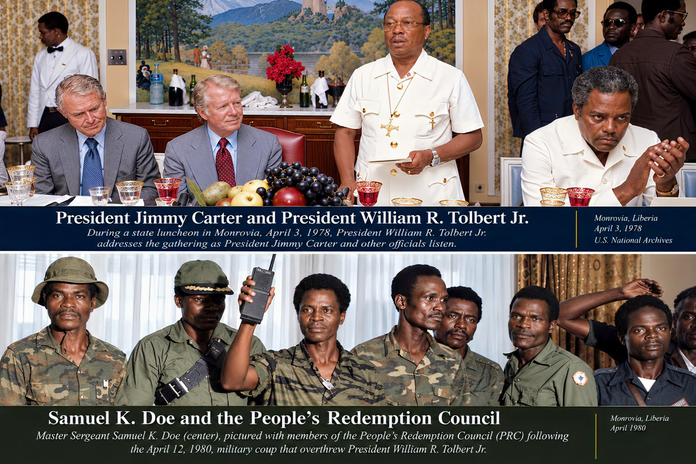
Politically, Liberia’s governance has been historically shaped by external influences, particularly from the United States. Established in the 19th century by freed African Americans under the American Colonization Society, Liberia’s early political framework mirrored that of the U.S. constitution (Dunn et al., 2001). This foundational connection continues to echo today, as Liberia maintains robust diplomatic ties with Washington. American support remains a pivotal factor in Liberia’s political landscape, guiding not only its domestic policies but also its international relations (Azango, 2018). This interaction exemplifies how spheres of influence can steer the trajectory of smaller nations within the overarching currents of global politics.
Conclusion
By understanding these frameworks, we can better comprehend the evolving landscape of international relations and the profound impact of global powers on the trajectories of nations like Liberia.
References
(BRI) Hillman, J. E. (2020). The emperor’s new road: China and the project of the century. Yale University Press.
Gaddis, J. L. (2005). The Cold War: A new history. Penguin Books.
Nugent, N. (2017). The government and politics of the European Union (8th ed.). Palgrave Macmillan.
Murithi, T. (2005). The African Union: Pan-Africanism, peacebuilding, and development. Ashgate.
Woods, N. (2006). The globalizers: The IMF, the World Bank, and their borrowers. Cornell University Press.
Vreeland, J. R. (2003). The IMF and economic development. Cambridge University Press.
Shambaugh, D. (2013). China goes global: The partial power. Oxford University Press.
Rynning, S. (2019). NATO’s futures: The Atlantic alliance between power and purpose. Journal of Strategic Studies, 42(2), 171–190.
Mankoff, J. (2014). Russia’s latest land grab. Foreign Affairs, 93(3), 60–68.
Kaplan, R. D. (2014). Asia’s cauldron: The South China Sea and the end of a stable Pacific. Random House.
Azango, M. T. (2018). America’s role in Liberian state formation. Liberian Studies Journal, 43(1), 23–45.
This essay was part of the International Relations Theory and Practice taught by Cllr. Phil Tarpeh Dixon, and supervised by Dr. Akiah P. Glay (Ph.D) Professor at the Cuttington University Graduate School of Global Affairs and Policy.
Support Independent Journalism
Your support helps FrontPage Africa continue delivering independent, credible, and impactful journalism. Every contribution strengthens our ability to investigate, inform, and hold power accountable while keeping quality journalism accessible to our readers.
Support our journalism or subscribe to receive the latest FrontPage Africa stories and updates.