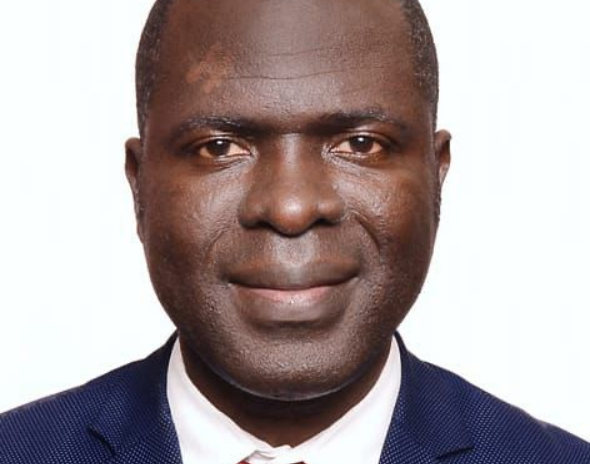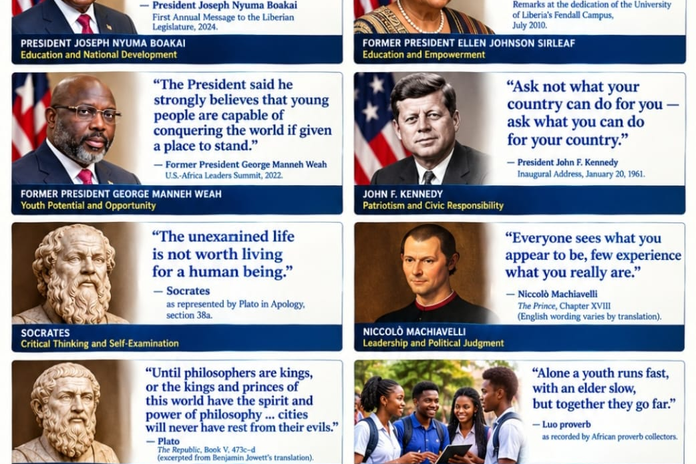
President Joseph Nyuma Boakai:At the signing of the 2023 Farmington River Declaration, then-Unity Party standard-bearer(now President of Liberia) Joseph Boakai emphasized:
“Your commitment to place national interest above personal and partisan concern…”
By: Austin S Fallah – A True Son of the Planet Earth Soil. [email protected]
He also argued:
“Election is not an event. It is a process which must not be merely observed but monitored…” The United Nations in Liberia.
This is particularly relevant to the distinction between partisanship and citizenship: partisan allegiance should not automatically override national interest.
Former President George Weah:In his 2017 victory speech, Weah said:
“To other political parties, we are not enemies. We welcome you with open arms as we all strive to build our country.”
He added: “This election was a contest in ideas, and not a clash of political personalities.” Vanguard News.
This provides an excellent distinction between partisan competition and political hostility.
A citizen can strongly support one party while still recognizing the legitimacy and contribution of people who support another.
Former President Ellen Johnson Sirleaf:In her 2006 inaugural address, former President Sirleaf made an even broader distinction between patriotism and loyalty to political power:
“Patriotism does not mean blind loyalty to power.”
She continued by arguing that citizens may demonstrate patriotism by peacefully opposing government policies:
“Sometimes the highest demonstration of patriotism may well be seen when citizens peacefully and respectfully express their opposition to particular policies proposed by those elected to govern them.”
This is extremely important to understanding political allegiance: support for a government is not synonymous with patriotism, and criticism of a government is not necessarily disloyalty.
Liberia’s political parties: Peaceful competition rather than political warfare:In the same 2023 declaration, Liberian political parties committed themselves to resolving disputes through:
“mediation or through legal means” rather than violence.
Political parties had committed to preventing:
“electoral violence, impunity, and injustice.” The United Nations in Liberia.
This provides a useful framework: political allegiance becomes dangerous when loyalty to a party or leader supersedes commitment to peaceful democratic rules.
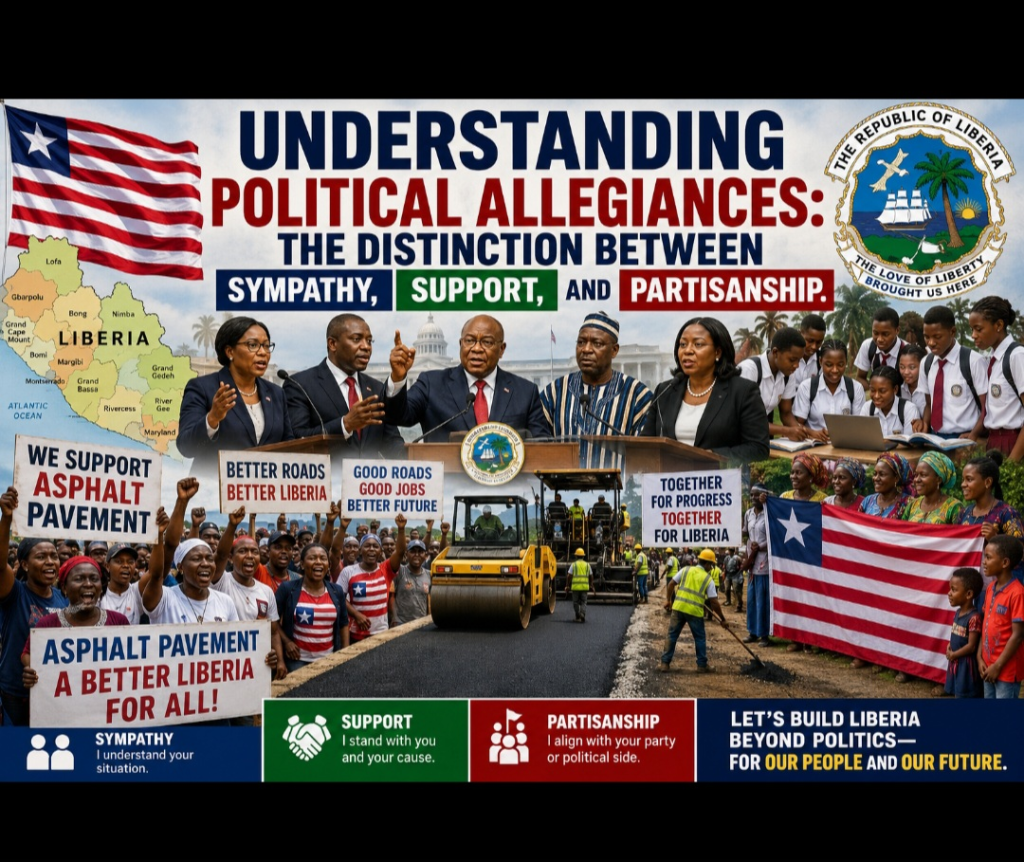
In the complex landscape of global politics, distinguishing between sympathizing with a political leader’s philosophy, supporting a political agenda, and being a partisan of a particular party remains a crucial aspect of civic engagement.
This distinction is particularly evident in a nation like Liberia, where the interplay of personal beliefs, political rhetoric, and party loyalty shapes the political discourse.
Understanding these differences is vital not only for the citizens of Liberia but also for political observers and participants worldwide.
This disquisition explores the nuances of political support, highlighting that advocacy for certain policies or philosophies does not inherently equate to partisanship.
Political philosophy represents the underlying principles and ideals that guide a leader’s vision and approach to governance.
A notable example of this distinction is evident in the ongoing discourse surrounding President Joseph Nyuma Boakai of Liberia.
Many citizens admire Keh-Keh President Boakai’s commitment to improving the nation’s infrastructure, specifically his goal of asphalt pavement roads across the country.
This admiration stems from recognition of the role enhanced transportation infrastructure plays in economic development, not necessarily from allegiance to the Unity Party.
People can acknowledge the importance of good roads for trade, education, and access to health care, while simultaneously maintaining an independent stance on party politics.
This situation is not unique to Liberia. Around the globe, individuals often find themselves endorsing the philosophies or policies proposed by leaders from opposing parties.
For instance, during his tenure, British Prime Minister Boris Johnson received support from various sectors of society for his “Build Back Britain” initiative after the COVID-19 pandemic.
Many citizens recognized the need to revitalize the economy despite their differences with the Conservative Party.
They recognized the need for drastic recovery measures, regardless of partisan loyalty.
Similarly, in the United States, political figures often garner public sympathy for their philosophies without drawing partisan lines.
For instance, Sen. Bernie Sanders has consistently advocated for universal healthcare and economic equality, which resonate with many Americans across the political spectrum.
Individuals who support these progressive ideals do not automatically align themselves as Democrats or Socialists; rather, they may appreciate the merits of universal healthcare without adhering to a particular political dogma.
In Liberia, support for President Boakai’s agenda, particularly his goal of creating a drug-free nation, reflects similar sentiments.
Liberians express concern about the negative impacts of drug trafficking and cartels, recognizing these issues as significant barriers to national progress.
The push to eradicate these problems, even if championed by the Unity Party, does not bind supporters to the party itself.
Instead, it reflects a collective desire for a safer living environment, free from the corrosive influences of narcotics.
The aspiration for a drug-free Liberia transcends partisan lines.
It aligns with broader goals of societal well-being and public safety, illustrating that political support can be issue-based rather than party-based.
Historically, political support has often been pronounced through movements rather than mere alignment with party structures.
Global events illustrate this further. The civil rights movement in the U.S., which fought for equality and justice, drew supporters from various backgrounds and political affiliations.
Many individuals who joined the movement were motivated by a shared ethical vision rather than allegiance to any particular political party.
The desire for social justice, equal rights, and the end of systemic racism was the unifying philosophy, not adherence to a Democratic or Republican agenda.
Similarly, movements like the Arab Spring in the early 2010s arose in multiple countries, with citizens united by a collective yearning for democracy, transparency, and reform rather than strict party affiliations.
In Tunisia, for instance, citizens rallied behind an idea of political change, seeking better governance and individual rights, without necessarily subscribing to the platforms of any specific parties that emerged during the transition.
The philosophical underpinnings of the movement centered on aspirations for a better society and governance, transcending mere political affiliations.
The distinction between sympathizing with a political leader’s philosophy and being a partisan is equally relevant in Liberia’s historical context.
The civil war that plagued the country in the 1990s and early 2000s left a fractured political landscape, with leaders from various factions advocating different ideologies.
Many ordinary Liberians understood the need for peace and reconciliation, supporting the philosophical undercurrent calling for national unity, even as different factions attempted to coalesce under unique party banners.
The Modern Liberian experience urges us to contemplate further the delicate relationship between personal philosophy and political identity.
The rise of diverse political parties in Liberia has often led to confusion among citizens regarding their political identities.
Many may support a leader’s initiatives based on tangible benefits, such as economic development or social reform, without intending to surrender their independent judgment to a political party.
This independent sentiment fosters a more robust democratic ethos by allowing citizens the flexibility to hold leaders accountable regardless of party affiliation.
The dynamic political landscape also introduces the concept of multilateralism, which emphasizes cooperation across different political and ideological lines.
In practice, cooperating on shared objectives illustrates a society’s ability to focus on pressing challenges rather than partisan squabbles.
A poignant example of this can be seen in post-war Liberia’s desire to rebuild through collaborative governance, a shared vision for national recovery and development that cuts across party affiliations.
This philosophy encourages citizens to view their leaders as facilitators for ideals rather than symbols of partisan division.
Understanding the difference between sympathizing with a political leader’s philosophy, supporting a party’s agenda, and being a partisan of that party remains critically important.
In Liberia and around the world, citizens can appreciate and support policies that lead to societal improvement while maintaining independence from specific political parties.
President Joseph Nyuma Boakai’s vision for better infrastructure and a drug-free nation illustrates that goals for societal change can garner collective support, free of partisanship.
As Liberians navigate the intricate relationship between political beliefs and party affiliations, it remains essential for citizens to advocate for their priorities without losing sight of their autonomy.
It is this independence that ultimately fortifies a democracy, where ideas and philosophies should reign supreme over party loyalty.
Therefore, it is paramount that political discourse embrace this nuanced understanding to foster a more engaged, informed, and independent citizenry capable of driving positive change in society.
Support Independent Journalism
Your support helps FrontPage Africa continue delivering independent, credible, and impactful journalism. Every contribution strengthens our ability to investigate, inform, and hold power accountable while keeping quality journalism accessible to our readers.
Support our journalism or subscribe to receive the latest FrontPage Africa stories and updates.