Rev, Dr. Myles Monroe. The purpose of the family is for civilization:
https://www.facebook.com/share/r/19LpdF4n3s/
“Destiny has no competition. Don’t compare yourself to others.
By: Austin S Fallah – A True Son of the Planet Earth Soil: [email protected]
The truth is, your journey is unique.
Run your race and wish others well.
What belongs to you will never miss you, and what belongs to someone else will never fit you.
Destiny is personal; it can not be copied.
When you spend time competing with others, you lose focus on the path Hala-Na-Meleka-God-Almighty designed for you.
Your only true competition is yourself.
Choose to encourage yourself instead of comparing and celebrating others.
Their success doesn’t stop yours. It proves that success is possible.
Run your race with patience and gratitude. Stay focused on your growth, your timing, and your calling.
Remember, destiny has no competition, so keep moving forward and wish it. Your light will shine, and nobody can stop it.”
President Joseph Nyuma Boakai: “Education is fundamental to Liberia’s renewal and growth in human capital.”
Former President George Manneh Weah: “The increasing cost of education in Liberia leading to non-enrollment, non-attendance, and frequent drop-outs is becoming counter-productive to our development goals.”
Former President Ellen Johnson Sirleaf: “Today, the experience shows that building schools, making them tuition-free and providing increased financial support was not enough.”
Former officials (Ministers) of the Ministry of Education, Dr. John Bernard Blamo, Dr. Henry Boima Fahnbulleh Jr., Hon.Jackson F. Doe, Dr. George S. B. Borley, Dr. Theophilus Sonpon: “Leaders must seize this opportunity to guarantee a free, quality, primary and secondary education for every child.” ” Liberia must transform the constitutional and statutory promise of free education into genuinely affordable, accessible, high-quality education—and finance it sufficiently to ensure that poverty never determines who gets an education and who does not.”
Dr. Jarso Maley Jallah — Current Liberian Minister of Education: “In Liberia, talent is abundant, but opportunity is not. And for too many of our young people, systems have failed them, not the other way around.”
Public views: Free education → equal opportunity → expanded access → human-capital development → poverty reduction → economic growth → national competitiveness.
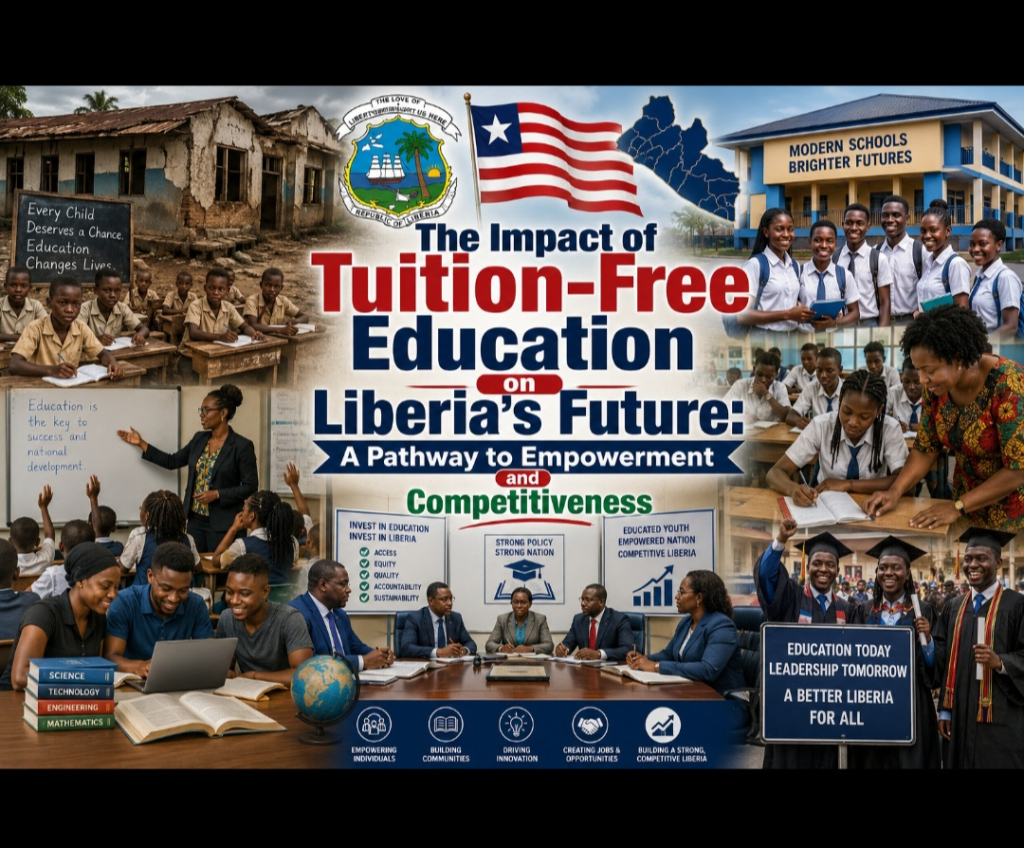
In recent announcements, Liberia’s Ministry of Education, under the Unity Party coalition government, is set to transition toward a tuition-free education system for all public schools beginning in the fall of the 2026-2027 academic year, and hopefully beyond.
This groundbreaking initiative, aimed at ensuring universal access to education, has the potential to revolutionize Liberia’s educational landscape, a nation that has faced significant challenges in this sector.
However, the success of this policy will depend on its implementation, the commitment of parents, the accountability of school administrators, and the overall engagement of the communities.
To understand the profound implications of this directive, it is essential to analyze the benefits it promises, the challenges it faces, and its historical context, including comparisons with Nigeria’s own educational reforms.
The Rationale Behind Tuition-Free Education:
The introduction of tuition-free education in Liberia is rooted in the fundamental belief that access to quality education is a right rather than a privilege.
For a country that has suffered decades of civil conflict, economic instability, and socio-political turmoil, this initiative represents a critical step toward rebuilding its human capital.
The government’s commitment to hold parents accountable for ensuring their children’s enrollment in school indicates a shift towards greater responsibility not only on the part of the state but also on families.
This dual accountability model aims to cultivate a culture where education is valued, thereby enhancing enrollment rates and educational outcomes.
Furthermore, the legal ramifications outlined for school administrators who impose unauthorized fees underscore the seriousness of this initiative.
By preventing financial barriers to education, the government aims to eliminate the cycle of poverty that has historically constrained many Liberian families.
Education must be recognized as a tool for emancipation, enabling individuals to become self-sufficient and contribute positively to society.
Historical Context: Learning from Nigeria’s Example:
Looking at Nigeria’s implementation of free education in 1976 provides valuable lessons for Liberia.
The Nigerian government’s move to eliminate school fees was primarily aimed at increasing literacy rates and ensuring that no child was denied an education due to financial constraints.
This policy led to a significant rise in enrollment figures, particularly among marginalized populations.
However, Nigeria’s experience also serves as a cautionary tale, illustrating how an ill-prepared or poorly executed educational reform can exacerbate existing challenges.
In Nigeria, despite the initial surge in enrollment, the quality of education suffered due to inadequate infrastructure, insufficiently trained teachers, and a lack of resources.
These issues ultimately led to educational disparities and a decline in standards.
Therefore, as Liberia embarks on this ambitious journey, it must acknowledge the pitfalls that Nigeria faced.
A successful implementation strategy should include investments in teacher training, curriculum development, and infrastructural improvements to ensure that educational quality matches the increased quantity of students.
Challenges Ahead: Implementation and Accountability
While the promise of tuition-free education is commendable, the path to achieving this goal is fraught with challenges.
Firstly, the commitment of both parents and school administrators will be tested.
The government’s reliance on parental accountability raises questions about the socio-economic realities that many families face.
In a country where poverty rates are high, and child labor is prevalent, some parents may struggle to prioritize education over immediate economic needs.
Thus, creating awareness about the long-term benefits of education and providing support for families may be necessary to foster consistent school attendance.
Moreover, the position of school administrators comes with inherent challenges.
The Ministry of Education’s emphasis on holding administrators accountable for any illegal fees necessitates a robust monitoring and regulatory framework.
Training administrators and ensuring their compliance with the new policies will be crucial to prevent exploitation and to uphold the integrity of the educational system.
Leaders within schools must also be equipped with the resources to handle increased student populations effectively, maintaining a conducive learning environment for all.
Equally important is the role of the broader community, including NGOs, local leaders, and civil society organizations, in advocating for educational reforms and supporting families in the transition to free schooling.
Positive grassroots mobilization will play a vital role in ensuring that communities understand the importance of education and the rights of every child to access it.
Promoting Quality Education: Essential Components:
Transitioning to a tuition-free education system is about more than simply eliminating fees.
Equally important are the strategies put in place to ensure that the education provided is of high quality and relevant to the 21st-century demands.
Liberia must prioritize curricula that foster critical thinking, innovation, and entrepreneurship, ensuring that students are equipped with the skills necessary to engage in a global economy.
Incorporating technology into classrooms, training teachers in pedagogical best practices, and emphasizing STEM (science, technology, engineering, and mathematics) education can empower Liberia’s youth to become competitive on the international stage.
Furthermore, promoting non-cognitive skills such as teamwork, resilience, and ethical thinking is essential to develop well-rounded individuals who can navigate the complexities of modern life.
Additionally, partnerships with international educational organizations and institutions can provide Liberia with the resources and expertise needed to strengthen its educational framework.
Leveraging global knowledge and best practices can enrich local teaching methods and curricula, fostering an environment that encourages innovation and critical engagement.
The Broader Impact of Education on Society:
Quality education has a cascading effect on various facets of society.
As more individuals gain access to education, the potential for higher literacy rates emerges, which can lead to improved health outcomes, reduced crime rates, and enhanced economic productivity.
Educated individuals are better equipped to make informed decisions, engage in positive civic activities, and contribute to the socio-economic development of their communities and their nation, Liberia.
Moreover, an educated populace can play a crucial role in breaking the cycle of abject poverty that has persisted in Liberia for generations.
By providing young people with the tools to uplift themselves and their families, the shift toward free education can bring about transformative change.
As Liberia reclaims its place in the intellectual community, it must also focus on fostering a sense of national identity and pride through education.
This involves incorporating local history and culture into the curriculum, ensuring that students not only become global citizens but also proud ambassadors of their heritage.
The initiative for tuition-free education in Liberia marks a significant turning point in the nation’s journey toward rebuilding its educational system.
It can serve as a model for other countries facing similar challenges.
However, success will require unwavering commitment from the government, parents, educators, and the broader community.
By learning from past experiences, particularly those of Nigeria, Liberia can avoid the pitfalls of rushed reforms and implement effective strategies that enhance both access and quality of education.
Ultimately, the goal of education is not merely to fill classrooms but to empower individuals to realize their potential and contribute positively to society.
Through a focus on critical thinking, innovative skills, and entrepreneurial mindsets, Liberia can enhance its competitiveness on the global stage and work toward lifting its citizens out of poverty.
The commitment to free education is an investment in the future, one that recognizes the value and potential of every child in Liberia.
With determination and collaborative effort, the promise of a brighter, educated future for the nation lies within reach.
Support Independent Journalism
Your support helps FrontPage Africa continue delivering independent, credible, and impactful journalism. Every contribution strengthens our ability to investigate, inform, and hold power accountable while keeping quality journalism accessible to our readers.
Support our journalism or subscribe to receive the latest FrontPage Africa stories and updates.