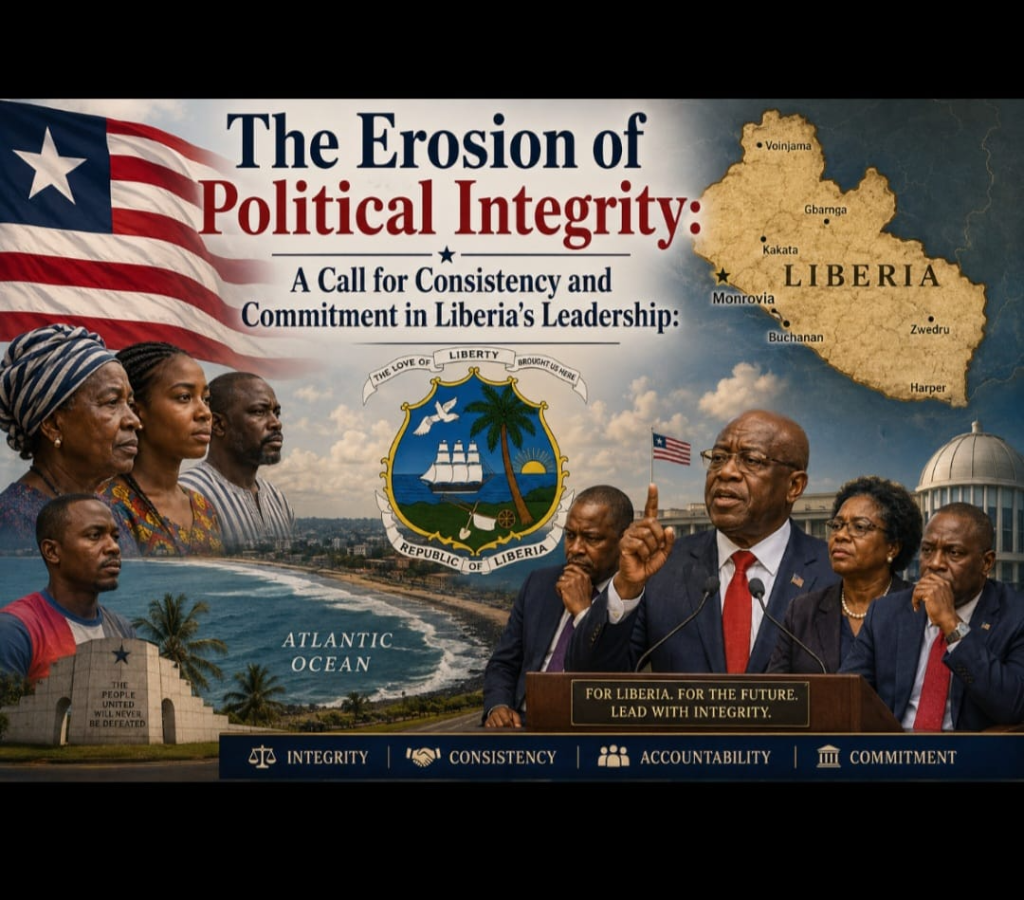
The erosion of political integrity demands a firm return to consistency, ethical governance, and deep commitment to the Liberian people.
Liberian presidents, politicians, scholars, and international leaders highlight the continuous struggle and call for integrity in Liberia’s leadership history.
President Joseph Nyuma Boakai: On transparency and asset recovery: “Those individuals who find themselves unable to provide a reasonable explanation for their sudden accumulation of vast wealth within a span of fewer than six years… will be required to present their case before the judiciary.”
President Boakai: On national unity: “We must reject the politics of hatred, insults, and revenge. Liberia does not need ‘Green Liberia’ or ‘Blue Liberia. Liberia needs ONE Liberia; united in diversity, governed by law, and committed to peace, justice, accountability, and development.”
Former President Ellen Johnson Sirleaf: On ethical governance and the role of women: “And when women are in charge, they demonstrate more integrity, more commitment, and they work harder.”
Former President George Weah: On corruption and accountability: “My government will be open. Anyone found guilty of corruption will be dealt with in accordance with the law. If you are corrupt, you will have to hang your boots.”
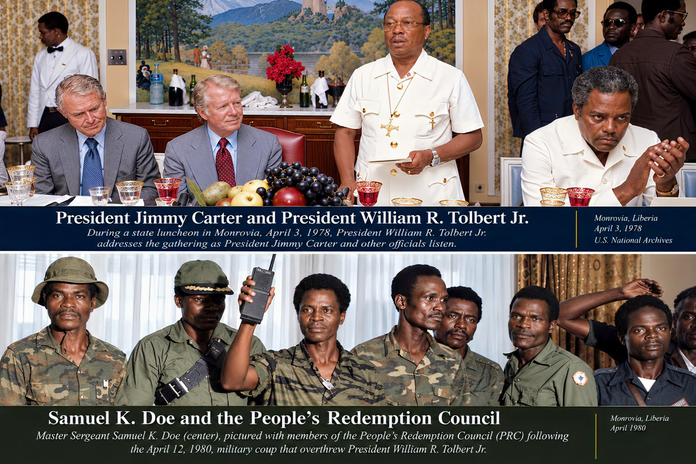
Former President William R. Tolbert, Jr.: On the fight against societal vices: “The Enemies of this Country to whom I refer are: Ignorance, Disease, and Poverty (IDP). Now, we must harness all our forces, for all our resources to bring our Enemies into subjugation, to conquer them, and to liberate our country.”
Former President William V.S. Tubman: On national unification: “Never before has unity of action been more desirable and urgent; never before have independent nations faced such a challenging and splendid opportunity for concerted action.”
Former President Samuel K. Doe: On the burden of public office: “Being head of state, you need support from God. A lot of people’s lives depend on you alone.”
Dr. Amos C. Sawyer (Former Interim President): On building solid systems rather than just seeking power: “If we build a capable state, it can administer to the people sufficiently that they will be happy, and the divisions will be minimized once the state is delivering.”
Dr. Togba-Nah Tipoteh (Economist, Scholar, Educator, Pan-Africanist, and Politician): On character as a prerequisite for leadership: “The Liberian people’s problem has been, they have evaluated politicians not based on character; instead, they have evaluated them based on popularity and intellectualism, if the candidate has dubious characters that compromise or undermine his or her integrity, the individual should not be voted into leadership.”
Dr. Henry Boima Fahnbulleh (Politician, Diplomat, Educator, Pan-Africanist, and Scholar)On political consistency and commitment: Known for emphasizing that true political integrity requires a revolutionary break from opportunistic cronyism, maintaining that leaders must subordinate personal material accumulation to the struggle for the empowerment of the masses.
Jimmy Carter (Former U.S. President): Praising Liberian leadership integrity: “Mr. President, by your sincere leadership, you are restoring to a weary world, refreshing new hopes of enterprise and prosperity, of liberty and morality.”
Kofi Annan (Former U.N. Secretary-General): On integrity in the developing world: “Good governance is perhaps the single most important factor in eradicating poverty and promoting development.” A guiding philosophy widely referenced in the discourse surrounding Liberian institutional and political reform.
By: Austin S Fallah – A True Son of the Planet Earth Soil: [email protected].
In the contemporary landscape of Liberian politics, a troubling phenomenon emerges: the rapid and unabashed shifting of allegiances among politicians in pursuit of personal gain.
This troubling trend not only reflects a lack of commitment to principles but also undermines more profound values of patriotism and national unity.
Clichéd yet revealing sayings proliferate among politicians, like “I will only sell bread where there is butter,” “I will only wash my clothes in a moving river, not in a bucket,” and “I will only hang my clothes where there is shining sun.” Such expressions, emblematic of the opportunism that plagues the political class, paint a disheartening picture of a system in which self-interest governs the nation’s collective welfare.
The endemic nature of political corruption, reflected in these sayings, serves as a catalyst for instability and inconsistency within Liberia’s political framework, thereby threatening the future of democracy and governance in the country.
Political Corruption: A Historical Context:
To understand the implications of this political opportunism, it is essential to acknowledge Liberia’s tumultuous history.
The specter of political corruption has loomed large over the nation’s governance for decades.
Since its founding, Liberia has been plagued by cycles of mismanagement and betrayal, where leaders have too often prioritized personal gain over the greater good.
The civil wars that ravaged the country between 1989 and 2003 can be partly attributed to governance failures, inefficiencies, and widespread corruption.
As a result, political integrity has suffered, and the distrust of the political class has only deepened over time.
In this context, the actions of politicians who switch allegiances in search of better opportunities highlight a broader systemic malady, one where the ideals of loyalty, commitment, and national service are compromised in favor of lucrative advantages.
Such behaviors are symptomatic of a political culture in which the ends justify the means, leading the populace to grow weary of political promises and to be demoralized by unfulfilled commitments.
The Cost of Political Inconsistency:
When politicians jump from one party to another in pursuit of personal gain, they degrade political discourse and undermine trust in democratic institutions.
The implications are far-reaching. Whether due to a longing for power, wealth, or influence, these leaders perpetuate a cycle of uncertainty that hampers long-term planning and development.
Moreover, such shifts reinforce a perception of political transactions as mere job opportunities rather than positions of responsibility and public service.
The metaphorical “monkey jumping from tree to tree” captures the capricious nature of these politicians and their inability to maintain a cohesive, principled stance.
Politicians who abandon their parties for others betray not only their constituents but also the ideals of transparency and dedication necessary to sustain a robust democracy.
This perceived treachery is notably disheartening for citizens who crave consistency and vision.
When future leaders witness their predecessors’ erratic behavior, the underlying message is that loyalty is expendable, undermining the possibility of forming a government grounded in steadfast principles.
The Danger of Opportunistic Politics:
Opportunistic politicians, driven by self-serving motives, create division and competition among political factions rather than unity.
This discrepancy leads to an environment in which collaboration is viewed skeptically, fostering animosity and hindering collective decision-making.
The bright ideal of democracy is overshadowed by the specter of backdoor dealings and shifting allegiances, leaving citizens questioning the very legitimacy of their leaders.
Moreover, these behaviors signal a lack of accountability. When politicians cite personal gain as their primary allegiance, citizens are left without any tangible means to hold them responsible for their actions.
In a democratic society, leaders are expected to serve with integrity and to place national interests above personal ambitions.
However, if switching parties becomes a norm, the social contract between leaders and citizens is effectively eroded, laying the groundwork for further disillusionment with the political process.
Reclaiming Political Ideals: Fighting Back Against Corruption:
Despite the significant challenges posed by opportunistic politics in Liberia, the path toward restoration is attainable.
By championing the values of integrity, loyalty, and commitment, the political landscape can be rejuvenated to foster trust in governance and enhance public faith in democratic institutions.
First and foremost, there must be an awakening of both political leaders and constituents around the need for consistent and principled governance.
This revival should focus on transparent practices that enable citizens to grasp their leaders’ intentions beyond mere rhetoric.
Initiating political education programs may galvanize the electorate, allowing them to recognize the negative implications of abandoning party allegiance.
Efforts could be made to encourage attendance at town hall meetings and to promote discussions that challenge oppressive narratives by actively engaging the populace.
Furthermore, to combat the allure of opportunism, political institutions should implement and enforce strict regulations that deter politicians from switching allegiances without substantive justification.
The introduction of legislative measures to regulate party hopping could impose penalties on politicians who engage in such behavior, thereby re-anchoring the focus on national benefit rather than personal gain.
Encouraging politicians to pledge allegiance to the party and the people they serve can create a culture in which loyalty abounds, dedication fosters unity, and politicians are viewed as representatives of the greater good.
The Power of a Cohesive Narrative:
The resonance of a cohesive narrative can redefine the political conversation in Liberia.
By cultivating inclusive campaigns and dynamic political agendas that prioritize the needs of the populace, politicians can reclaim the trust that has eroded over decades of opportunism.
Crafting messages that speak to collective progress and development—rather than the self-centered motives often highlighted- can change the framework of political discourse in the country.
Through grassroots activism, civil society organizations, and collaboration among political factions with shared values, there lies the potential for a renewed commitment to democracy.
Civic education and engagement should promote the virtues of loyalty to one’s party and considerations of collective wellbeing, as opposed to the “gravy-governance” mentality that has characterized too much of Liberia’s political landscape.
Embracing a New Political Ethos:
Moving forward, the nation must reject the notion that seeking personal gain is an acceptable or valid cause of political instability.
Instead, Liberians must embrace a new political ethos rooted in values of loyalty, integrity, and accountability.
Political leaders must embody the spirit of service, prioritizing the interests of their constituents over their ambitions.
Simultaneously, the electorate must advocate for change, demanding a culture of transparency and principled governance.
Only by uniting in the pursuit of a shared vision for Liberia can Liberians hope to transcend the ingrained patterns of opportunism and political corruption that have hindered progress for too long.
Without courageous action and a commitment to fostering trust through consistency, the ideals of democracy and governance will remain at risk, casting a long shadow over Liberia’s potential for growth and stability.
This awakening is critical; the nation can not afford to sink deeper into the quicksand of opportunism—its future depends on a courageous stand for integrity in the political arena.
Through collective efforts, Liberia can emerge from its tumultuous past and carve out a path toward sustainable democracy.
Support Independent Journalism
Your support helps FrontPage Africa continue delivering independent, credible, and impactful journalism. Every contribution strengthens our ability to investigate, inform, and hold power accountable while keeping quality journalism accessible to our readers.
Support our journalism or subscribe to receive the latest FrontPage Africa stories and updates.