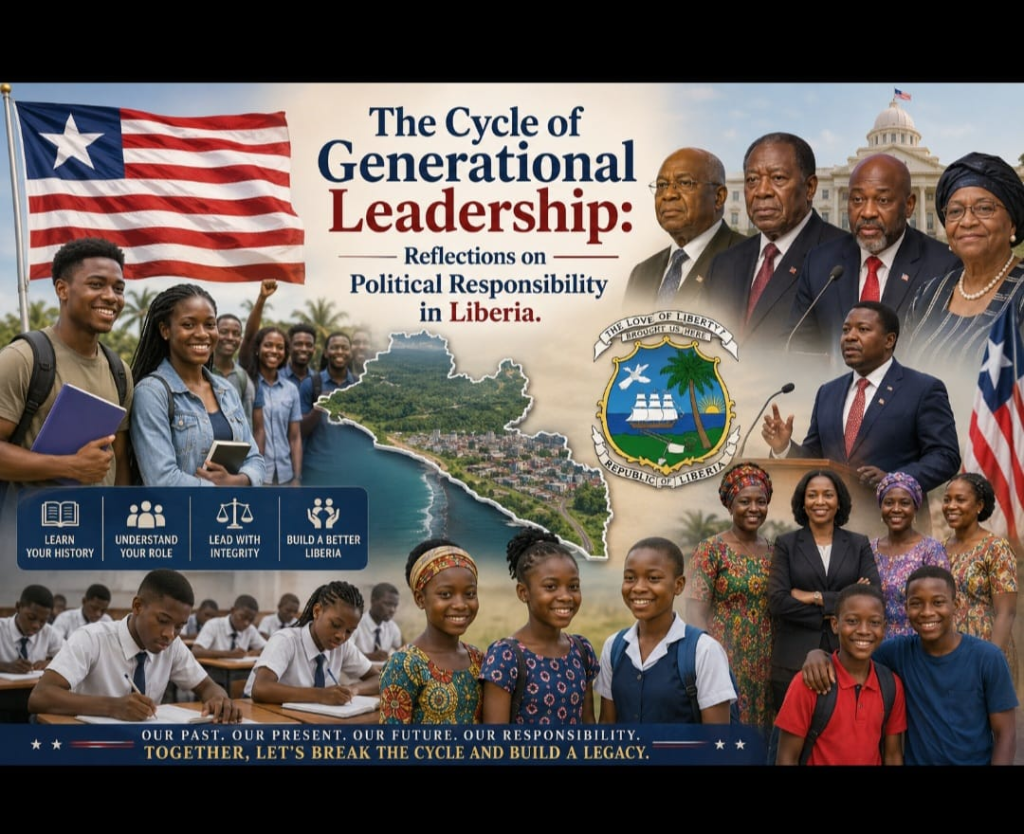
The cycle of generational leadership in Liberia highlights a profound shift from older political gatekeepers to an empowered youth demanding systemic reform, ethical governance, and accountability.
African Parables and Proverbs on Correction: “The world will teach the child who the mother does not teach.” (Meaning: Gentle correction at home prevents harsh punishment later in life).
“The young bird does not crow until it hears the old ones.” (Meaning: Young ones learn proper behavior by watching and following the elders).
“A tree is bent while it is still wet.” (Meaning: Training and correction must happen when the child or young animal is still young and flexible).
President Joseph Nyuma Boakai: “I fear not the next election; I am raising the next generation and building a legacy to lay the foundation for a greater Liberia.” He also emphasized citizen responsibility: “The real security is the citizens who are committed to making sure that Liberia is protected.”
Former President Ellen Johnson Sirleaf: “Leadership is never given on a silver platter; one has to earn it.” Addressing youth empowerment, she noted that young people must shift from silence to becoming the nation’s active conscience.”
Former President George Manneh Weah: “Reflecting on political transitions and governance, he asserted: “The people are suffering more than ever. Prices are rising. Promises are broken. But I have not given up on Liberia—and I will never give up on my people.”
Student and Youth Coalitions (Monrovia Dialogues): “Young academic leaders voiced that modern political responsibility requires mastering civic duty over political patronage, stating that true generational change means replacing elite cronyism with institutional merit.”
Civil Society & Religious Voices: “The Liberia Council of Churches articulated that national leadership must be anchored in moral courage, treating every citizen with dignity and rejecting the weaponization of the law.”
By: Austin S Fallah – A True Son of the Planet Earth Soil: [email protected]
Generational dynamics play a pivotal role in shaping the socio-political landscape of any nation.
Within the context of Liberia, the transition of political power from the Silent Generation and Baby Boomers to Generation X and Millennials, a cohort characterized by their experiences of instability and hardship during Liberia’s civil wars, has unveiled a paradox of expectations versus reality.
While the older generations assumed that their successors would foster an era of rejuvenation and advancement, the ensuing reality instead revealed a treacherous descent into corruption and fiscal mismanagement, drugs, and drug cartelism.
This disquisition elucidates the implications of generational leadership transitions, employing the case of Liberia to analyze how the youthful promise of the X and Millennial generations fell woefully short, ultimately forcing the elders to reassume their roles in governance for the country’s salvation.
Generational Characteristics and Expectations in Liberia:
The Silent Generation (1928–1945) and the Baby Boomers (1946–1964) witnessed the nascent years of Liberia’s political narrative, comprising a tapestry woven with independence struggles and post-colonial aspirations.
Having experienced a nation torn apart by conflict, these generations approached leadership with a considerable degree of commitment to national integrity, cultural preservation, and economic development.
Their political experiences shaped a vision of a stable and prosperous Liberia. Thus, they harbored substantial expectations that the succeeding generations, particularly some sons and daughters of Generation X (1965–1980) and Millennials (1981–1996), could translate that vision into reality.
The rationale behind this generational transfer was not merely coincidental; the leaders of the Silent and Boomer generations believed that those who had experienced the direct ramifications of civil unrest would be more morally attuned to the populace’s needs.
Moreover, the hope stemmed from the notion that younger leaders would be better equipped to understand and leverage new socio-economic paradigms in a rapidly globalizing world.
The idealistic view presumed they would possess a passion for reform, a fresh perspective on governance, and a commitment to equitable resource distribution.
The Reality of Governance: A Reflection of Corruption and Betrayal:
Contrary to the optimistic expectations, the handover of political power unveiled a stark reality: Generations X and Millennials, rather than ushering in a new dawn of progressive governance, engrossed themselves in nefarious practices marked by systemic corruption and drug cartelism.
The envisioned economic development and social upliftment devolved into a landscape characterized by depravity and exploitation.
Some members of these generations became metaphorically akin to “money-eating hyenas and vampires, smoking ebu,” indicating a voracious appetite for personal gain at the expense of public welfare.
In political contexts, corruption can brew from multiple sources: the seduction of power, socio-economic deprivation, lack of accountability mechanisms, and the absence of a culture of service to the public.
In the case of Liberia, the young leaders allured by the spoils of political office floundered under the weight of their responsibilities.
They misappropriated resources, implemented misguided policies, and largely paid no heed to the socio-economic suffering of the populace.
Essential state functions faltered as a result of this widespread corruption, with the public left to bear the brunt of deteriorating infrastructure, poor healthcare systems, and rampant unemployment.
The allure of political power, alongside the perceived ease of corrupt practices, appears to have eclipsed principles of integrity and service among many leaders of these younger generations.
A generation that had ostensibly suffered the consequences of a fractured nation seemed to exhibit a blatant disregard for building a future that would, in theory, break the cycle of mediocrity and poverty.
The Silent Generation and Baby Boomers: A Return to Leadership:
As the socio-political fabric of Liberia began to fray further under the bureaucratic negligence of its new leaders, the Silent Generation and Baby Boomers felt compelled to reinsert themselves into the political arena.
This involuntary resurgence speaks volumes about the perceived failings of Generations X and Millennials in their roles as custodians of national leadership.
Such a move is emblematic not only of a crisis in faith in the youth but also of the cyclical nature of power and governance, wherein the elders, upon recognizing the failure of their successors, sought to reclaim the mantle for the greater good of the nation.
This return is layered with complexities, including questions of legitimacy, generational conflict, and the potential for historical repetition.
The older generations wield accumulated wisdom and experience, yet their resurgence can also evoke skepticism from the very cohorts they had previously supported.
The potential inability to innovate and adapt in a rapidly evolving political landscape raises concerns about whether reverting to past leadership methods will truly pave the way for progress or merely perpetuate entrenched ignorance and self-serving governance.
Intergenerational Dialogue: Building Bridges for the Future:
One of the critical lessons from Liberia’s political saga is the significance of intergenerational dialogue and the alignment of governance principles that transcend individual aspirations.
It is not enough for one generation to scorn another for its failures; a collaborative approach must emerge in which the wisdom of older generations complements the enthusiasm and innovative perspectives of younger ones.
The Silent and Boomer generations have a wealth of experience learning from governance successes and failures, and they must engage actively with younger leaders in mentoring and nurturing a sense of national responsibility.
Conversely, Generations X and Millennials can revitalize the political landscape with their understanding of contemporary issues like globalization, technology, and social justice.
Such an alliance could engender a renaissance in political strategy, wherein progressive governance serves the populace rather than the privileged few.
The case of Liberia presents a compelling narrative on the dynamics of generational transitions in leadership.
The expectations placed upon Generation X and Millennials to ascend as custodians of social and economic development were met with disillusionment and despair as they succumbed to corruption and entitlement.
In response, the Silent Generation and Baby Boomers returned to the helm, not out of mere nostalgia, but as a necessary recalibration for the future of the nation.
As the global community continues to grapple with the complexities inherent in generational leadership, Liberia’s experience serves as a poignant reminder that prosperity requires collective responsibility, integrity, and collaborative governance.
The onus lies on all generations to combat the allure of corruption and privilege and to foster an environment where dedicated service to the community is both a revered ideal and a practical reality.
In an age characterized by rapid change, diplomatic dialogue across generations remains crucial in ensuring that the lessons of the past propel Liberia and other nations towards a brighter, more equitable future.
Support Independent Journalism
Your support helps FrontPage Africa continue delivering independent, credible, and impactful journalism. Every contribution strengthens our ability to investigate, inform, and hold power accountable while keeping quality journalism accessible to our readers.
Support our journalism or subscribe to receive the latest FrontPage Africa stories and updates.