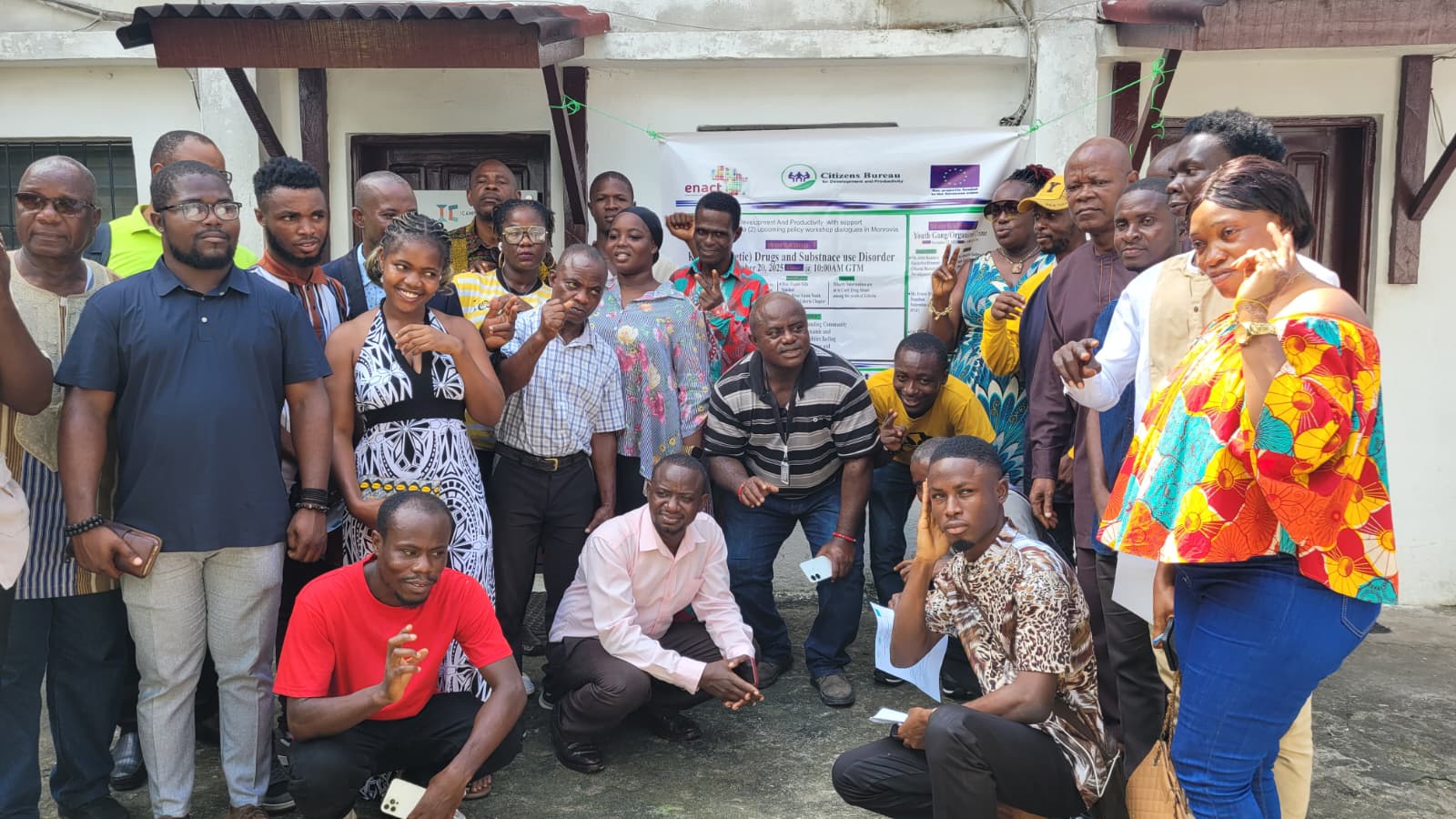
MONROVIA – The Citizen Bureau for Development and Productivity, in partnership with the Institute for Security Studies (ISS) as part of the ENACT Project, has completed a workshop discussing the rising problems of youth gangs, drug use, and organized crime in Liberia.
By Jaheim T. [email protected]
This workshop brought together a wide range of people including victims of gang violence, gang members, women’s organizations, community leaders, students, former police officers, and representatives from the Ministry of Justice and the Liberia National Police (LNP).
Making a brief remark, Citizen Burau, Executive Director John Kama, reiterated the organization’s commitment to promoting inclusive participation and collaboration in tackling these pressing issues.
Also speaking at the conclusion of the workshop, Accountability Lab Liberia, Country Director Lawrence Yealue reminded government officials about the ongoing drug crisis.
He urged them to set a good example by publicly undergoing drug tests and sharing the results to regain public trust.
Yealue pointed out that many young people are joining gangs not out of desire for violence, but because they feel compelled to do so as a means of survival. He stated:
“Young people are stepping in to fill the void left by failing institutions. When their needs for social support and jobs aren’t met, they come together in gangs—not for trouble, but to survive.”
He warned that if the government doesn’t address these gaps, more young people will continue to turn to gangs.
Youth Leaders Demand Inclusion
Several youth representatives also made statements and points during the event. Speakers included Patrick F. Wee, the Montserrado County Coordinator of the Federation of Liberian Youth (FLY), and Robert R. Whereboe, Executive Director of the African Youth Action for Sustainable Development. They criticized the government for focusing on youth groups that don’t truly represent Liberia’s most vulnerable young people, often labeled as “zogos.”
“These young people know their struggles better than anyone. They’ve formed small gangs to survive because they feel abandoned. If we want real change, we must listen to those who are most affected.”
However, Wee commended the Citizen Bureau for its ability to create a space where gang members, drug users, police officers, and community members can come together to talk openly.
He mentioned that organizations based on trust, rather than bureaucratic institutions, are crucial for making real changes.
“Citizen Bureau has the unique capacity to unite various groups, including drug users and police. No government body has achieved this because trust has been lost. To truly fight this issue, we must invest in where trust exists,” he stated.
FLY also highlighted that drug addiction is harming college students and young graduates, leaving them vulnerable and easily influenced by political groups.
Speaking for the LNP’s 108 Unit, DCP Joe Jerry Jones, expressed his concern for young people, noting that over 200,000 have been affected by drugs and gang activities.
He pointed out that simply policing the issue won’t be enough; a broader approach is needed:
“This problem affects us all. The gangs are our children. To tackle this, we need to start at home and in our communities, working together sincerely rather than pointing fingers.”
Jones explained that the crisis is rooted in weak family bonds, declining community leadership, and a loss of traditional values.
After extensive discussions, several vital points were agreed upon: Youth gang formation happens mainly because of poverty, unemployment, and lack of skills, rather than any desire for violence.
Accordingly, drug use plays a significant role in gang activity, as it fosters a sense of community and can lead to violence. Currently, rehabilitation programs are lacking and need improvement to be effective in helping individuals reintegrate into society.
According to the participants, to prevent small, desperate gangs from developing into larger criminal networks, Liberia must create a comprehensive strategy that combines prevention, police reform, rehabilitation, and job opportunities.
Support Independent Journalism
Your support helps FrontPage Africa continue delivering independent, credible, and impactful journalism. Every contribution strengthens our ability to investigate, inform, and hold power accountable while keeping quality journalism accessible to our readers.
Support our journalism or subscribe to receive the latest FrontPage Africa stories and updates.