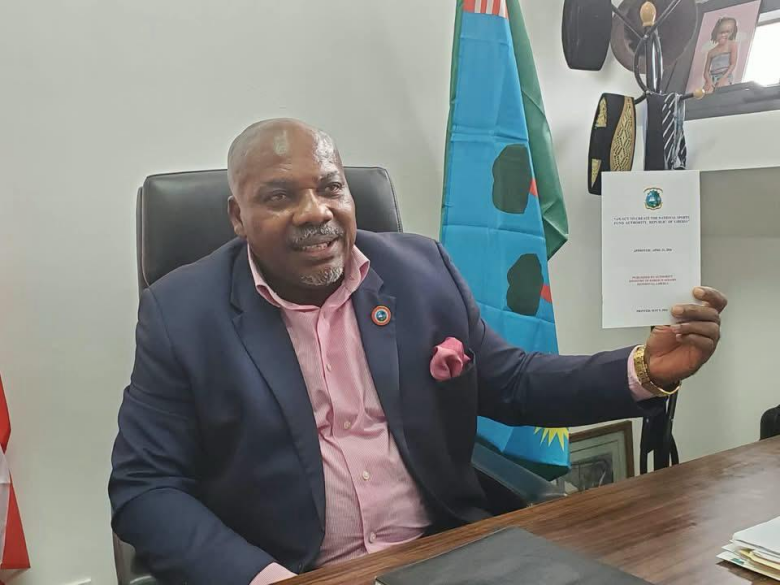
MONROVIA —Senator Jonathan Boycharles Sogbie of River Gee County who sponsored the legislation that established the National Sports Fund Authority, says the new authority could require an initial annual financial envelope of about US$12 million, with the amount potentially rising to US$18 million or even US$24 million as Liberia seeks to become more competitive in international sports.
By Christopher C. Walker | [email protected]
President Joseph Nyuma Boakai recently signed the National Sports Fund Authority bill into law, creating a dedicated mechanism intended to address one of Liberia’s longstanding challenges in sports inadequate and unreliable funding for national teams and athletes competing locally and internationally.
Speaking about the legislation, Senator Sogbie said the primary objective is to ensure that Liberian athletes and national teams no longer have to face the recurring problem of insufficient funding when preparing for international competitions.
“The idea of this bill is to simply enable us to have enough money to be able to participate in these competitions worldwide, not only to participate but to be a contestant,” Sogbie said.
Moving Beyond the “No Money” Problem
According to the River Gee County senator, Liberia’s disappointing performances at international competitions are not necessarily a reflection of a lack of talent.
Instead, he said, inadequate preparation caused by funding constraints has often placed Liberian athletes at a disadvantage.
Sogbie, a former Liberian footballer, argued that athletes need proper preparation, equipment, training opportunities and other forms of support if the country expects them to compete successfully against better-funded nations.
He said the new funding mechanism is intended to change that cycle by ensuring that resources are available ahead of major international sporting events.
“The idea is not just to send our people to participate,” he emphasized, but to create the conditions necessary for Liberians to compete seriously and challenge for results.
$12 Million Initial Target
Sogbie said the authority’s initial target is expected to be around US$12 million annually, although efforts are already being made to increase the amount.
“The initial envelope on top of our head for the running of the authority is $12 million a year, but recently we started looking for up to $18 million dollars, and this could go up to around $24 million,” he said.
The senator stressed that increased investment would be necessary if Liberia wants to become competitive across multiple sporting disciplines.
“If Liberia wants to be competitive, we have to be in all areas and we need to adequately support our people,” he said.
The proposed funding, according to Sogbie, is intended to provide broader support to Liberia’s sporting community rather than being concentrated on a single discipline.
All Sporting Federations to Be Included
Sogbie disclosed that the new authority will incorporate Liberia’s various sporting federations, with representation from the federations expected to form part of the Board of Directors.
The structure, he said, is designed to ensure that the country’s different sporting disciplines have a voice in decisions concerning the management and allocation of sports funding.
He also clarified that the authority will not replace or assume the responsibilities of the Ministry of Youth and Sports.
“This authority will not play the role of the Ministry of Youth and Sports,” he explained.
Instead, its central responsibility will be to mobilize and secure financial resources specifically for the development and advancement of sports in Liberia.
Sogbie Defends Accountability Measures
The creation of a dedicated sports fund has also raised questions about how the money will be managed and whether resources could be diverted to unrelated government programs.
Addressing those concerns, Senator Sogbie said the legislation clearly establishes that funds collected for sports must remain dedicated to their intended purpose.
He said the money cannot be redirected to finance unrelated government projects.
Sogbie further assured the public that administrators of the authority will be subject to government auditing and accountability procedures.
“This authority will function accordingly and in accordance with the laws,” he said, expressing confidence that implementation would not be a major challenge.
“I can tell you implementation will not be a problem,” he added.
Hailing the Legislature and President
The River Gee senator credited both chambers of the National Legislature and President Boakai for supporting the legislation.
He said the bill received overwhelming support from members of the Senate and House of Representatives before reaching the Executive Mansion for presidential approval.
Sogbie also thanked President Boakai for signing the legislation into law, describing the development as an important step toward creating a more sustainable financing system for Liberian sports.
For a country where national teams and athletes have repeatedly faced funding challenges ahead of international competitions, the new authority now carries the expectation of transforming how Liberia finances sports.
The bigger test, however, will be whether the promised funding can be mobilized, managed transparently and translated into the preparation and competitive performances that the legislation’s sponsors envision.
Support Independent Journalism
Your support helps FrontPage Africa continue delivering independent, credible, and impactful journalism. Every contribution strengthens our ability to investigate, inform, and hold power accountable while keeping quality journalism accessible to our readers.
Support our journalism or subscribe to receive the latest FrontPage Africa stories and updates.