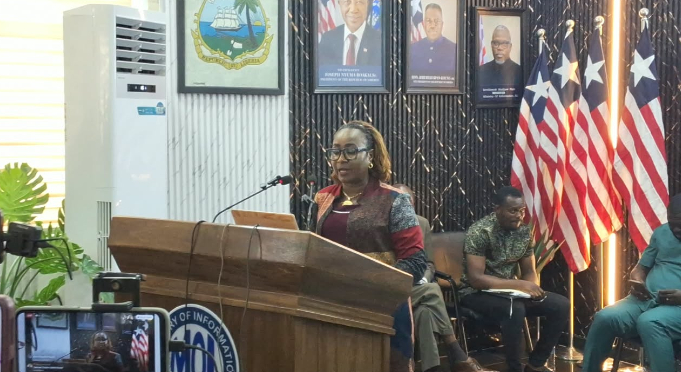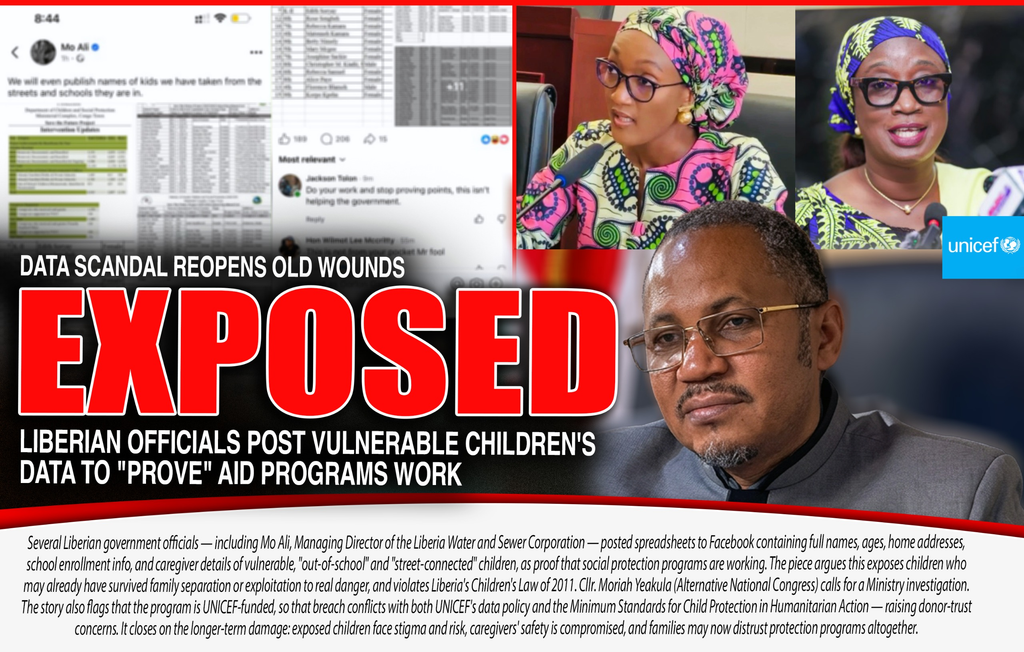
Monrovia – In Liberia, showing your work used to mean something simple — a photo of a handshake, a ribbon-cutting, a smiling child holding a new backpack. This week, several government officials, among them Mo Ali, Managing Director of the Liberia Water and Sewer Corporation, took “showing your work” somewhere it should never go: they published spreadsheets. Full names. Ages. School enrollment lists. Home addresses. The names of caregivers. All of it, posted to Facebook, as proof that the government’s social protection programs for vulnerable children are real.
By Rodney D. Sieh, [email protected]
The backlash was immediate. Commenters accused the officials of playing politics with children’s lives. But the deeper story here isn’t really about a bad social media post. It’s about what happens when a country still carrying the scars of two civil wars treats a child’s location as a talking point.
A generation that has already been found — and lost — before
Look closely at who’s on these lists, and a pattern emerges. These aren’t just any children. Many were flagged as “out-of-school” or “street-connected” — bureaucratic terms that, in Liberia, often sit quietly on top of a much harder story: family separation, displacement, exploitation. Decades after the guns went silent, the trauma from those years hasn’t simply evaporated. It shows up today in the same places — kids without stable homes, kids vulnerable to being used, moved, or sold.
These are precisely the children a protection program exists to shield. Publishing their addresses and school names doesn’t just embarrass an agency. It can hand a map straight to whoever they were removed from in the first place.
The law is not vague about this
Cllr. Moriah Yeakula, an outspoken voice in the opposition Alternative National Congress, didn’t mince words: “Vulnerable children’s data cannot be used as a chess piece in the cesspool of political buffoonery,” she said. “Not only were their names published, but their schools, addresses, and even their parents’ and caretakers’ information. That’s a violation of the Children’s Law, and the Ministry must investigate this breach.”
She’s not reaching. Liberia’s Children’s Law of 2011 grants every child a right to privacy, and the guidelines built into that law specifically address the disclosure of a child’s personal information to outside parties — the exact thing that happened here. This isn’t a gray area dressed up as one for political effect. It’s the kind of breach the law was written to prevent.
UNICEF’s fingerprints are on this too — and that matters
The project behind these lists is funded by UNICEF, which raises the stakes further. The international standard that guides child protection work in exactly these situations — the Minimum Standards for Child Protection in Humanitarian Action, built with UNICEF’s own participation — says that information on vulnerable children should only move with informed consent from children and their caregivers, and only under real confidentiality protocols. Nobody asked these families first. UNICEF’s own global data policy says much the same: personal data on the people it serves should only be processed for a legitimate, protective reason — not to win an argument on Facebook.
That gap between policy and practice is now a donor’s problem too. A breach at this scale — names, schools, addresses, caregiver contacts, all in one place — is the kind of thing that tends to trigger uncomfortable questions from funders about who, exactly, their local partners are trusting with sensitive data.
The quiet damage no one’s talking about
Beyond the legal violation, there’s a slower harm that will outlast this week’s outrage cycle. A child publicly tagged as “removed and reunified” carries that label into a new school, a new neighborhood — a target for bullying, or worse, for someone who remembers a name from a Facebook post. Caregivers who took in a child at real personal risk — grandmothers, aunts, foster families — now have their contact details sitting in public view, reachable by whoever they were protecting that child from.
And there’s a longer-term cost still: trust. Families who might otherwise report abuse or accept help from these programs will think twice if the lesson they’ve just learned is that their children’s private details can end up as a political prop. Once that trust breaks, it is notoriously hard to rebuild — and the children who need these programs most are the ones who pay for it.
For a country still working to heal from war, that’s not a cost Liberia can afford to shrug off.
Support Independent Journalism
Your support helps FrontPage Africa continue delivering independent, credible, and impactful journalism. Every contribution strengthens our ability to investigate, inform, and hold power accountable while keeping quality journalism accessible to our readers.
Support our journalism or subscribe to receive the latest FrontPage Africa stories and updates.