MONROVIA – A renowned Liberian Professional Engineer John Kpehe Boimah has sounded a caveat to the Legislature, to reject the proposed US$365M Pavi Fort–Al Associates (SL) Ltd Road Financing Agreement currently before it.
By Emmanuel Weedee-Conway
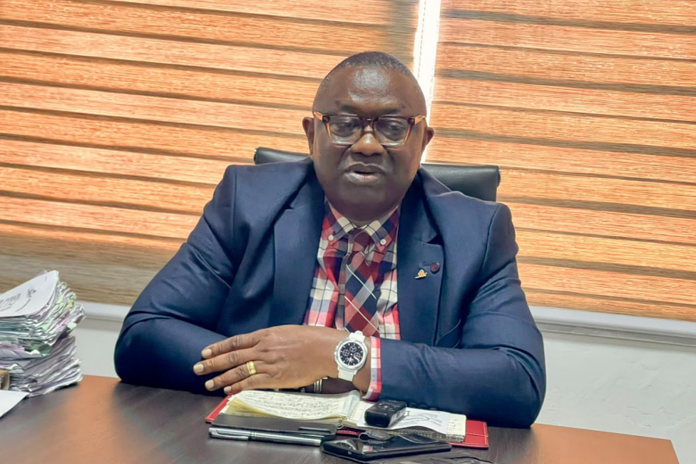
Engineer Boimah, Team Lead of Boimah Engineering Incorporated (BEL), in a statement described the proposed contract as “a dangerous precedent” that undermines national sovereignty and professional empowerment and as such, it must be rejected.
Engineer Boimah said the proposed concession, currently before the Legislature for ratification, risks plunging Liberia into another costly and ill-conceived infrastructure deal.
According to him, the deal is a repeat of the past failures, which left the country heavily indebted and structurally dependent on foreign contractors.
“This is not a matter of nationality—it is a matter of capacity, credibility, and accountability,” Boimah asserted.
“The evidence clearly shows that Pavi Fort–Al Associates (SL) Ltd lacks both the technical competence and financial depth to manage a project of this scale. Entrusting our national infrastructure to such an entity is an unacceptable risk. Liberia cannot afford another misstep that mortgages its future.”
Boimah, whose firm specializes in highway engineering, geotechnical investigations, and construction supervision, said his position is grounded in professional assessment and national interest, not politics.
He urged the Legislature to instruct the Ministry of Public Works to reopen the process and engage a qualified international firm through a transparent and competitive bidding process—one that guarantees value for money, technical integrity, and local capacity transfer.
In his caution to the lawmakers, Engineer Boimah outlined five major risks posed by the proposed concession, arguing that it represents a step backward for Liberia’s infrastructure and economic independence.
First, he stated that the deal would represent a systematic exclusion of Liberian professionals because it centralizes control of infrastructure projects, finances, and contracts in the hands of a single foreign entity.
He maintains that this structure sidelines Liberian firms and engineers from meaningful participation and restricts them to minor subcontracting roles—if any.
“This deal drains national wealth and marginalizes our own engineers. Liberian professionals are becoming spectators in the development of their own country,” Boimah warned.
Second, the renowned Liberian engineer stressed that the proposed concession would create job losses and professional empowerment.
He furthered that the concession’s framework allows limited or no leadership roles for Liberians. Senior technical and managerial positions would likely go to expatriates, leaving local engineers to perform low-level tasks.
“What message are we sending to our young engineers—that there’s no room for them in their own country’s development? This kills ambition and drives talent away,” he lamented.
Third, Boimah highlighted the absence of technical transfer and capacity building, indicating that the Pavi Fort–Al Associates deal contains no binding clauses for skills training, local subcontracting, or mentorship.
“We are not just building roads—we are building a nation. Without structured capacity transfer, we are locking ourselves into permanent dependence,” he cautioned.
Fourth, he states that the proposed agreement also sidelines local contractors and consultants, as millions of dollars in potential contracts and salaries will leave the Liberian economy, thus deepening poverty and weakening the middle class.
“This is an economic paradox: a development project that impoverishes those it should empower,” he said.
Lastly, Boimah warned that the agreement entrenched foreign control over Liberia’s critical infrastructure, eroding national self-reliance.
“True sovereignty means the ability to shape your own destiny. This deal surrenders that power. A nation that cannot build its own roads cannot build its future.”
Boimah called on the Liberian Legislature to reject the agreement and instead champion a Liberian-centered development model, a one that strengthens domestic engineering institutions, promotes transparent procurement, and invests in local expertise.
He pointed to Boimah Engineering Incorporated (BEL) and similar Liberian firms as proof of the country’s latent capacity. BEL operates under internationally recognized standards such as those of the American Association of State Highway and Transportation Officials (AASHTO) and the American Society for Testing and Materials (ASTM).
“Liberia has the expertise it needs. The Legislature must act with courage and foresight—to protect our national interest, empower Liberian professionals, and ensure that every mile of road built also builds Liberian capacity,” he added.
Support Independent Journalism
Your support helps FrontPage Africa continue delivering independent, credible, and impactful journalism. Every contribution strengthens our ability to investigate, inform, and hold power accountable while keeping quality journalism accessible to our readers.
Support our journalism or subscribe to receive the latest FrontPage Africa stories and updates.