
Summary:
- President Joseph Boakai received draft bills for Liberia’s proposed war crimes and anti-corruption courts just days after renewing the mandate of the office overseeing the process.
- The move follows weeks of public infighting over funding delays, transparency concerns and allegations that senior officials were undermining the process.
- Advocates say multiple competing draft bills and legislative hurdles now put pressure on lawmakers to unify efforts and move the process forward.
By Anthony Stephens, senior justice correspondent with New Narratives
President Joseph Nyuma Boakai on Wednesday received draft bills for a proposed war and economic crimes court and a national anti-corruption court, barely four days after renewing the mandate of the Office tasked with establishing the tribunals. Boakai had ordered it to work immediately with the Legislature to secure passage of the measures within 90 days.
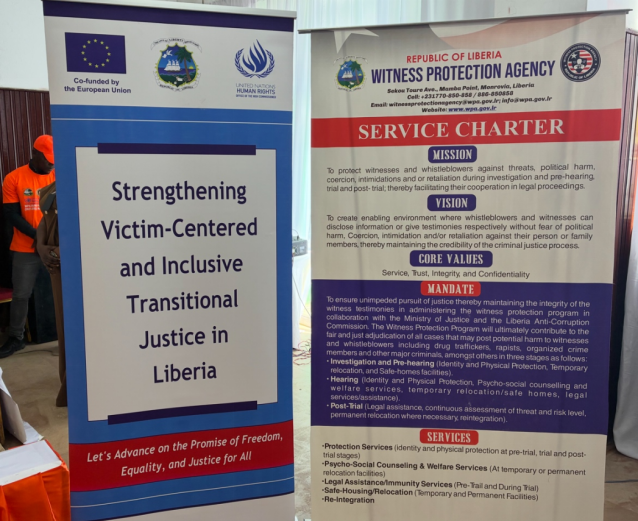
The ceremony brought together transitional justice advocates, victims and survivors’ groups, religious leaders, traditional chiefs and senior government officials, including Nathaniel Kwabo, the cabinet director. Barbu, who had accused accused Kwabo and other senior government offcials of not responding to him after he had shared the bills with them in December, said he had held wider consultations before putting the bills together.
“We engaged legal scholars, international justice experts, and anti-corruption practitioners who provided technical guidance to align the drafts with both Liberia’s constitutional framework and international standards,” Barbu said.
He said the Office had also reviewed “historical records, reports of past commissions including the Truth and Reconciliation Commission’s Final Report” and lessons from countries that had established similar courts.
“Our office has prepared the legislative engagement plan,” he said. “We have initiated dialogue with several members of the Legislature to build consensus and secure bipartisan support.”
Boakai, fresh from a trip to the United States where he received a prestigious peace award, used the ceremony to reaffirm his support for accountability and to reject suggestions that the process was driven by personalities or politics.
“It was intended to make people know that Liberia is a country with a rule of law, respect for humanity and a country that is determined to remove impunity,” Boakai said. “We want to thank all of you who have participated in this to make sure that we have this as a guide as to how people know that tomorrow, we cannot rule this country by taking up guns. We have issues, we discuss.”
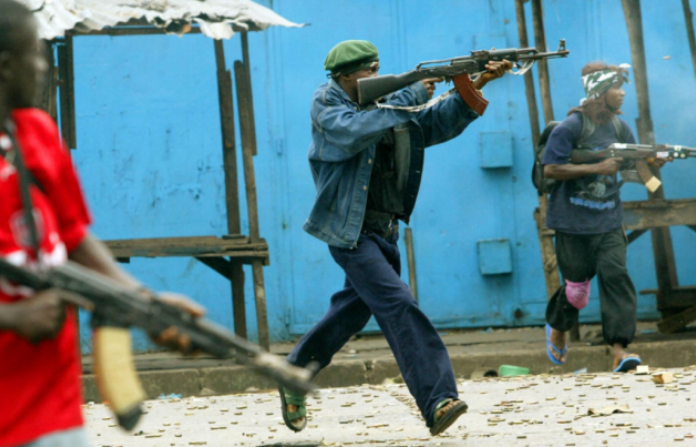
Justice advocates described the moment as a major breakthrough and said it was an important step toward establishing a long-delayed court to prosecute those accused of “bearing the greatest responsibility” for war crimes and crimes against humanity, including rape as a weapon of war, murder of civilians and prisoners of war, recruitment of child soldiers and forced labor.

“This is a defining moment for criminal accountability in Liberia,” said Tennen Tehoungue, a Liberian transitional justice expert.
Esther Yango, head of the Women NGO Secretariat of Liberia, a network of Liberian women’s non governmental organizations, who was also at the ceremony, said justice was essential to development and public trust.
“Justice is a cornerstone of development,” Yango said. “Without accountability, corruption thrives, trust in institutions erodes, and the most vulnerable, especially women and girls, continue to suffer.”
She urged that the process remain victim-centered, inclusive of women and transparent. “The establishment of these courts will not only address past wrongs but also serve as a deterrent against future abuses of power,” she said.

The submission came after weeks of public controversy that exposed divisions within the government over the court process.
The Office of the War and Economic Crimes Court had become embroiled in a dispute over funding, performance and internal coordination. Under last year’s mandate, President Boakai pledged the office $US2 million annually. So far, it has received only $US800,000 — 40 percent.
In a live radio appearance on Okay FM, Barbu accused officials including Justice Minister Oswald Tweh, presidential legal adviser Bushuben Keita and national security adviser Samuel Kofi Woods of obstructing progress, saying, “some people, they protecting themselves. Some people, they don’t want this government to get this particular thing to go.”
He also accused Tweh, his direct supervisor, of “avoiding me,” and complained that the Office was struggling financially.
Tweh later acknowledged that the government had withheld funding because “no government compliance spending plan was submitted,” though he dismissed Barbu’s allegations as “far-fetched, false and misleading.”
Woods’ office similarly rejected the accusations as “false, unfounded, and ill-fated.”
In the latest executive order renewing the office’s mandate — which Boakai suggested should be the last unless another extension becomes necessary — the president maintained the $US2 million annual allocation. But he directed that the funding remain a line item under the Ministry of Justice and ordered stricter oversight.
“The Office shall submit quarterly operational and financial reports to the President through the Minister of Justice, beginning no later than July 31, 2026,” the order said.
At Wednesday’s ceremony, Boakai did not mention the dispute. Woods was not present and did not respond to requests for comment. Tweh was also absent. He was represented by Cora N. Hare-Konuwa, the deputy justice minister for codification, who expressed the ministry’s support for the courts. Tweh did not respond to a request for comment about his absence.
Barbu’s direct presentation to the president came four months after he had first submitted the bills to Tweh and Keita. That submission itself came more than nine months after Barbu had repeatedly assured Liberians and the international community the bills would be ready “very soon.”
The delays helped trigger rival legislative proposals.
In October, Senate Pro Tempore Nyonblee Karnga-Lawrence and Senator Joseph Jallah introduced two separate bills for a war crimes court and an anti-corruption court that would route cases through Liberia’s domestic courts while excluding international crimes.
Rights advocates warned that the proposals could shield alleged perpetrators and weaken the credibility of the process.
At least two current lawmakers — Senators Thomas Yaya Nimely of Grand Gedeh and Edwin Snowe of Bomi — were named in Liberia’s Truth and Reconciliation Commission Report over alleged wartime and economic crimes respectively. Both men have denied wrongdoing. Yaya warned in 2024 that a war crimes court would “dismantle” the country’s peace.
As frustration mounted over delays, a coalition led by the Independent National Commission on Human Rights submited its own draft bill to the Senate, warning that further delays could push the issue into Liberia’s 2029 election cycle.
Before all of those efforts, the Liberian National Bar Association had submitted a separate proposal in 2021 that received broad support from civil society and international justice advocates.
The emergence of competing bills has prompted calls for harmonization.
Tweh recently told a high-level meeting that there was a “need for technical review and harmonization of the multiple draft bills.” Hare-Konuwa referred to the rival bills at Wednesday’s ceremony but provided no further details.
Barbu did not address the rival proposals directly in his speech. But he said his office’s bills “have undergone initial peer review,” and that they met national and international standards.
“We envisage public hearings when they are before the Legislature,” Barbu said. “We are ready to provide any clarification to Your [President’s] Cabinet, either collectively or individually.”
Martin Toe, chairman of the National Transitional Justice Working Group, one of the organizations that joined the Independent National Commission on Human Rights-led coalition, called for unity among the competing camps.
“The presentation should cautiously put to rest the debate concerning a legal framework of the War and Economic Crimes Court,” Toe said in a WhatsApp message. “Now, the ball is in the court of the Executive Branch, the Liberian Senate, Independent National Commission on Human Rights and the broader civil society to work together to bring justice to the victims and accountability of the civil wars.”
The Legislature, which has the constitutional authority to pass laws, is currently on its annual break. Barbu said he was prepared to continue engaging lawmakers.
Hassan Bility, director of the Global Justice and Research Project, Liberia’s leading war crimes investigators, urged lawmakers to back the process financially and politically.
“The burden now is on the Legislature to pass this into law,” Bility said in a text message. “The time is now. You need to stand where duty requires you to stand. Reduce your salaries and give more money to Jallah Barbu. If you don’t, it’ll be almost impossible for the court to get any funding.”
Tehoungue said lawmakers should not force victims to fight again for justice.
“Victim groups should not have to negotiate justice again,” she said by a WhatsApp text message.
Boakai also used the ceremony to reject a long-held claim by former warlords, including the late Prince Johnson and Yaya, that they were granted immunity from prosecution by the Charles Taylor government.
“You think that was enough?” Boakai said. “It was not enough. When you are part of the international world, they bring things, you ratify them, you are adding them to your laws. You think you can forgive yourselves?”

This story is a collaboration with New Narratives as part of the West Africa Justice Reporting Project. Funding was provided by the Swedish International Development Cooperation Agency which had no say in the story’s content.
Support Independent Journalism
Your support helps FrontPage Africa continue delivering independent, credible, and impactful journalism. Every contribution strengthens our ability to investigate, inform, and hold power accountable while keeping quality journalism accessible to our readers.
Support our journalism or subscribe to receive the latest FrontPage Africa stories and updates.