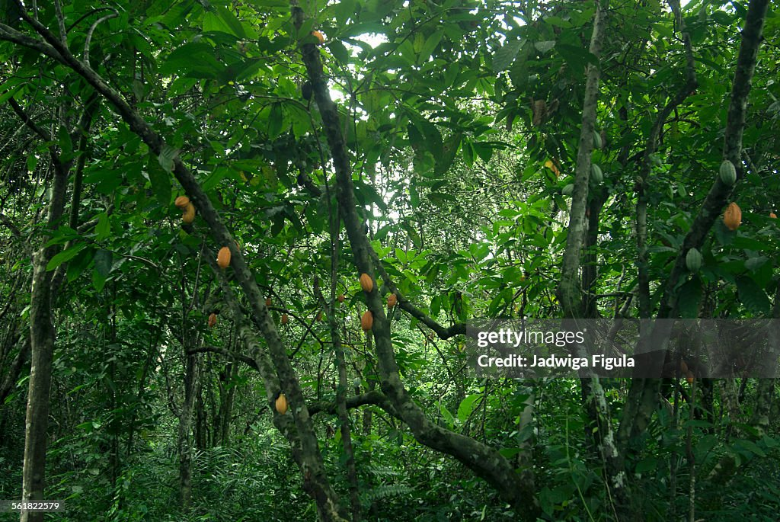
Joseph Tumbey walks past the dirt road to his palm farm in Konwonkpo Jeadae district, Greenville, Sinoe County. Once a hunter, he was recruited to work as a forest guard, protecting their portion of the Sapo forest in Sinoe County. His new task was forged by an agreement signed between his town and the Integrated Development Learning (IDL) to conserve 7,131 hectares at a rate of $1.50 per hectare, for a total of US$ 10,715.
By Tina S. Mehnpaine, contributing writer
“At least we are benefiting from keeping our forest,” he says. As part of this, he and other members received a monthly stipend of US$25 as a guard for monthly patrol, monitoring, and reporting. Village Saving Loans Programs (VSLA) are also set up in these communities to help save and keep their money from the farming products they sell.
Funded by the Irish government, the “Payment for Stewardship,” a two-year-old program, provided this amount for Tumbey and other towns under the Wedjahh Land Development and Management Committee (CLDMC). This amount will be used to fund bridge construction between Monah town and Boyea town, according to Lasting S. Kadee, chairman of the Lower and Upper Wedjah district.
As a former hunter, Tumbey has survived in the forest, hunting animals to sell to make a living—an activity that experts say is depleting the Upper rainforest. Under this agreement, which lasts for two years from 2025 to 2027, Tumbey and his peers are being paid to halt these activities, including burning wood for charcoal.
Forests in Liberia have been a lifeline for many, especially those who live closer and own them. Moreover, the country’s 2018 Land Rights Law grants communities full ownership of their customary lands, including the right to manage, use, and benefit from forest resources. This includes entering into agreements with local NGOs, such as IDL, to conserve and get paid as a reward. Under this process, the communities can set up a group called the “Community Land Development and Management Committee” (CLDMC), such as the Wedjahh CLDMC.
While Tumbey and other townspeople in Sinoe County have received cash for keeping their trees standing, communities in Lofa County say they have yet to receive any tangible benefit including cash for keeping their forest too.
“No benefit,” said Wilson G. Forkpa, one of the elders in Vetesu, Lofa County, referring to cash and developmental benefits such as schools, hand pumps, and roads. “They just asked us to keep the forest; we are not getting anything.”
Their project, a decade-long effort implemented by Fauna & Flora International (FFI), the Skills and Agriculture Development Services (SADS), and the Forestry Development Authority (FDA), asked Vetesu and neighboring communities to conserve their forest. An MoU among the parties promised to improve local livelihoods through community engagement and various surveys on wildlife, carbon, and flora.
Contrary to claims of receiving no tangible benefits, Forkpa acknowledged that he and other residents received training in farming and animal husbandry, and a Village Saving Loan Association (VSLA) program was established to help them save and manage their income. Notably, the MoU signed between Vetesu and the project implementers does not mention the building of schools, hand pumps, or roads.
Project Similarities, Different Approaches
Both engagements in Lofa and Sinoe counties run on similar modules: former hunters are recruited to serve as forest watchmen, and VSLA programs are set up to help them manage and save their income. The forest watchmen are trained in camera tracking, identifying animal footprints, and tree species. Additionally, they are trained in sustainable farming practices to reduce their dependence on forest farming and hunting.
However, the payment structures differ. In Lofa County, forest guides receive US$75 for a 15-day patrol or US$50 for a 10-day patrol. But this amount is only payable if they go out for patrol. While in Sinoe County, forest watchmen receive a steady US$25 per month.
FDA Challenged: Lack of Equipment and Manpower
Samuel Freeman, the head of the FDA office in Lofa County, said manpower is one of his biggest challenges. According to him, only 12 staff are assigned to the entire Wonegizi landscape, an area covering more than 27,000 hectares.
“One of the things we also lack is an operational budget to pursue wildlife crime cases. Sometimes I used my own money to send people to court. We have limited equipment such as GPS, patrol rations, and tents,” he said. “For the office, we don’t have a computer. We don’t have the field equipment or the vehicle. We received 12 motorbikes under the Liberia forest sector project. Now everything is down. Staff use their money to get some of it repaired because the cost of transportation is very expensive.”
“So we are working with 17 communities around the Wonegizi landscape. We were able to recruit about 39 community auxiliaries to beat up the strength of the FDA,” he added.
Since taking his assignment in 2012, Freeman said his office prioritized a “community-first” approach to conservation, working closely with local authorities, landlords, and paramount chiefs to weave the cultural history of the Wonegizi and Wologizi mountains into the protection strategy. This collaboration ensured that community members were active participants in every stage of the project’s development—from bio-monitoring and surveillance patrols to camera tracking and water quality testing for the conservation of local wildlife and forests.
By involving the people in these technical feasibility studies, Freeman says he and his team secured a deep level of trust, which eventually led to the signing of a formal letter of commitment. This document serves as a testament to the community’s full participation in the Free, Prior, and Informed Consent (FPIC) process, officially setting aside the forest for protection with the people’s blessing.
According to Freeman, communities viewed cash as the primary benefit when they talked about benefits.
“FFI, who is our partner, established the farmers’ feed school. We also established the VSLAs and some communities are already making use of them.”
Support Independent Journalism
Your support helps FrontPage Africa continue delivering independent, credible, and impactful journalism. Every contribution strengthens our ability to investigate, inform, and hold power accountable while keeping quality journalism accessible to our readers.
Support our journalism or subscribe to receive the latest FrontPage Africa stories and updates.