NIMBA COUNTY – There is a version of Nimba County politics that has held for a generation. Influence flows through party structures, and party structures flow through a handful of dominant personalities. It is the version built by the late Prince Yormie Johnson and carried forward, in different form, by the Movement for Democracy and Reconstruction (MDR), the organization that still counts the majority of the county’s sitting lawmakers among its ranks.
By Selma Lomax, [email protected]
Representative Taa Z. Wongbe is the exception the model was not built to accommodate.
Elected in 2023 to represent District Nine, Wongbe took his seat in the 55th National Legislature not as an MDR candidate, not as a coalition pick, but as an independent who defeated an incumbent by more than 2,300 votes — 6,538 to 4,209, according to the National Elections Commission.
Three years on, his political survival is being tested less by the ballot box than by a quieter question whether a lawmaker with no party machine behind him out-perform the machine itself?
Wongbe’s answer, so far, has been to substitute infrastructure for ideology.
His constituency office’s 2026 report lays out seven priority areas — education, infrastructure, health, economic empowerment, energy, youth and sports, and social cohesion — and documents engagement across eight communities during the legislative break alone.
It’s an approach less about grand political theory than about a working theory of representation that a lawmaker who shows up between elections earns more durable loyalty than one who shows up only for them.
That theory is being tested against Nimba’s geography as much as its politics. District Nine’s communities are separated by roads that make basic services a daily negotiation rather than a given, and it’s against that backdrop that Wongbe’s project list has to be read — less as a monument-building exercise, more as an attempt to close gaps that have existed for decades.
Classrooms and Clinics
Two projects anchor the education push. The Volay Public School, roughly 85 percent finished as of early 2026, has become something of a personal checkpoint for the representative, who has inspected the site directly ahead of its planned handover. But the more structurally interesting move came in August 2026, when Wongbe’s office partnered with the Luminos Fund Liberia to launch an Accelerated Learning Program across nine District Nine public schools — a program aimed squarely at children who have fallen behind or dropped out, built around foundational literacy and numeracy rather than new buildings.
The district’s office committed roughly US$6,360 to stipends and transport for a dozen volunteer teachers going through the required training, a relatively small outlay for what is, in effect, an attempt to intervene in a problem no construction project can fix on its own.
Healthcare has followed a similar dual pattern, a physical renovation paired with a service gap being addressed directly. The Zuatown Clinic has been completed, the Mehnla Clinic is about 80 percent done. At Graie, a maternal waiting house is under construction — a facility designed for pregnant women who would otherwise face long, often dangerous journeys to reach care as delivery approaches. It’s a modest-sounding project with an outsized purpose in a rural district where distance itself can be a health risk.
Power, Signal and the Search for an Economic Identity
If schools and clinics represent the district’s present needs, electricity and telecommunications represent its bid for a different future. The “Light Up District 9” initiative, formalized in August 2026 through a Memorandum of Understanding with BNE Development Corporation, aims to extend energy access into communities that have functioned without it for years.
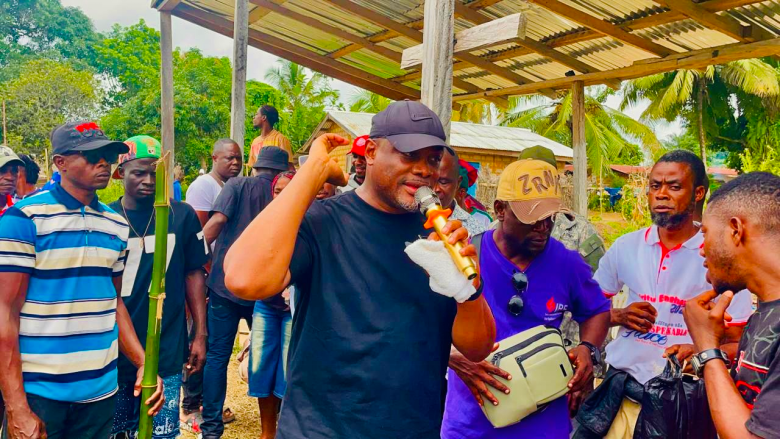
A parallel push to secure an Orange telecommunications tower reflects the same logic in 2026, connectivity is not a convenience but an economic precondition, tied to everything from mobile banking to emergency response.
Agriculture may be where Rep. Wongbe’s ambitions run longest. During a development tour through Zekepa, Guoiton, Blamein, Mehnla and Graie, he met directly with farmers and cooperatives to discuss market access and productivity — conversations that fit a broader argument he has made publicly: that a district cannot build lasting prosperity on government jobs and political patronage alone.
His personal investment in a farm in Graie Township, alongside emerging engagement with the North Carolina–based Green Rural Redevelopment Organization, suggests an attempt to position District Nine as a genuine agricultural contributor to both Nimba and Liberia’s food security goals, not merely a recipient of aid.
The Small Interventions
Not every line item is a headline project. A women’s microloan initiative continues to support small-scale economic activity. A sponsored knockout tournament in Kwendin, and support for District Nine teams at the Inter-District Peace Tournament in Ganta — complete with jerseys, footballs, and cash incentives for participating teams and goal scorers — reads, on its face, like modest constituency spending.
But in a district where organized youth activity is scarce, these interventions function less as sport and more as social infrastructure: one of the few settings where young people from different communities regularly interact.
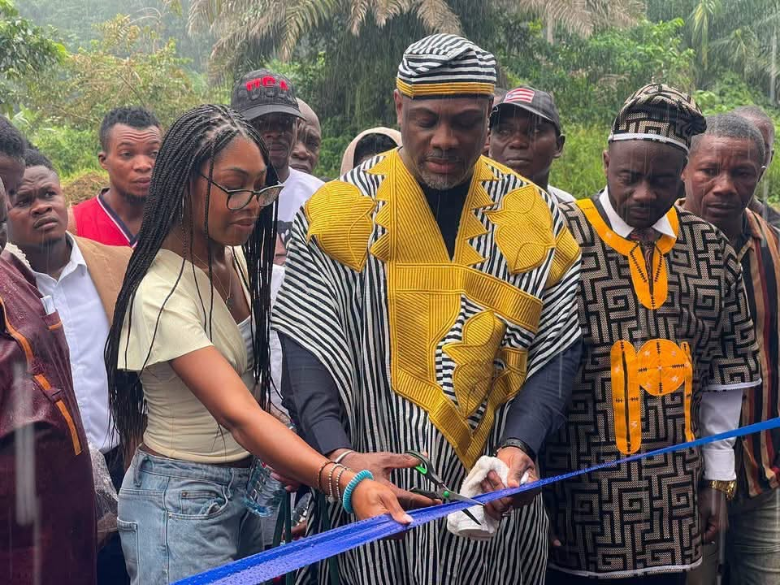
A community town hall project in Kwendin — backed by cement, zinc, steel rod and cash contributions from Rep. Wongbe’s office — has also become a case study in the harder part of constituency work: follow-through. When residents raised concerns about the pace of construction, Wongbe committed to closer monitoring, an episode that illustrates both the risk and the discipline required of projects announced with fanfare and expected to be finished quietly.
What the Ledger Doesn’t Yet Show
A more complete accounting of Wongbe’s tenure would include the voices of the people these projects are meant to serve — market women, farmers, parents whose children are now in the Luminos program, families closer to a functioning clinic than they were three years ago.
That reporting has not yet been done here, and any such testimony belongs in the story only once it has actually been gathered, attributed to real people who can be identified and, if necessary, contacted for verification. Their assessment — distinguishing what the representative’s office reports from what residents actually experience — would tell a fuller story than any list of completion percentages can.
Legislator, Not Just Builder
Wongbe’s footprint in Monrovia has extended beyond constituency work. In February 2024, a communication he brought to the House helped trigger scrutiny of electricity supply problems and financial questions at the Liberia Electricity Corporation.
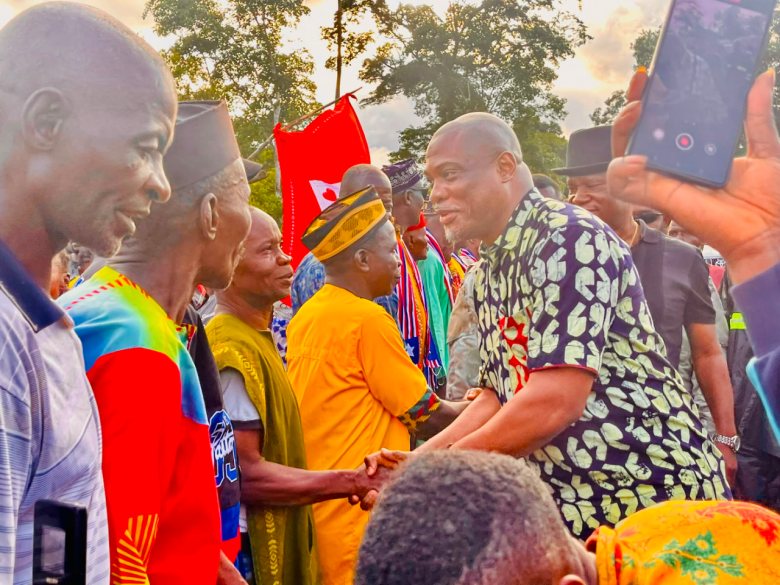
He was a visible player in the 2024 speakership contest, chairing the strategic committee that backed then-Speaker J. Fonati Koffa. And in November 2025, he introduced two pieces of proposed economic legislation: a National Community & MSME Stimulus Bill seeking US$10 million for grants to small businesses, farmer groups and women-led initiatives, and a Liberia Future Generations Extractive Savings Fund Act proposing that 10 percent of extractive revenues be set aside in a long-term national savings mechanism.
Neither bill’s fate is yet decided. But together they suggest a lawmaker trying to connect what he sees in District Nine’s villages to policy debates in the capital — an attempt, at minimum, to be more than a construction manager with a legislative title.
The Machine He Didn’t Join
None of this happens apart from Nimba’s political arithmetic. The MDR’s weight in national politics grew substantially after April 28, 2023, when Joseph Boakai named Jeremiah Kpan Koung — then MDR’s standard-bearer — as his running mate on the Unity Party ticket, fusing MDR’s Nimba-based organization to what became the winning presidential
campaign. The Carter Center’s report on the 2023 elections documented just how central Nimba, and the tensions surrounding it, had become to that race.
Koung is now Vice President. MDR still holds the majority of Nimba’s legislative seats. And Wongbe’s decision to stay outside that structure inevitably reads as a political statement whether he intends it as one or not — particularly as allies describe a rise in hostile media narratives they attribute to his refusal to align with the party.
That characterization has circulated, but it remains an allegation rather than a documented fact, absent evidence identifying who is actually producing or funding any specific attack. What can be stated plainly is the structural contrast that an independent lawmaker operating inside a county where nearly every other seat answers to a party apparatus he has chosen not to join.
2029 Is Already in the Room
With the next general election still three years away, Nimba’s political map is already shifting under the surface. MDR has clear incentive to consolidate its Nimba base — its 2023 alliance with the Unity Party remains the foundation of a governing partnership it has every reason to protect.
But the county’s politics are no longer a single storyline. Senator Samuel Gongben Kogar, Representative Musa Hassan Bility of the Citizens Movement for Change, and Garrison Yealue of the opposition Congress for Democratic Change each represent distinct currents pulling at Nimba’s political identity — and Senator Kogar’s own expulsion from MDR is a reminder that party loyalty in the county is neither permanent nor uncomplicated even for those who hold the party card. District 9’s uniqueness: There are 78 towns and villages, border five counties, and are Liberia’s largest electoral district by land area. That scale is central to understanding our development challenges.
Cultural diversity: Our district is home to three principal tribes: Gio, Mano and Gbi. This diversity is an important part of our identity.
Development philosophy: Wongbe approached District 9 almost as a small country requiring an integrated development plan. My focus is connecting education, healthcare, agriculture, infrastructure, energy and economic opportunities.
Project updates: Volay Public School has been completed and dedicated. Dorbor town will be dedicated in October. Please update that section and the conclusion. We can also provide updated project figures.
5. Roads: Roads and bridges remain Wongbe’s biggest challenge and an area where he hasn’t delivered. According to many in the district, this deserves honest attention because connectivity is fundamental to everything else we are trying to accomplish.
Electoral history: FrontPage Africa gathered that District 9 has never re-elected an incumbent lawmaker. Against that shifting field, Rep. Wongbe’s central wager is that voters will eventually judge him on delivery rather than affiliation.
The Record, Contested
It would be incomplete, and inaccurate, to present that wager as uncontested. A 2024 report by In Profile Daily documented criticism from the NYDO over alleged interference by Wongbe in a road development project in the district — a reminder that his record, like any lawmaker’s, has drawn scrutiny as well as praise.
Democratic accountability requires exactly that kind of friction; a representative’s standing should rest on more than the account his own office publishes.
The Real Test Ahead
Ultimately, the measure of Rep. Wongbe’s independence will not be settled in press statements or social media disputes. It will be settled in whether the Volay school opens on schedule, whether the Luminos program actually lifts outcomes for children who had fallen behind, whether the maternal waiting house in Graie reduces real risk for real women, whether “Light Up District 9” reaches homes that have never had power, and whether the farmers he has met with gain the market access they were promised.
For now, Wongbe occupies a genuinely unusual position in Liberian politics, an independent lawmaker inside one of the country’s most tightly organized political counties, testing whether a development record can substitute for a party network. The next election will be less a referendum on which party controls Nimba than a test of whether that substitution actually works.
Support Independent Journalism
Your support helps FrontPage Africa continue delivering independent, credible, and impactful journalism. Every contribution strengthens our ability to investigate, inform, and hold power accountable while keeping quality journalism accessible to our readers.
Support our journalism or subscribe to receive the latest FrontPage Africa stories and updates.