Strip away the titles and the procedural language, and what happened at Monrovia Central Prison on the afternoon of August 1 comes down to a very human moment: a career officer, watching two men in prohibited clothing bluff their way past his gate, trying to decide how far to push back against people who outrank him on paper but not, in his telling, in judgment.
By Rodney D. Sieh, [email protected]
That officer, Jackson K. Kolako, has now told his version of events in a lengthy public statement — one considerably more textured, and considerably more defiant, than the bureaucratic language the Ministry of Justice used to answer him days later. Read side by side, the two accounts agree on almost nothing except the outline: a prison, a drug case, an inmate, and an arrest that neither side disputes actually happened.
A gate, not an interrogation room, is where this starts
The Ministry’s version begins clinically — NSA personnel arriving to interview an inmate “in furtherance of the investigation.” Kolako’s version begins with a detail the Ministry’s statement omits entirely: that the two men who showed up claiming to be NSA agents were, in his account, dressed in shorts — a violation of prison protocol — and refused to sign the visitor logbook or explain themselves beyond saying their mission was covert. It is the kind of granular, sensory detail that rarely survives into an institutional press release, and its absence from the Ministry’s account is itself notable. The Ministry’s statement treats the encounter as a straightforward operational visit; Kolako’s account treats it as the moment he first suspected something was procedurally wrong.
From there the two stories diverge sharply on a second point: who was informed, and when. Kolako says that when he asked whether his superiors — the MCP’s Chief Superintendent and the Assistant Minister for Corrections — had been told about the visit, he was informed they had not, and that the visit’s authority superseded the Corrections Department entirely. He says he then called both men directly and that each expressed surprise at the operation. If accurate, that detail cuts against the Ministry’s framing that Kolako’s objections amounted to interference with a lawful, properly-sanctioned operation — it suggests that even his direct superiors in Corrections had not been looped in.
The moment of arrest, told two ways
The most striking gap between the accounts is the arrest itself. The Ministry describes a sequence in which intelligence “subsequently made available” indicated Kolako had contact with the inmate before the interview, that the inmate initially refused to cooperate, and that only after Kolako’s removal did the inmate allege he’d felt intimidated. It is a bureaucratic passive-voice account: things became known, information was received.
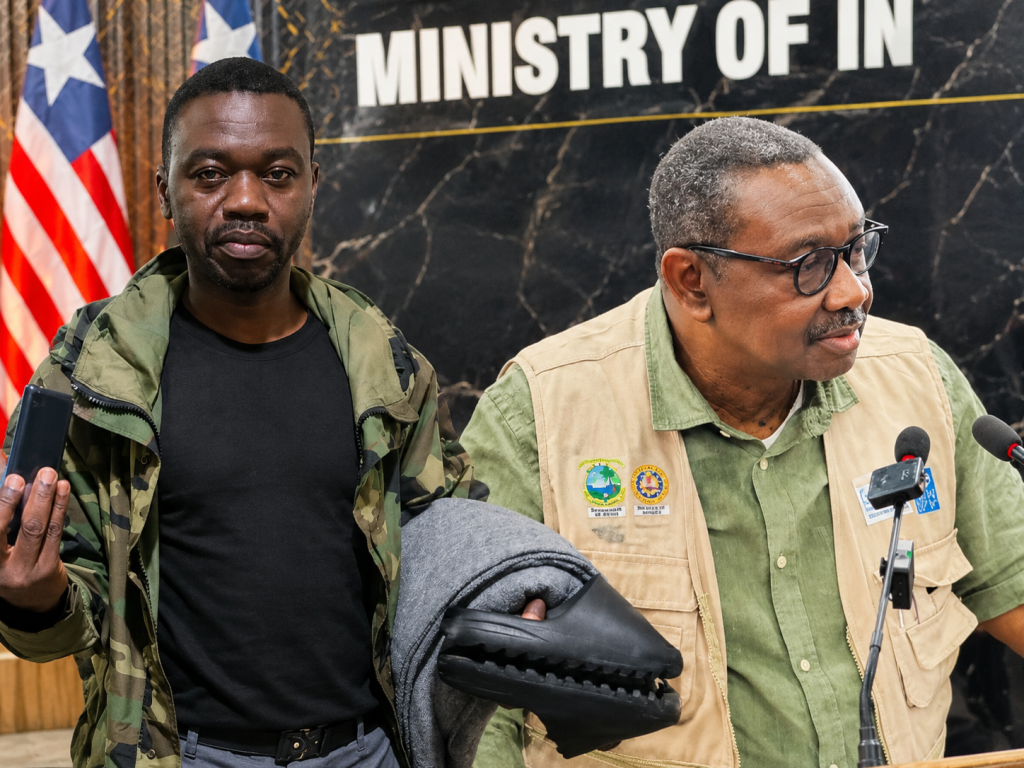
Kolako’s account is far more immediate and personal. He says he had already ordered the inmate — who he says was outside simply for exercise — back to his housing unit and returned to his ordinary duties overseeing roughly 1,800 inmates and around 100 officers, before Siafa Bahn Kemokai arrived with police officers and ordered his arrest without acknowledging Kolako’s salute. Kolako describes this refusal of customary courtesy, and what he calls Kemokai’s public, almost theatrical manner of ordering the arrest, as a deliberate provocation — one he worried was calibrated to trigger resistance from his own officers and potentially a riot that inmates could exploit. His response, he says, was to walk away quietly rather than let his officers witness the arrest.
Whether or not one credits the specific charge of provocation, the underlying image — an experienced officer choosing self-restraint precisely because he understood the security stakes of an 1,800-inmate facility better than the people arresting him — is a more sympathetic and more detailed picture than anything in the Ministry’s statement, which addresses Kolako’s twelve years of service only to argue that his seniority did not entitle him to advance knowledge of the operation.
What happened after the arrest is where the accounts stop touching at all
Here the Ministry’s statement goes essentially silent, and Kolako’s fills the gap with the most serious allegations of the whole affair. He says he was held from August 1 to August 7 without the police taking any formal statement from him; that on the night of August 3, Ministry officers, NSA agents, and a police unit compelled him to surrender his phones and passwords; that he was accused that same night of being connected to a drug cartel and receiving payments from it; and that when told to go home the next day, he refused, unwilling to leave custody without assurance of his safety. He says he was eventually released on August 7 still without his phones, was handed a suspension letter the same day citing disruption of the inmate interview, and points out — pointedly — that if such an infraction occurred, the Ministry has its own disciplinary board, raising the question of why the matter was routed through the police at all.
The Ministry’s statement, dated after Kolako’s, never mentions the six days in custody, the confiscated phones, the cartel accusation, or the suspension letter’s specific wording. Its account of “money allegedly being provided to him” through an outside contact reads, against Kolako’s statement, like a paraphrase of the same cartel allegation he says was leveled at him directly on August 3 — except the Ministry frames it as an open investigative question rather than something already put to him as an accusation days earlier.
Two different appeals to legitimacy
The rhetorical strategies are as different as the accounts themselves. The Ministry leans on institutional language — need-to-know principles, chains of authorization, the presumption against guilt before findings are concluded — to argue that what looks irregular from outside was, in fact, procedure. Kolako leans on personal biography: nine years as a teacher, three as a transit conductor, twelve in law enforcement, a salary that never topped $224 a month, and what he describes as an unblemished record he says he has refused to trade for money. He closes not with a request for due process in the abstract, but with a direct, public appeal — naming the Attorney General, the heads of the NSA, the Ministry of National Defense, and the police, and even invoking the U.S. Embassy — asking that drug-case detainees be moved to a secure facility abroad so the investigation cannot be compromised from within. He also names four individuals he asks the public to remember as the investigation proceeds, a move that reads less like a defense and more like a warning.
What the contrast reveals
Neither statement is a neutral document — one is an institution defending a decision it has already made, the other is a man defending a record he says has never been in question. But the specific, checkable claims in Kolako’s account — who he called, what time the suspension letter arrived, how long he was held, when his phones were taken and by whom — give reporters concrete threads to pull that the Ministry’s more abstract statement does not offer. Whether Colonel Roosevelt Varney and Assistant Minister Gabriel Fayiah Ndupellar confirm they were uninformed of the operation, whether police records show a formal statement was ever taken from Kolako during his custody, and what the suspension letter actually says about the alleged disruption are all now matters of record that could be verified rather than argued. Until they are, the public is left with two accounts of the same afternoon that cannot both be complete.
Support Independent Journalism
Your support helps FrontPage Africa continue delivering independent, credible, and impactful journalism. Every contribution strengthens our ability to investigate, inform, and hold power accountable while keeping quality journalism accessible to our readers.
Support our journalism or subscribe to receive the latest FrontPage Africa stories and updates.