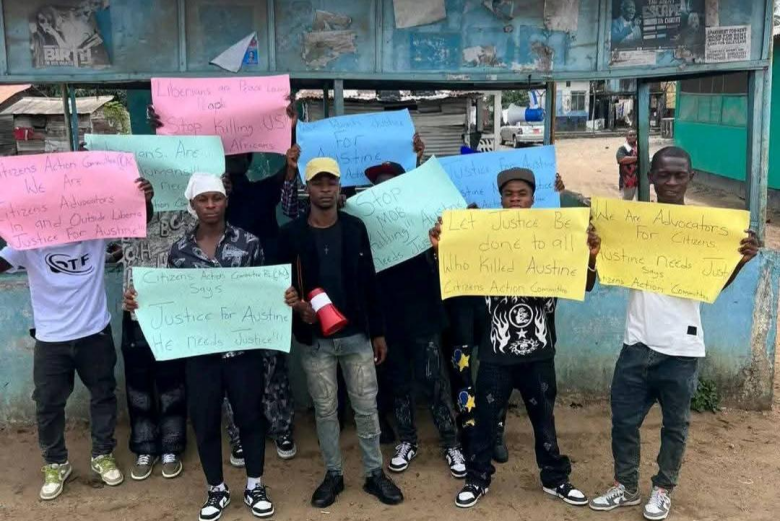
MONROVIA– A group of peaceful protesters gathered Friday at the Ghanaian Embassy in Monrovia, coinciding with Ghana’s Independence Day celebrations, to demand justice in the death of young Liberian, Austin Tengbeh, who was killed in Lashibi, near Accra, after visiting a friend with his partner.
By Jaheim T. [email protected]
Witness accounts suggest the confrontation began when a pregnant woman in the compound reported feeling harassed by Tengbeh. She told her husband and the compound’s guard, Vincent Adzikah, that Tengbeh had approached her while she was hanging laundry and said, “Hi baby.” The woman later clarified she did not consider the incident sexual harassment but said she felt unsafe.
The guard confronted Tengbeh with a machete, striking him with the flat side of the blade and ordering him to leave. Witnesses described Tengbeh as calm and non‑confrontational.
However, the situation escalated when Vincent allegedly pursued him outside the compound, shouting “thief, thief.”
In Ghana, such an alarm often prompts bystanders to intervene. Tengbeh was later found unconscious after being beaten by several people and was pronounced dead at Sakumono Community Hospital.
The Accra Regional Police Command announced the arrest of three suspects: Vincent Adzikah (38), Francis Amuzu (44), and William Addison (34). A fourth suspect, Enoch Mensah, remains at large. Police said preliminary investigations indicate Tengbeh was mistaken for a thief after the caretaker raised an alarm.
The demonstration, dubbed “Justice for Austin Day,” was organized by the Citizens Action Committee (CAC-RL) and Rev. Philip S. Blamo, alongside Tengbeh’s family and friends. Protesters carried placards and chanted slogans, stressing that their action was peaceful but purposeful.
“This is not just about Austin,” one participant said. “It is about ensuring that no Liberian life is taken without accountability.”
Rev. Blamo explained the protest’s timing: “We chose Ghana’s Independence Day deliberately, to remind our Ghanaian brothers and sisters that independence means justice, and justice must be shared across borders.”
Tengbeh’s relatives expressed grief and demanded accountability. “I want justice for my brother because he didn’t deserve the way he died. My country wants justice, my mom wants justice,” his sister said, describing him as caring and responsible.
In an emotional tribute, she described Tengbeh as caring and responsible, noting that despite being her younger brother, he played a fatherly role in her life.
Analysis
First, happy belated Independence to the people of Ghana. Yet the tragedy of Austin Tengbeh raises deeper questions about how Africans treat one another. It troubles many observers when protesters allege that foreign nationals are solely responsible for criminal activities in Ghana. This narrative is dangerous and divisive. As West Africans, we must be our brother’s keeper, not each other’s accuser.
We have seen similar tensions before in South Africa, where Nigerians and other Africans were unfairly targeted. Those moments were not only erroneous but painfully awkward for the continent. In contrast, North Africa often demonstrates stronger bonds of unity and interconnectedness. Why should suspicion and blame weaken solidarity in West Africa?
The real betrayal, critics argue, lies not in the streets of Oxford, Osu, Lashibi, Pokuasi Road, Independence Square, or Adum in Kumasi, but in the halls of parliament, government offices, and presidencies where corruption thrives. Instead of confronting systemic failures, societies risk scapegoating fellow Africans.
For many young people, the disappointment is compounded by leaders whose speeches at global forums like the United Nations General Assembly echo across the world but rarely translate into action at home. “We deserve better than empty promises,” one activist remarked.
The lesson from Austin’s death and similar struggles is clear: Africans are brothers on the same boat, not enemies. Division weakens the African agenda. Unity is not optional but it is the only path forward. Justice, observers insist, is only fair when accountability is placed squarely on the criminals who committed the crime, not on entire communities.
The tragedy has sparked debate about unity and mistrust among Africans. Observers warn against scapegoating foreign nationals, noting parallels with xenophobic tensions in South Africa. Critics argue that the real betrayal lies in corruption and systemic failures, not in ordinary citizens.
“The lesson from Austin’s death is clear,” one activist remarked. “Africans are brothers on the same boat, not enemies. Division weakens the African agenda. Justice must focus on the criminals, not entire communities.”
Support Independent Journalism
Your support helps FrontPage Africa continue delivering independent, credible, and impactful journalism. Every contribution strengthens our ability to investigate, inform, and hold power accountable while keeping quality journalism accessible to our readers.
Support our journalism or subscribe to receive the latest FrontPage Africa stories and updates.