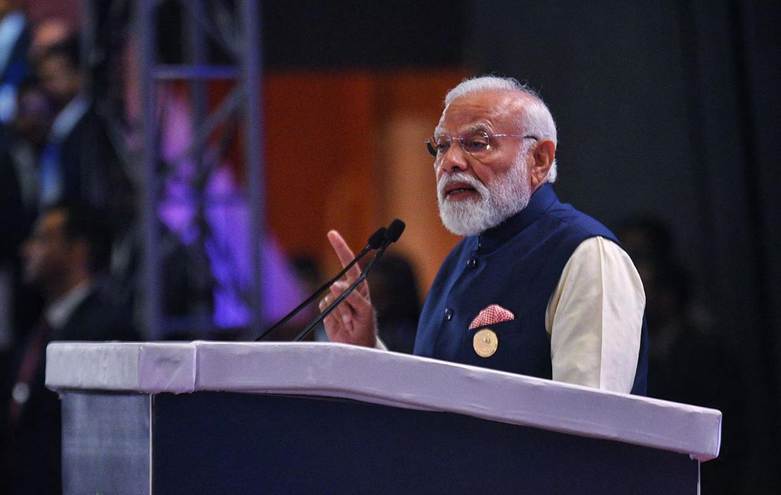
New Delhi, India – Prime Minister Narendra Modi has called for a human-centric approach to artificial intelligence (AI), urging global leaders to anchor technological advancement in ethics, inclusion and public trust.
By Patience M. Jones
Speaking at the AI Impact Summit 2026 in New Delhi, which drew representatives from over 100 countries, Modi described artificial intelligence as a transformative force comparable to fire, electricity and the internet, but cautioned that its rapid evolution requires careful global stewardship.
“At a defining moment in human history, we must ensure AI serves humanity,” Modi said, emphasizing that technology should remain a tool for public good rather than a force that diminishes human agency.
The summit brought together Heads of State, government officials, innovators and young technology enthusiasts, with thousands attending exhibitions showcasing cutting-edge AI products and services.
Modi described the gathering as one of the largest and most democratised AI forums globally, highlighting the strong participation of youth.
He stressed the guiding principle of “Sarvajana Hitaya, Sarvajana Sukhaya” — welfare for all, happiness for all — as central to India’s AI vision. According to him, AI must be “human-centric, not machine-centric,” reinforcing its role as a force multiplier for human intent rather than a replacement for human decision-making.
Modi pointed to India’s track record in deploying technology at scale, referencing digital public infrastructure initiatives such as UPI and nationwide COVID-19 vaccination systems as examples of inclusive innovation.
He highlighted AI-driven tools already making an impact in India, including “Sarlaben,” an AI-powered assistant developed by dairy cooperative AMUL to support millions of farmers with real-time guidance on cattle health and productivity. Another platform, Bharat VISTAAR, provides multilingual agricultural information ranging from weather forecasts to market prices.
“These examples show the empowering potential of AI when it is designed to meet local needs,” he noted.
At the summit, India unveiled the MANAV framework for human-centric AI governance. The framework outlines five guiding principles:
M – Moral and Ethical Systems: AI must adhere to ethical standards.
A – Accountable Governance: Transparent oversight and regulatory clarity.
N – National Sovereignty: Respect for countries’ rights over their data.
A – Accessible and Inclusive: AI should not become the monopoly of a few.
V – Valid and Legitimate: Systems must comply with laws and remain verifiable.
Modi said the framework aims to ensure AI development remains rooted in human values while addressing global concerns such as deepfakes, misinformation and data misuse.
He called for international collaboration on watermarking and authenticity standards for digital content, noting that India has already introduced legal requirements for labelling synthetically generated content.
Looking ahead, Modi underscored the need for skilling, reskilling and lifelong learning as AI reshapes global job markets. He expressed confidence that India’s large youth population and technology talent base position the country to play a leading role in the AI era.
Under the India AI Mission, the government has deployed thousands of GPUs to expand access to high-performance computing, alongside establishing a national AI repository to democratise datasets and models. The initiative aims to strengthen the entire AI value chain, from semiconductors and data infrastructure to startups and applied research.
Support Independent Journalism
Your support helps FrontPage Africa continue delivering independent, credible, and impactful journalism. Every contribution strengthens our ability to investigate, inform, and hold power accountable while keeping quality journalism accessible to our readers.
Support our journalism or subscribe to receive the latest FrontPage Africa stories and updates.