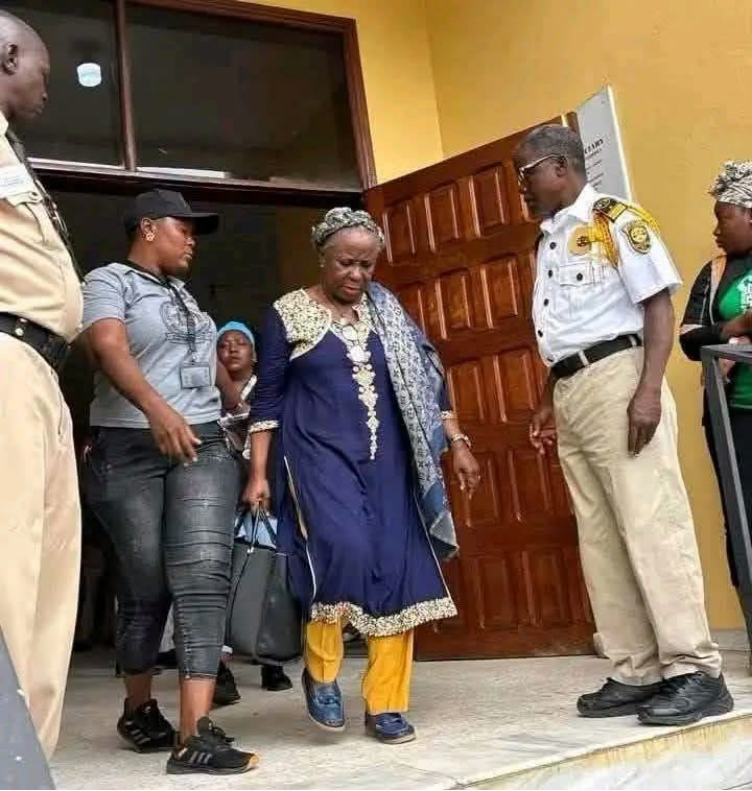
Monrovia – The Saudi rice case has been a dramatic fall for former GSA Director General Mary Tanyonoh Broh, from one of Liberia’s most recognizable public offices to a prison cell, and now, more than a year after her arrest, an unexpected exit from the criminal proceedings.
By: Willie N. Tokpah
On Tuesday, August 11, Criminal Court “C” Assigned Judge Ousman F. Feika granted the prosecution’s application for nolle prosequi, bringing to an end the criminal case against the former Director-General of the General Services Agency.
The ruling formally removed Broh as a defendant in the case and ordered the Clerk of Court to return her criminal appearance bond, or its value where applicable.
Her departure from the case marks a striking turn in a saga that began in June 2025, when Broh was arrested alongside former Foreign Affairs Minister Dee-Maxwell Saah Kemayah and former National Disaster Management Agency Executive Director Henry O. Williams over allegations surrounding thousands of bags of rice donated to Liberia by Saudi Arabia.
From City Hall to the Center of Power
Long before the rice controversy, Broh had already established herself as one of the most forceful and controversial figures in Liberia’s public administration.
During the administration of former President Ellen Johnson Sirleaf, she became widely known for her aggressive campaign to clean Monrovia, enforce municipal regulations and reclaim public spaces.
Her methods earned her both admiration and criticism.
Supporters saw a determined public official willing to confront entrenched interests and restore order to the capital. Critics accused her of heavy-handed enforcement.
Her public profile grew further when she later served as Director-General of the GSA under former President George Manneh Weah.
The GSA, a central government institution responsible for managing state assets, procurement-related functions and government property, placed Broh at the heart of Liberia’s administrative machinery.
But the same public profile that once made her a symbol of government activism would later place her under intense scrutiny.
The Rice Scandal
The controversy centered on 29,412 bags of rice donated by the Kingdom of Saudi Arabia through the King Salman Humanitarian Aid and Relief Center in 2023.
The donation was intended to assist Liberians affected by disasters, including floods and fires.
Investigators later alleged that more than 25,000 bags were diverted or otherwise unaccounted for, with the value of the allegedly missing rice estimated at more than US$425,000.
The allegations placed several former officials under investigation, including Broh, Kemayah and Williams.
According to reports at the time, authorities alleged that the humanitarian donation was distributed without adequate documentation and was diverted for personal or political benefit.
Broh denied wrongdoing.
Her arrest in June 2025 became particularly controversial because police went to the Fish Market compound in Sinkor, the residence of former President Sirleaf, where Broh also lived.
Reports said the police operation generated concerns over protocol surrounding the former president’s residence.
From Arrest to Incarceration
The case quickly moved beyond political controversy and into the criminal justice system.
Broh was detained at the Monrovia Central Prison, alongside other accused former officials, as the government moved to prosecute what it presented as a broader campaign against corruption.
The allegations against the defendants included Theft of Property, Economic Sabotage, misuse and illegal disbursement of public funds, misapplication of entrusted property, abuse of office and criminal conspiracy.
The arrests became one of the most consequential corruption prosecutions involving former senior officials of the Weah administration.
But for Broh, the period of incarceration represented a dramatic reversal of fortune.
A woman once known for commanding government task forces and enforcing public policy was suddenly appearing before the courts as a criminal defendant.
A Case That Kept Moving
The Saudi rice proceedings did not move in a straight line.
Questions surrounding bonds, indictments, evidence and procedural issues repeatedly complicated the case.
At various stages, defendants challenged aspects of the government’s prosecution while the state maintained that it had sufficient evidence to proceed.
By August 2026, the prosecution had prepared the case for trial against the remaining defendants.
But Broh would no longer be among them.
On August 11, Judge Feika granted the prosecution’s nolle prosequi application, which had been filed on July 3, 2025.
The court held that the prosecution’s decision fell within its authority under Chapter 18, Section 18.1 of Liberia’s Criminal Procedural Law.
The ruling did not amount to a judicial determination that the allegations against Broh had been proven false, nor did it constitute a conviction or acquittal after trial.
Instead, the prosecution chose to discontinue its case against her.
That distinction is significant.
What Her Exit Means
Broh’s removal came just days before the remaining defendants were scheduled to face trial. During proceedings, prosecutors presented as many as 90 exhibits as part of discovery.
Defense lawyers, however, complained that some documents were missing or illegible and requested clearer copies, as well as the Grand
Jury Transcript.
Judge Feika subsequently ordered the prosecution to provide clearer copies and the requested grand jury material.
The court also accepted an amended indictment into the official record.
With those issues addressed, Judge Feika ordered the remaining case to proceed to trial.
The defendants pleaded not guilty when the trial process began on August 17.
The Questions Left Behind
Broh’s exit does not end the broader questions surrounding the Saudi rice donation: where did the 29,412 bags of rice ultimately go, how many bags were actually distributed to disaster victims, how many were sold or diverted, who authorized the distribution, what records were created, and, perhaps most importantly, who should ultimately be held accountable if the government’s allegations are proven.
Those questions now belong to the trial of the remaining defendants.
Broh, however, has stepped outside that courtroom battle.
After being arrested, detained, indicted and publicly linked to one of the most closely watched corruption cases of the former administration, she now leaves the criminal proceedings through a decision made not by a jury, but by the prosecution itself.
For a public figure whose career has repeatedly placed her at the intersection of power, controversy and public accountability, the latest chapter is unusually quiet.
There will be no trial verdict against Mary Broh in the Saudi rice case.
There will be no jury finding her guilty or not guilty.
Instead, the case against the former GSA boss has been withdrawn.
And after more than a year of legal uncertainty, incarceration and public scrutiny, Mary Broh is no longer a defendant in Liberia’s Saudi rice prosecution.
She is declared innocent of the allegations that were brought against her, as the prosecution now turns its full attention to those still standing trial.
Support Independent Journalism
Your support helps FrontPage Africa continue delivering independent, credible, and impactful journalism. Every contribution strengthens our ability to investigate, inform, and hold power accountable while keeping quality journalism accessible to our readers.
Support our journalism or subscribe to receive the latest FrontPage Africa stories and updates.