Summary:
- One of the defendants on trial in Liberia’s largest human trafficking trial pleads guilty and testifies for the state
- Defense stunned defense by her action
- Prosecutors hail the move
By Anthony Stephens, senior justice correspondent with New Narratives
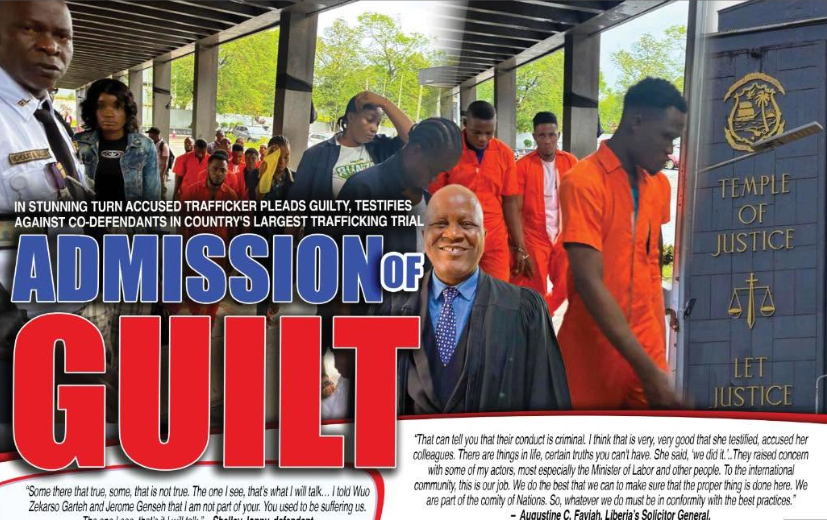
A stunning turn in Liberia’s largest human trafficking trial unfolded Wednesday, as one of the 12 defendants plead guilty and took the stand against her co-defendants.
Moments before proceedings resumed, Shelley Jonny, dressed in a blue prison uniform, moved from the dock to address the court. Her calm demeanor contrasted sharply with the expressions of the other defendants, who appeared stunned by her decision to abandon her earlier plea of “not guilty” at the trial’s opening on Tuesday.
When asked by Judge Roosevelt Willie of Criminal Court “A” whether the charges against her were true, Jonny responded:
“Some there that true. Some there is not true,” said Jonny speaking in Liberian English. “The one I see, that’s what I will talk.”
Willie then directed questions to Sennay Carlor, the lead defense lawyer, about whether Jonny, one of three women among the defendants, had previously discussed her change of position with him. Carlor told the court that she did but asked her to wait for Mamae Gongbah, the other defense lawyer in the case, but she refused. He said he had no objection to her decsion to plead guilty and testify against the other accused.
Willie ordered a 10-minute reccess to allow the prosecution to meet with the witness. The parties returned with prosecutors asking the court to accept the defendant as a witness and announcing the state had dropped charges against her. Jonny was facing charges of trafficking in persons, theft of property and criminal conspiracy and was facing a minimum 20-year prison sentence. Wille approved the move, clearing the way for Jonny to testify for the state.
On the witness stand, Jonny became a powerful witness for the prosecution. She told the court she was originally a victim, recruited from Nimba County by Jonny Dahn, another accused whom the state says remains at large. Jonny said she gave Shelley Suah, another defendant, US$3000 on Dahn’s instructions with the hopes of traveling to Canada.
She told the court that after arriving in Monrovia, she was taken to the compound in Gbankpa Town, near the residence of Vice President Jeremiah Koung along the Roberts International Airport highway, that became the alleged holding location for all the women victims in this case. There she realized that she was not going to get the money or travel to Canada. From there her story resembled that of other victims in the case.
Jonny testified, that Dahn and other accused – Shelley Suah, Stanley Wonlebaye, Luther Flomo, Maxson Wonlebaye and others – directed her to bring two more recruits, promising payment of $225 per week, and began encouraging her to recruit. Over time that encouragement turned to coercion through torture.
Jonny also corroborated the testimony of the prosecutions’ first witness, who FrontPage Africa/New Narratives is calling S., to protect her from retribution. On Tuesday, S. described what she said was inhumane treatment during captivity—including deprivation of food and beatings—while detained at the compound. Jonny said there were about 150 people held there in total.
“Martherline [Tompia, another accused] gave me sea water to drink,” Jonny said. “Luther used to make me to pump tire. Preston used to beat on my head. Stanley used to make me to sit down in dirty water and tell me to stretch my two hands. No food. They put you on your knees, you pump tire, they give you 15 bags of water to drink.”
She testified that sexual violence was part of the conditions in the compound, characterizing rape as a widespread practice among the captors’ tactics.
“They used to do it to other people but not me,” Johhny said during cross examination. Jonny said that rape was the “trend,” describing a pattern in which captors allegedly used rape to pressure victims to hand over money. She added that captors used water—she said large quantities—then restricted food afterward, contributing to sickness and vomiting.
Jonny said she did not immediately join other detainees who, she said, escaped the compound after the alleged death of Ophelia Melway—a death that, according to her testimony, triggered panic and fear among those held. She told the court she had wanted to stay to clear her name and make clear that she had originally been a victim and felt she had no choice in her actions.
She testified that she had warned the accused she was willing to testify against them.
“I told Wuo Zekarso Garteh and Jerome Genseh that ‘I am not part of you. You used to be suffering us,’” said Jonny. “The one I see, that’s it, I will talk.” She said the accused and Prince Konway, a lawyer for the accused at the start of the case in the Paynesville Magestrates’ Court, had—discouraged her from breaking away from the group saying that the case would soon be cleared.
Her decision to cooperate, was hailed as a significant step toward accountability by Augustine C. Fayiah, Liberia’s solicitor general.
“That will tell you that their conduct is criminal,” said Fayiah. “I think that is very, very good that she testified against her colleagues.”
In an interview, Fayiah, who took the unusual step of leading the prosecution at Wednesday’s proceedings, said the government had taken seriously concerns raised in earlier reporting by FrontPage Africa and New Narratives revealing that victims said that bribes were being paid to reduce the charges and delay the trial long enough so that defendants could escape justice. He said “the process” made it seem as though the government wasn’t interested in the case. Fayiah conceded the international community had raised the case with the government.
“They raised concern with some of my actors, most especially the Minister of Labor and other people,” he said. “To the international community, I say: ‘This is our job. We will do the best that we can to make sure that the proper thing is done here. We are part of the comity of nations. So, whatever we do must be in conformity with the best practices.’”
All 12 jurors and 3 alternate jurors were sequestered, an unusual move, meaning they were held separately during the trial to prevent bribery and intimidation of jurors. Fayiah said security had been increased with four-armed police officers were deployed to the protected area of the Temple of Justice, the seat of Liberia’s judiciary, on Wednesday morning, with additional officers planned by Thursday.
After Jonny’s testimony, the state presented two additional female witnesses, each describing rape and coercion by alleged captors. One witness—identified in court with the initial “P.”—testified that she was recruited from Grand Gedeh County by defendant Bill Plato with a promise of travel to Canada, describing paying $3000 for processing her passport and traveling documents. She then described abused similar to that of Jonny. She said she was taken to the compound and kept with others under inhumane conditions.
“We slept on the bare ground,” she said. She said she was raped by Plato.
A second witness, identified as “L.”, testified that she was raped by Maxson Wonlebaye and said she was compelled to abort a resulting pregnancy with abortion pills.
“The next day, he brought the medicine,” said L. She first refused to take the medicine but then he forced her. She said the resulting blood loss made her fear she would die.
She also said captors punished her when she would not request money from her relatives, describing forced labor in which she was tortured and forced to pump tires for two hours at a time.
Both witnesses described harsh treatment, and their accounts, along with Jonny’s, offered a consistent theme: coercion, confinement, and sexual violence were used as mechanisms to control them and extract money.
The trial continues Thursday.
This story was a collaboration with New Narratives as part of the Investigating Liberia project. Funding was provided by the Swedish International Cooperation Development Agency. The funder had no say in the story’s content.
Support Independent Journalism
Your support helps FrontPage Africa continue delivering independent, credible, and impactful journalism. Every contribution strengthens our ability to investigate, inform, and hold power accountable while keeping quality journalism accessible to our readers.
Support our journalism or subscribe to receive the latest FrontPage Africa stories and updates.