Monrovia —ECOWAS Ambassador to Liberia, Josephine Nkrumah, has challenged Liberians especially the youth to rethink their approach to accountability, warning that the country’s greatest obstacle is not only failed leadership, but a failed national mindset.
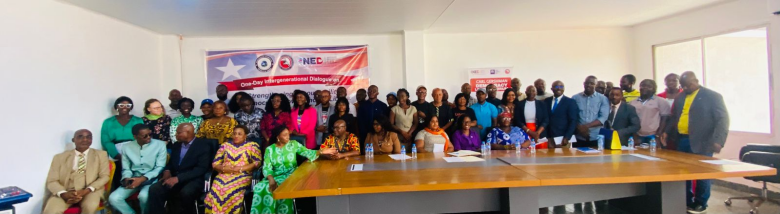
Speaking at an Intergenerational Dialogue on Strengthening Accountability in Democratic Governance, organized by NAYMOTE Partners for Democratic Development in collaboration with the Governance Commission, Ambassador Nkrumah said Liberia’s democratic future depends on citizens first holding themselves accountable before demanding the same from leaders.
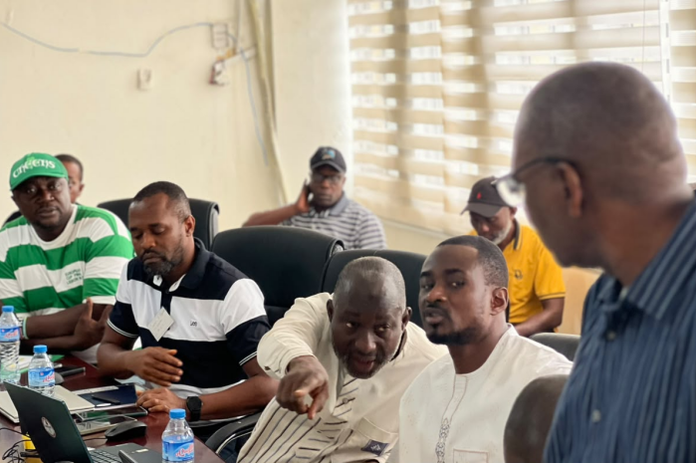
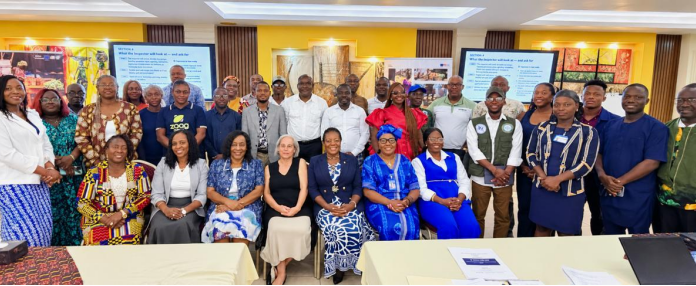
The dialogue, held Friday at the Governance Commission Conference Hall on 3rd Street, Sinkor, Monrovia, brought together civil society actors, youth leaders, government officials, members of the diplomatic corps,and policy experts under the theme: “Strengthening Accountability in Democratic Governance: Building Trust, Integrity, and Intergenerational Leadership in Liberia.”
Addressing the audience in a candid and heartfelt tone, Ambassador Nkrumah said accountability must start with everyday personal choices and behavior.
“Our leaders do not come from Mars. Our leaders are a reflection of who we are,” she declared.
“If we keep talking about accountability but continue to break rules in our daily lives, then we are part of the problem.”
She argued that corruption is not limited to public office, but also exists in ordinary acts such as bribing traffic officers, cutting lines, littering public spaces, arriving late to work, or bypassing lawful procedures.
“Our mindset has failed us,” she emphasized. “If we do not invest in our mindset, we will keep talking about accountability and intergenerational dialogue without making the kind of changes that are necessary.”
According to the ECOWAS envoy, Liberia needs “a new kind of citizen” one who puts nation above self, values discipline, and understands that rights must be balanced with responsibilities.
Ambassador Nkrumah also raised concerns about what she described as an imbalance in Liberia’s national discourse, where citizens often speak strongly about their constitutional rights but rarely about their responsibilities to the state.
“The citizens have their rights, but where are the citizens’ responsibilities?” she asked. “We are always talking about accountability, but the youth are also breaking accountability.”
Using examples from traffic violations, sanitation, broken public infrastructure, and the poor state of public institutions, she challenged young people to stop blaming government alone for problems they also contribute to.
She cited poor sanitation in Monrovia and damaged facilities at the University of Liberia as examples of how citizens often fail to care for public spaces, yet still demand accountability only from public officials.
“Why is Monrovia filthy? Is it the politician who came to drop rubbish on the road? We did,” she said. “You broke it, fix it.”
A major part of Ambassador Nkrumah’s address focused on the urgent need for civic education, which she described as essential to building a culture of accountability from childhood.
Drawing from Ghana’s experience, she explained that civic education has been deliberately institutionalized there, reaching children, farmers, market women, church members, and professionals across all levels of society.
“It did not happen by chance. It was deliberately institutionalized,” she noted.
She urged Liberian institutions and organizations such as NAYMOTE to begin serious conversations around embedding citizens’ responsibilities more clearly in public discourse, legal education, and democratic practice.
Archie Delaney: “If you don’t know your rights, people will abuse you”
Also speaking during the policy dialogue, Mr. Archie Delaney, Sr., Data and Spatial Management Consultant at the National Elections Commission (NEC), stressed that civic ignorance remains one of the greatest threats to democratic resilience in Liberia.
“If you don’t know your rights, people will abuse you,” Delaney warned.
“People are abused not because the abuser is so powerful, but because they don’t know their rights.”
Delaney highlighted weak accountability systems, tolerance for corruption, youth marginalization in formal decision-making, and fragile democratic institutions as major barriers to democratic progress.
Citing the 2022 National Population and Housing Census, he said Liberians aged 25 and below make up about 60 percent of the population, while those 35 and under account for roughly 75 percent, making youth not just participants, but the central force in Liberia’s governance future.
Delaney also argued that Liberia’s Constitution itself contributes to some governance challenges. “The Constitution is one of the sources of the problems we have in this country,” he said, renewing calls for constitutional reform.
For his part, Lawrence Yealue II, head of the National Civil Society Council of Liberia, delivered a provocative reflection on Liberia’s political and cultural systems, challenging both the older and younger generations to rethink inherited structures.
“Knowledge is not resident in positions. Intelligence is not resident in how you dress,” Mr. Yealue said.
He argued that Liberia must confront what he described as colonial mindsets embedded in governance, education, and political participation, particularly in laws that restrict youth leadership despite granting them voting rights.
Mr. Yealue criticized the contradictions in a system where an 18-year-old can vote, but cannot contest certain offices until much later, describing such arrangements as outdated and in need of reform.
He also lamented what he called the “lucky accident” model of youth development, where young people succeed despite the system rather than because of it.
“We are lucky accidents of a country that does not intentionally invest in young people,” he said.
James Kiawoin: Liberia’s democracy is “procedural, not substantive”
Meanwhile, James Kiawoin, Country Manager of Luminous Fund and former Chair of the National Youth Advisory Council at the Office of the Presidency, said Liberia’s democratic institutions remain weak and overly dependent on external validation.
Mr. Kiawoin said many Liberians have lost confidence in local institutions, often appealing to foreign embassies rather than domestic systems when seeking justice or accountability.
“Most times when Liberians are aggrieved, they will tag the U.S. Embassy or the Swedish Embassy in their posts,” he said.
“It underscores the fact that we do not have faith in the institutions that are meant to be accountable to us.”
He further criticized what he described as the government’s shallow approach to youth empowerment, saying Liberia lacks a clear, ambitious national agenda for young people.
According to him, youth policy is too often reduced to short-term employment and low-investment vocational training, while areas like artificial intelligence, cybersecurity, higher education, and medical training remain underfunded.
In Liberia, we tend to treat youth participation as a single policy issue,” Kiawoin said.
“We are quick to claim victory because youth are at the table, but no one asks whether they are actually empowered to effect change.”
He described Liberia’s democracy as “procedural” one that holds elections and respects term limits, but lacks the deeper substance of strong institutions, press freedom, and genuine respect for dissent.
Most times I feel our democracy in Liberia is a performance,” he added.
In his remarks, Alaric K. Tokpa, Acting Chairman of the Governance Commission, described the dialogue as more than a formal gathering, calling it a national responsibility to protect Liberia’s democracy.
Democracy is a collective trust, and each of us here is a custodian of that trust,” Tokpa said.
He emphasized that institutional accountability, youth participation, and democratic resilience are not abstract ideas but the pillars of Liberia’s democratic survival.
Mr. Tokpa called on the older generation to leave behind a legacy of honesty, discipline, and accountability, while urging young people to embrace hard work, patience, focus, and responsibility instead of instant gratification.
‘‘We must act because corruption erodes trust. We must act because exclusion weakens democracy. We must act because silence empowers impunity,” he said.
The event was officially opened by Eddie D. Jarwolo, Executive Director of NAYMOTE Partners for Democratic Development, who welcomed participants and underscored the importance of creating spaces where Liberians from different generations can honestly reflect on the country’s past, present, and future.
Mr. Jarwolo described the dialogue as a necessary step in preparing the next generation of leaders to build a stronger, more accountable Liberia.
As the event closed, one message rang clear from both panelists and participants: accountability cannot remain a slogan. It must become a lived culture, reinforced by institutions, civic education, and personal responsibility.
For Ambassador Nkrumah, that transformation begins not in government buildings alone, but in homes, schools, streets, and the daily choices of ordinary citizens.
“Without accountability beginning with us, the talk about democratic governance will be nothing more than an academic exercise,” she said.
Support Independent Journalism
Your support helps FrontPage Africa continue delivering independent, credible, and impactful journalism. Every contribution strengthens our ability to investigate, inform, and hold power accountable while keeping quality journalism accessible to our readers.
Support our journalism or subscribe to receive the latest FrontPage Africa stories and updates.