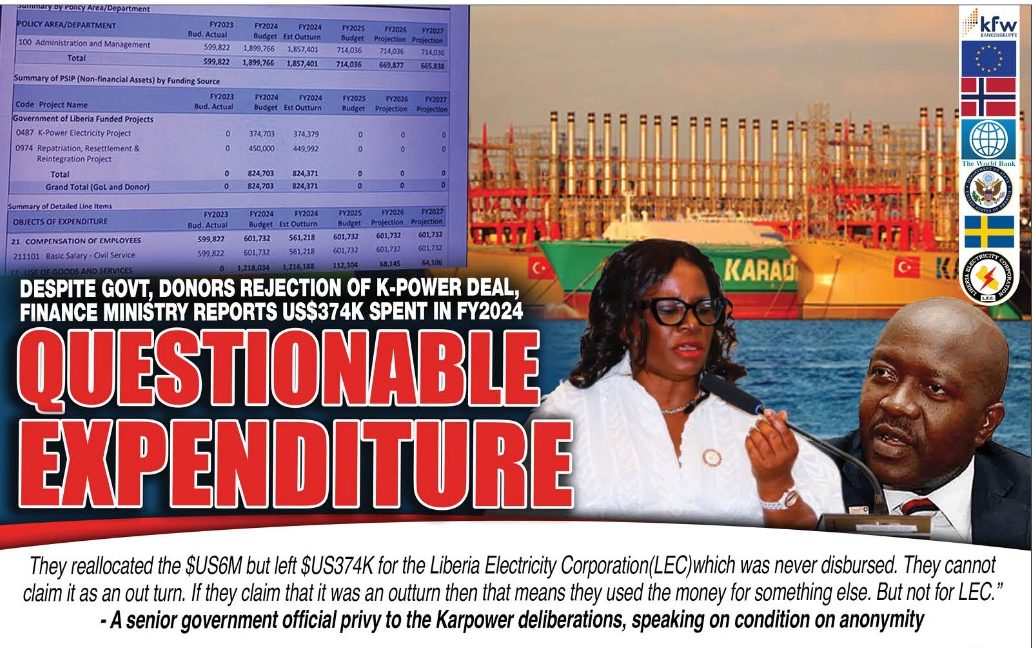
MONROVIA – The 2025 Approved National Budget has come under intense scrutiny following the revelation that US$374,379 was allocated to the Turkish Karpowership deal in FY2024, despite the government rejecting the agreement. The amount, listed under the “outturn” section on page 278 of the budget, has raised serious concerns about how the funds were used.
By Gerald C. Koinyeneh, [email protected]
A Dubious Budget Line?
The Ministry of Finance and Development Planning (MFDP) maintains that no disbursement was made, raising concern on how it was spent, why is it listed as an outturn? And if it was indeed disbursed, where did it go?
A senior government official with knowledge of the Karpower discussions revealed that while a US$6 million allocation originally intended for the Liberia Electricity Corporation (LEC) was reallocated, the $374,000 remained.
“They reallocated the $US6M but left $US374K for the Liberia Electricity Corporation (LEC) which was never disbursed. They cannot claim it as an out turn. If they claim that it was an outturn, then that means they used the money for something else. But not for LEC,” the official said.
The Karpower Controversy
Karpower, a private Turkish company, operates a floating power plant has on several occasions, engaged the Liberian government to operate. The company is currently operating in several African countries including neighboring Serra Leone. This is not the first time Karpowership has surfaced in Liberian government affairs. In 2024, the Turkish company engaged six African nations, including Liberia, in discussions about expanding its floating power plant services. However, the deal collapsed due to widespread criticism, with opponents arguing it only offered a short-term fix to Liberia’s long-standing energy crisis.
Despite the public backlash, Karpower executives formally pitched their proposal to the Boakai administration.
The Turkish Company’s Proposal
A letter dated February 15, 2024, obtained by FrontPageAfrica, and signed by Emre Durmusoglu, Africa Regional Director of Karpowership Global, outlines the company’s proposal to supply electricity to Liberia.
“Our fleet of Powerships, composed of 36 assets with an installed capacity exceeding 6,000 MW, offers a wide range of capacities from 30 to 500 MW. On February 5, 2024, we had the privilege to introduce our company and Powership solution to His Excellency Joseph Nyumah Boakai. Based on discussions and technical site visits, we agreed on a potential location and further project details.”
Durmusoglu noted that Liberia Electricity Corporation (LEC) and Karpowership Global DMCC were expected to sign a Term Sheet, which would pave the way for immediate implementation of the project. Several of President Boakai’s key advisors were copied on the letter, including Sylvester Grisby, Minister of State for Presidential Affairs, Samuel Kofi Woods, National Security Advisor and Monie Captan, then CEO of Liberia Electricity Corporation (LEC)
Why Did the Boakai Administration Push a Rejected Deal?
A similar attempt by the Weah administration to introduce Karpowership was met with strong opposition from international donors, including the Millennium Challenge Corporation (MCC), the Norwegian government, the European Union, the World Bank, and the German Development Bank. Donors warned that the project could jeopardize Liberia’s energy sector reforms and discourage further foreign investment.
In a 2018 letter from the partners including the then U.S. Ambassador to Liberia, co-signed by the Ambassadors of Norway, the United Kingdom, Ireland, Germany, Sweden, theEuropean Union, and the Country Director of the World Bank in Liberia addressed to then Minister of Finance and Development Planning Samuel Tweah, they warned the government of serious repercussions Liberia could face if the Karpower deal was ratified by the Legislature.
Collectively, these international partners have invested over US$825 million in Liberia’s electricity sector, supporting projects such as the Mt. Coffee Hydropower Plant, power transmission and distribution, training at the Liberia Electricity Corporation (LEC), and the completion of the CLSG network.
Key Concerns Raised by International Partners
The letter highlighted significant financial and managerial challenges facing the Liberia Electricity Corporation (LEC), which, if unaddressed, could undermine the sustainability of Mt. Coffee Hydropower Plant and other energy sector initiatives.
Among the pressing concerns was the Liberian government’s failure to settle its LEC utilitybills, a situation that deprives the company of essential funds needed for basic operations, including customer connections and servicing.
The most contentious issue was the government’s proposed 10-year power purchaseagreement with Karpower, which the international partners describe as counterproductive to LEC’s long-term sustainability.
The partners argued that the solution to Liberia’s seasonal energy shortages (a 0-20week gap of 0-15MW of electricity) lies in completing the CLSG project, rather than committing to an expensive decade-long deal with Karpower.
The Côte d’Ivoire-Liberia-Sierra Leone-Guinea (CLSG) transmission project—funded by the World Bank, African Development Bank, European Investment Bank, and KfW—is expected to bridge Liberia’s electricity gap. The transmission line, spanning 1,300 kilometers, will connect Man (Côte d’Ivoire) to Danané, Yekepa, Buchanan, Mt. Coffee, and Bo Waterside, creating new opportunities for Liberia’s power sector.
The letter warned that ratifying the Karpower deal would increase Liberia’s debt burden by locking LEC into an unnecessary multi-million-dollar contract, raise electricity prices for consumers due to high costs associated with running a 36MW power barge 24/7 and hinder LEC’s ability to focus on critical infrastructure projects, such as expanding power connections and distribution.
The partners recommended short-term solutions such as maximizing Mt. Coffee’s hydropower output, utilizing HFO plants at Bushrod Island, and implementing demand management strategies, including requiring large commercial users to switch to self-generation during the dry season. The international partners urged the Liberian government to take urgent action to safeguard existing investments in the energy sector.
Failure to heed their concerns, the letter warned, could make it difficult to sustain the unprecedented level of coordinated donor support for Liberia’s electricity sector.
A senior international stakeholder, speaking on condition of anonymity, told FrontPage Africa that the Karpower deal could lead to a suspension of donor commitments to Liberia, potentially jeopardizing future funding for the country’s energy development.
With this warning, the deal was cutoff.
While former President George Weah’s government eventually abandoned the deal under donor pressure, some officials within the Boakai-Koung administration and top lawmakers attempted to push it through.
In 2024, FPA gathered that Senate Pro Tempore Nyonblee Karngar-Lawrence had a vested interest in a Karpowership contract for which she secured US$6 million in the 2024 budget, but was reportedly rejected by LEC management headed by Monie Captain.
Critics are now questioning why certain presidential aides and senior legislators backed a deal that had already been dismissed by donors.
Misplaced Priorities?
Sources within the government cycle told FrontPage Africa that $6 million to $7 million was allocated for LEC, but some of these funds may have been earmarked for Karpower instead was not used. This revelation comes at a time when Liberia is struggling to settle outstanding debts with Ivory Coast, which has threatened to cut power supply over unpaid bills for electricity under the CLSG (Côte d’Ivoire–Liberia–Sierra Leone–Guinea) interconnection project. FPA has gathered that some officials within LEC strongly opposed diverting funds to Karpower, arguing that settling the CLSG debt was a more urgent priority. However, their concerns were reportedly ignored.
Energy analysts argue that if the money was available, it should have been used to clear Liberia’s debt to Ivory Coast rather than being tied to a controversial project.
Call for Government Accountability
The Boakai-Koung administration has faced mounting criticism for budget misallocation, prioritizing recurring expenditures such as salaries, travel, fuel, entertainment and allowances over critical infrastructure and social services.
With the uncertainty surrounding the $374,000 allocation for Karpower in FY2024, the onus is now on the government to explain where the money went and why it was listed as an outturn despite claims that no disbursement was made.
The public awaits clarity from President Boakai’s administration on how funds meant for electricity supply were handled—or potentially misused.
Support Independent Journalism
Your support helps FrontPage Africa continue delivering independent, credible, and impactful journalism. Every contribution strengthens our ability to investigate, inform, and hold power accountable while keeping quality journalism accessible to our readers.
Support our journalism or subscribe to receive the latest FrontPage Africa stories and updates.