
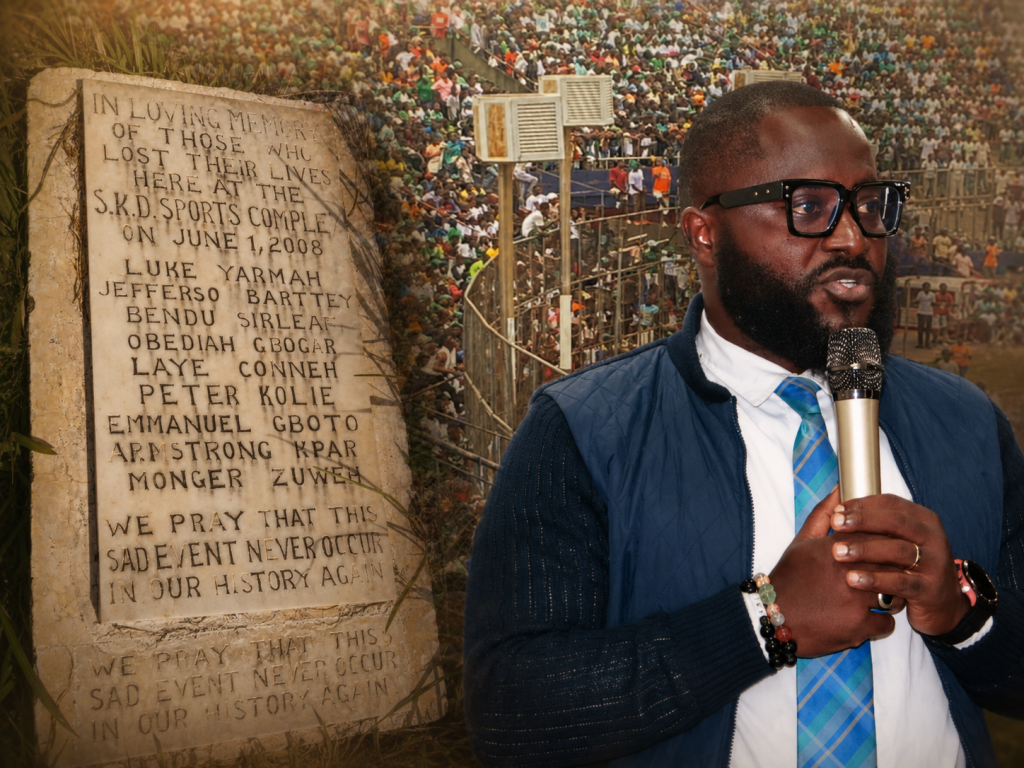
Monrovia – Eighteen years after one of the darkest days in Liberian sporting history, prominent sports administrator and communications professional D. Webster Cassell has made a passionate plea to the government and football stakeholders to reconstruct the demolished memorial dedicated to the victims of the June 1, 2008, Samuel Kanyon Doe (SKD) Sports Complex stampede.
By Christopher C. Walker | [email protected] | 0777898224
On that fateful afternoon, a high-stakes World Cup and Africa Cup of Nations qualifying match between the Lone Star of Liberia and The Gambia turned into an unimaginable catastrophe.
Severe overcrowding and inadequate crowd-control measures led to a horrific stampede, claiming the lives of nine innocent Liberian football fans.
Reflecting on the tragedy, Cassell, who was inside the stadium that day, recalled the intense atmosphere that quickly turned into a national nightmare.
“Every nation has defining moments in its sporting history moments of triumph, heartbreak, and profound lessons that shape the future,” Cassell said.
“Like hundreds of enthusiastic supporters, I was among those who eagerly anticipated witnessing a victorious return for the Lone Star on home soil. Tragically, what should have been a celebration of national pride and sporting unity descended into an unimaginable catastrophe,” he said.
The disaster claimed the lives of nine devoted supporters: Luke Yarmah, Jefferson Barttey, Bendu Sirleaf, Obediah Gbogar, Laye Conneh, Peter Kolie, Emmay Gboto, Armstrong Kpar, and Monger Zuweh.
In the wake of the tragedy, the Government of Liberia, through the Ministry of Youth and Sports, erected a monument at the SKD Sports Complex to honor their lives and sacrifice.
However, nearly two decades later, that monument has vanished, having been demolished and removed during the stadium renovations. Furthermore, regular memorial services involving the victims’ families have entirely ceased.
“Those supporters never anticipated that attending a football match would become their final journey,” Cassell lamented. “Their sacrifice and memory deserve permanent recognition, and a memorial erected in their honor should never have been allowed to disappear. Today, it exists only in memory.”
Cassell revealed that this institutional indifference is not new. He has spent years writing articles and directly engaging consecutive administrations, including past leadership at the Ministry of Youth and Sports, to safeguard and renovate the structure before it was ultimately torn down.
“Unfortunately, those appeals fell on deaf ears, and the structure was eventually demolished and removed from its original location,” Cassell told FrontPage Africa. “Regrettably, these appeals yielded no tangible results, reinforcing the perception that the victims have been forgotten by the very institutions entrusted with preserving their legacy.”
With Liberia observing another anniversary of the tragedy, Cassell is calling for a unified national effort across the entire football ecosystem to right this wrong. He argues that restoring the monument must transcend institutional bureaucracy and politics, appealing directly to the Ministry of Youth and Sports, the Liberia Football Association (LFA), the Sports Writers Association of Liberia (SWAL), the National Football Fans Base Association, and the Association of Former National Team Players.
“Memorials are not merely structures of concrete, steel, and stone. They are powerful symbols of collective memory, sacrifice, national reflection, and historical accountability,” Cassell emphasized. “The supporters who lost their lives on June 1, 2008, were neither politicians nor celebrities. They were ordinary Liberians bound together by an extraordinary love for football and country.”
As football administrators look toward the future of sports governance in Liberia, Cassell insists that a nation cannot move forward if it chooses to erase the memories of those who died showing ultimate patriotism for the national team.
“Our commitment to memorializing those who lost their lives while cheering the Lone Star of Liberia must transcend politics, personal interests, and institutional indifference,” Cassell stated.
“It is a moral obligation, a historical responsibility, and a debt of honor owed to nine loyal supporters whose final act was one of patriotism. He that hath ears to hear, let him hear. A hint to the wise is sufficient.”
Support Independent Journalism
Your support helps FrontPage Africa continue delivering independent, credible, and impactful journalism. Every contribution strengthens our ability to investigate, inform, and hold power accountable while keeping quality journalism accessible to our readers.
Support our journalism or subscribe to receive the latest FrontPage Africa stories and updates.