Monrovia – The Liberia Chamber of Commerce (LCC) has renewed its call for stronger local content policies, innovation, and value addition, describing them as critical to unlocking Liberia’s economic potential and positioning Liberian businesses at the center of the country’s development.
By Claudius Greene, contributing writer
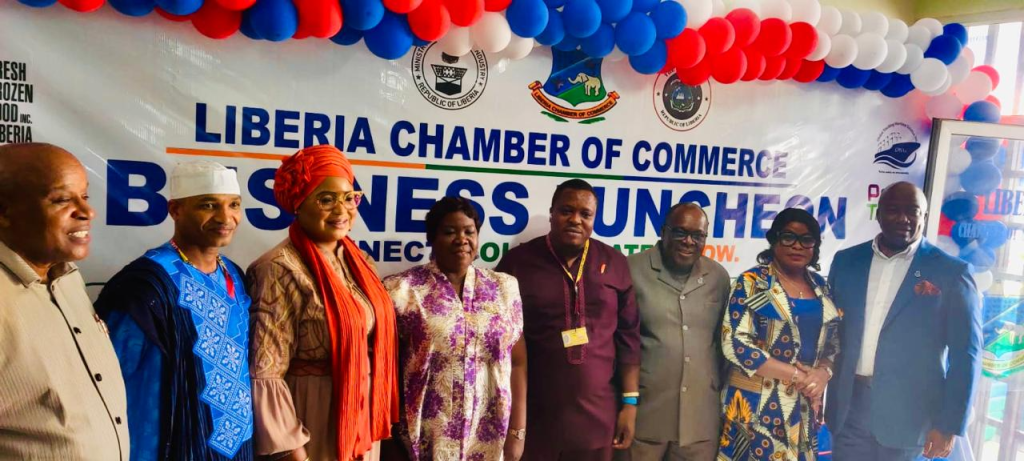
The call was made Thursday during the Chamber’s Annual Business Luncheon at its headquarters on Queen’s Avenue, Capitol Hill, under the theme, “Liberia’s Next Economic Chapter: Innovation, Trade and Leadership for Economic Transformation.”
The event brought together government officials, diplomats, development partners, investors, business executives, and entrepreneurs to discuss strategies for advancing Liberia’s economic transformation through a stronger private sector.
Delivering the keynote address, LCC President O. Natty B. Davis II said Liberia has reached a defining moment in its economic journey and must move beyond exporting raw materials to building an economy driven by local production, manufacturing, innovation, and competitive businesses.
He observed that although global demand for Africa’s natural resources continues to grow, Liberia must ensure its citizens derive greater value from those resources through local processing, manufacturing, and stronger domestic supply chains.
“For more than 15 years, Liberia has largely extracted and exported its natural resources with limited processing and value addition. We must now do business differently,” Davis declared.
According to Davis, strengthening local content is no longer optional but essential to creating sustainable employment, increasing Liberian ownership of the economy, and advancing the country’s ambition to attain middle-income status.
He stressed that Liberian businesses must be equipped with the skills, standards, and opportunities necessary to compete for contracts in concession operations, government procurement, and regional markets.
“Strengthening local content and developing competitive supply chains are essential first steps toward ensuring Liberian businesses benefit from investment flowing into the country,” he said.
Davis highlighted several initiatives implemented by the Chamber over the past year, including the Supplier Development Program, the MSME Clinic, and the Young Business Leaders Platform, all designed to strengthen the capacity and competitiveness of Liberian entrepreneurs.
He also noted that the Chamber has collaborated with the Judiciary to improve commercial arbitration mechanisms, a move aimed at boosting investor confidence and creating a more predictable business environment.
The LCC president further announced that the Chamber will sign a Memorandum of Understanding with the European Union’s Private Sector Development Support Programme to strengthen institutional capacity, support trade policy advocacy, promote women’s and youth entrepreneurship, and improve the Chamber’s financial sustainability.
Looking ahead, Davis disclosed that Liberia will host the Prosperity Africa Investment Forum 2026 in October, bringing together investors, financial institutions, policymakers, entrepreneurs, and development partners from across Africa and beyond.
Unlike previous editions, he said this year’s forum will focus on implementation by connecting Liberian businesses with investment opportunities, expanding regional trade, and strengthening local value chains.
“The forum is being positioned as a launch pad for long-term implementation that will strengthen business linkages and advance the local content agenda central to Liberia’s economic transformation,” Davis explained.
Representing President Joseph Nyuma Boakai Sr., Minister of State without Portfolio for Presidential Affairs Mamaka H. Bility reaffirmed the government’s commitment to creating a business environment where Liberian enterprises can thrive.
She said the government’s ARREST Agenda for Inclusive Development (AAID) recognizes the private sector as the engine of national development, placing strong emphasis on entrepreneurship, investment, and job creation.
“A vibrant and competitive private sector is indispensable to creating jobs, stimulating investment, increasing productivity, and delivering broad-based prosperity for all Liberians,” Bility said.
She commended the Chamber’s Supplier Development Program and online Supplier Development Portal, describing them as practical initiatives that are helping Liberian-owned businesses meet industry standards and participate more effectively in corporate supply chains, concession operations, and government procurement.
Bility emphasized that economic progress should not be measured solely by the volume of foreign investment entering Liberia, but by the number of local businesses that expand, the quality of jobs created, and the opportunities available for Liberians to innovate and compete.
“When Liberian enterprises become stronger, communities become more prosperous, government revenues increase, and our nation moves closer to achieving inclusive and sustainable development,” she noted.
Also addressing the luncheon, Minister of Commerce and Industry Magdalene Ellen Dagoseh said strengthening local businesses remains a key pillar of the government’s economic agenda.
She said the Ministry continues to implement reforms aimed at improving the ease of doing business, promoting industrialization, strengthening market systems, and supporting micro, small, and medium-sized enterprises (MSMEs).
Dagoseh noted that Liberia’s participation in the African Continental Free Trade Area (AfCFTA) and the ECOWAS Trade Liberalization Scheme (ETLS) presents significant opportunities for Liberian businesses to access regional markets and expand exports.
She called for stronger collaboration among government, the Chamber of Commerce, development partners, and the private sector to build a competitive economy capable of creating jobs and attracting sustainable investment.
“The Ministry of Commerce and Industry remains committed to creating an environment where businesses flourish, innovation is encouraged, investment increases, exports expand, industries grow, and decent jobs are created for our citizens,” Dagoseh said.
Throughout the luncheon, speakers agreed that Liberia’s economic transformation will depend largely on how effectively the country empowers its private sector, develops local industries, and builds competitive value chains that enable Liberian businesses to participate meaningfully in domestic, regional, and international markets.
With renewed commitments from both government and the private sector, the Liberia Chamber of Commerce pledged to continue advocating for policies that strengthen local content, promote innovation, and foster an inclusive economy in which Liberian enterprises serve as the primary drivers of national growth.
Support Independent Journalism
Your support helps FrontPage Africa continue delivering independent, credible, and impactful journalism. Every contribution strengthens our ability to investigate, inform, and hold power accountable while keeping quality journalism accessible to our readers.
Support our journalism or subscribe to receive the latest FrontPage Africa stories and updates.