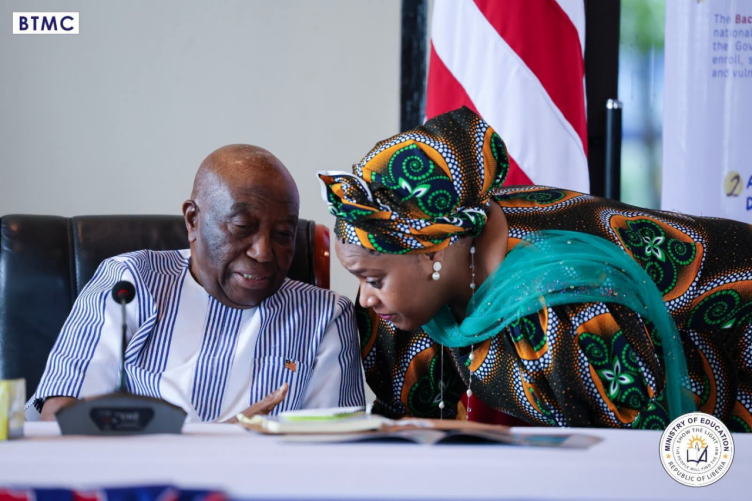
Monrovia – President Joseph Nyuma Boakai has called on county superintendents and national leaders to take direct ownership of education reform.
By Emmanuel Weedee-Conway
President Boakai believes that when local leadership gets involved, the entire education system in that county improves.
Speaking at the Steering Committee Meeting of the “Back To My Classroom” initiative held at the Executive Mansion in Monrovia on the weekend, the President indicated that the government is moving away from symbolic “Back to School” marches toward concrete action that puts every child in a classroom with the tools to learn.
It Starts Now.
He described the moment as the beginning of a serious, multi-level commitment to education.
The Liberian leader recalled how he was encouraged by young people sacrificing weekends to participate in learning activities.
“On Saturdays, libraries are open. Learning centers are active. Communities are mobilized. That is the commitment our children deserve,” he told the gathering of ministers, superintendents and partners.
Counties Under-Represented
The President furthered that his own resolve deepened after seeing statistics released two years ago showing which counties were under-represented at every level of schooling.
Concerned by the data, he requested a further breakdown on the number of children out of school.
He recounted traveling across the country and seeing children “playing music on the roadside while a school bus passes with other children headed to class.”
“Too often, we do not realize what we are losing. These are children of Liberia who do not even know what they are missing – because no one has shown them.”
He maintains that the presence of county leaders at the meeting signaled the country is beginning to take education seriously.
Free Registration At Public Schools Commended
On access, the President welcomed the Ministry of Education’s announcement of free registration, noting that fees had been used as an excuse to keep children at home.
He also shared that friends from England recently donated shoes which will be given out to the “many children who do not have shoes to go to school.”
With concrete action by government and partners, the Liberian chief executive reckons no child should be in the street hanging around with no excuse not to be in school.
Building The System
Turning to governance, President Boakai said the administration is building “systems for every aspect of public service.”
He disclosed how he had just met with the Minister of Finance and the committee tasked with rewarding dedicated public servants.
“In this country now, taking from government is not part of the agenda,” he stated, adding that Liberia must also plan for the future of teachers and civil servants who are often “forgotten” after leaving service.
The President stressed that reform must go beyond Monrovia.
He called for county and district-level activities that go beyond weekend football to include educational competitions, so children in rural areas are active and have access to opportunity.
“All of this planning takes people. It takes all of us to do it,” he asserted.
President Boakai acknowledged challenges inside the Ministry of Education but expressed optimism about a “sense of commitment and a sense of interest” among the current team.
The President noted that government is committed to finding resources and that the international community is willing to support Liberia “when they see progress.”
“We see more young people in school. We are renovating schools. We are working to ensure that quality school buildings are constructed.”
President Condemns Poor Facility
The President condemned conditions where children learn without chairs or desks, describing it as unfair and unpleasing.
“That is not fair to those children. It is not fair to our country. It is not fair to our future. Because these are the children who will lead us tomorrow.”
The “Back to My Classroom” project was launched in 2024, wherein the Liberian leader set a clear mandate to find the children outside the school system, address the root causes keeping them out, safely return them through the right pathways, and ensure that they stay there.
MOE Sets Ambitious Target
Education Minister, Dr. Jarso Maley Jallah, revealed a target is to reintegrate 250,000 children by 2029, beginning with the first 80,000 children across seven counties in 2026.
“Experience has taught us that getting a child through the school gate is only the first step. Children stay out of school for complex, overlapping reasons: poverty, missing documents, distance, disability, and age-related barriers,” the Minister warned.
All Hands On Deck Approach
Based on the critical importance of expanding and improving education, the MOE boss craved the need for holistic effort – as the Ministry of Education cannot do it alone.
“Education, Health, Gender, Local Government, and our statistical agencies must surround the same child with support. Back to My Classroom is the framework that makes this multi-agency response possible.”
What Has Been Done?
Behind the scenes, Minister Jallah disclosed that the inter-ministerial technical teams, focal points, and working groups have spent months aligning mandates, costing work plans, and building a unified implementation model.
Since reactivating the campaign earlier this year, she revealed the team has established core governance by reactivating the National Secretariat and appointed a National Program Coordinator, whose salary UNICEF has graciously supported.
Also, the team has streamlined pathways – mapped the full process from identification to placement, to follow-up and retention.
Importantly too, the Minister explained that the team has built real-time tracking by developing a child-level tracking system so as to enable the government to monitor individual progress, replacing fragmented lists.
Learning From Experience
Dr. Jallah noted that initial rollout in Grand Gedeh proved that community mobilization works, but with the realization that placement and school readiness are what drive long-term retention.
“We are now taking these lessons directly to the counties.”
“Bomi County has led the way. It has established the first County Steering Committee, operationalized its secretariat, and signed its accountability charter. Bomi sets the standard. The truest test of Back to My Classroom happens on the ground, in our local communities,” added the Minister.
Friday’s review process was intended to formalize cross-ministry responsibilities through the Inter-Ministerial Review.
It also aimed to assess county-level operational readiness as well as align high-level political will around key decision points and financing needs.
Meanwhile, development partners at the meeting, including UNICEF and other UN agencies around the table, reaffirmed their commitment to support efforts that are aimed at accelerating Liberia’s education
Support Independent Journalism
Your support helps FrontPage Africa continue delivering independent, credible, and impactful journalism. Every contribution strengthens our ability to investigate, inform, and hold power accountable while keeping quality journalism accessible to our readers.
Support our journalism or subscribe to receive the latest FrontPage Africa stories and updates.