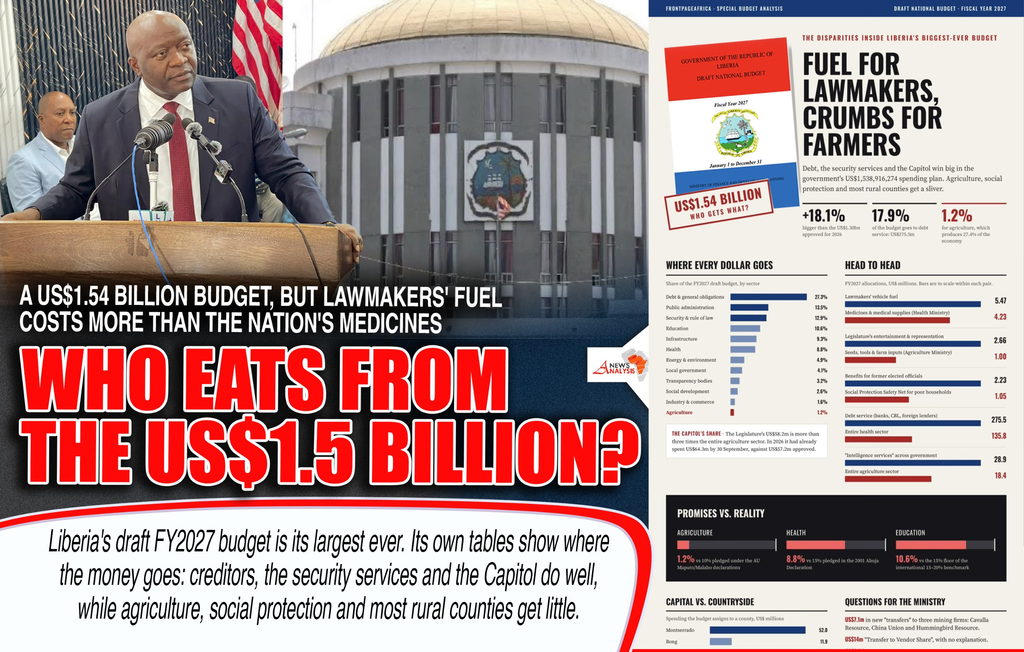
MONROVIA – Liberia’s government is preparing to spend more money than at any time in its history. The draft national budget for fiscal year 2027, prepared by the Ministry of Finance and Development Planning, totals US$1,538,916,274. That is US$236 million, or 18.1 percent, more than the US$1.30 billion approved for 2026.
By Rodney D. Sieh
The government calls it “A Growing Budget for Bigger Impact.” The timing helps. On 14 September 2026, domestic revenue collection passed US$1 billion in a single year for the first time. Officials credit a mining boom, a stronger Liberian dollar and a planned switch from a sales tax (GST) to value-added tax (VAT).
But a line-by-line review of the 845-page document by FrontPageAfrica shows that much of the new money goes to creditors, the security services, the Legislature and the Monrovia area. Farmers, the poorest households and much of rural Liberia get far less.
WHERE THE MONEY GOES
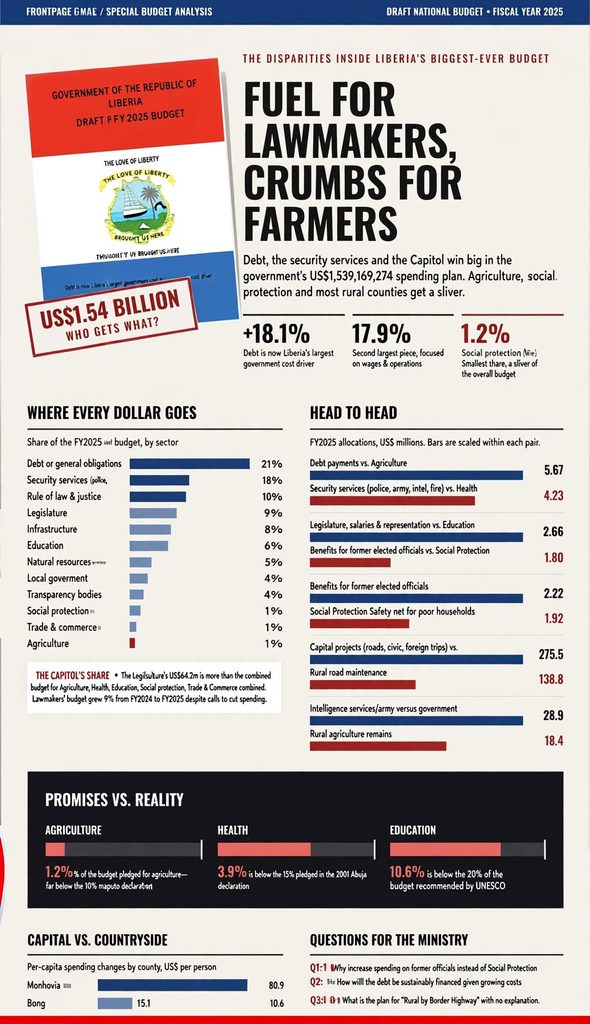
The largest single block, US$419.6 million or 27.3 percent of the budget, sits in a new category called “General Obligations and Programs.” About US$275.5 million of it is debt service, up from US$232 million this year.
The biggest payments go to Liberians’ own banks and the central bank. Commercial banks receive US$103.3 million, mostly Treasury bond repayments. The Central Bank of Liberia receives US$65 million, including US$22.4 million in interest alone. External creditors, led by the World Bank, receive US$78.8 million.
Debt service now takes about one dollar in every five of core domestic revenue. It is twice the entire health budget and fifteen times what the government will spend on agriculture.
Public sector pay is the next big draw. Compensation rises to US$369.4 million, nearly a quarter of the budget. The government says about 17,065 workers will benefit from new hires, the conversion of volunteers into paid staff, and salary top-ups. Teachers are the main winners: new minimum monthly salaries of US$650 for teachers with a master’s degree, US$400 for a bachelor’s degree and US$200 for a C-Certificate. Pay will be equal across Ministry of Education and Monrovia Consolidated School System schools. About 1,934 police officers will get raises tied to rank, and 616 Liberia Drug Enforcement Agency staff will get 15 percent.
THE WINNERS
Security. The security and rule-of-law sector rises 21.5 percent to US$198.4 million. The budget promises to recruit 600 police officers and between 800 and 1,200 soldiers; the document gives both figures. The National Security Agency receives US$30.25 million, with no capital projects. Its 2026 budget was US$24.7 million, but by 30 September it had already spent US$30.2 million, 22 percent over budget with a quarter of the year still to go.
Spending on “intelligence services” across government rises from US$21.1 million to US$28.9 million. The NSA’s share rises to US$13.7 million and the Ministry of Justice’s to nearly US$8 million. Neither the budget nor its annexes explain what these lines pay for.
The Legislature. Liberia’s 103 lawmakers and their staff are allocated US$58.2 million. That is more than three times the entire agriculture sector (US$18.4 million) and more than four times the Ministry of Agriculture alone (US$13.1 million).
The 2026 figures show how far the Legislature already exceeds its budget. By 30 September it had spent US$64.3 million against an approved US$57.2 million:
• Constituency visits: US$1.12 million budgeted, more than US$6.2 million spent.
• Legislative committee hearings: US$1.4 million budgeted, US$6.5 million spent.
• Transfers to the Public Accounts Committee: US$738,000 budgeted, US$3.6 million paid.
For 2027 the constituency-visit line more than triples to US$3.8 million. The Legislature’s vehicle fuel allowance rises by US$1 million to US$5.47 million. That is more than the Ministry of Health’s entire budget for drugs and medical consumables, which stays at US$4.23 million. Health spent less than half of that drug money by September. The Legislature also keeps US$2.66 million for “entertainment and representation,” almost 77 percent of all entertainment spending in government. Its cleaning budget rises from US$130,000 to US$954,677.
The Presidency and Vice Presidency. The Ministry of State for Presidential Affairs rises 32.6 percent to US$21.9 million. Domestic travel jumps from US$35,000 to US$535,000, vehicle repairs from US$120,000 to US$520,000, and “special operations” to US$1.79 million. A US$1.3 million line for “Special Presidential Projects” is not explained. The Office of the Vice President’s allowance for domestic travel subsistence rises from US$220,000 to US$770,000.
Monrovia, sport and motorcyclists. The Monrovia City Corporation’s budget rises 74 percent to US$8.46 million, partly for a US$4 million “smart sanitation and city beautification” programme. Paynesville gets a 60 percent increase. The Ministry of Youth and Sports nearly doubles to US$18.2 million, including about US$3.9 million in transfers to football; the government says US$3 million is for the Lone Star national team. A new US$2 million “Motorcyclist Empowerment Program” sits alongside a US$2.5 million small-business initiative. Government purchases of vehicles double, from US$4.7 million to US$9.5 million, in the same budget that allows agencies to buy second-hand cars.
THE LOSERS
Farmers. Agriculture and fisheries produce 27.4 percent of Liberia’s economic output and employ much of its rural population. The sector receives 1.2 percent of the budget. African Union governments pledged under the Maputo and Malabo declarations to spend 10 percent. The whole Ministry of Agriculture allocation for seeds, tools and other farm inputs is US$997,080, less than half what the Legislature will spend on entertainment. Of the US$5.5 million approved for agriculture capital projects in 2026, nothing had been spent by September.
Health and education. Health gets 8.8 percent of the budget, against the 15 percent African governments pledged in the 2001 Abuja Declaration. Education gets 10.6 percent, below the 15 to 20 percent recommended internationally. Health also struggled to spend what it was given in 2026: none of its US$7.15 million capital budget or its US$1.62 million for laboratory supplies had been spent by September.
The poorest households. The flagship Social Protection Safety Net receives US$1.05 million. The same budget sets aside US$2.23 million in benefits for former elected officials and those who have “elected and served.”
The environment. Environmental sustainability, which includes forestry, the Environmental Protection Agency and disaster management, gets 0.7 percent. Most of Liberia’s climate work is left to donors. Energy spending falls 5 percent, with the Liberia Electricity Corporation’s allocation cut from US$50 million to US$40 million.
Rural counties. Most spending is not linked to any county: about 89 percent of agency spending is booked as “nationwide.” Of the US$124.5 million that is, Montserrado, the county that includes Monrovia, takes US$52 million. Rivercess receives US$837,710, the least of any county. Lofa University’s allocation rises 73 percent to US$3.5 million. Nimba University’s vote, by contrast, falls from US$2 million to US$386,200. Its US$2.04 million subsidy appears instead under the budget of Grand Bassa University.
UNUSUAL ALLOCATIONS
Several lines raise questions the Finance Ministry will need to answer.
• Payments to mining companies. The Ministry of Local Government’s budget includes three new transfers totalling US$7.1 million. US$3.3 million goes to “Cavalla Resource Liberia Inc.,” US$2.38 million to “China Union Mining Company” and US$1.43 million to “Hummingbird Resource Liberia Inc.” Elsewhere, county social development funds from ArcelorMittal and Firestone are listed under the counties that receive them. These three are written as transfers to the companies themselves.
• Unexplained transfers. A “Transfer to Vendor Share” of US$14 million and a US$2.95 million “Deficit Pool Fund” have no explanation.
• A laboratory under Defence. The Ministry of National Defense will pay US$1.3 million to the National Reference Laboratory, which is normally a health function.
• Foreign travel jumps. Foreign air travel at the Ministry of Local Government rises from US$17,690 to US$780,357. At the Judiciary it rises from US$55,000 to US$455,000, and at the Ministry of Information from US$35,000 to US$295,000.
THE REVENUE GAMBLE
The budget counts on tax revenue rising to about US$1.07 billion, an increase of more than 26 percent on this year’s estimate, driven mainly by the move to VAT. One-off “sign-on bonuses” from new concessions fall from US$228 million in 2026 to US$40 million. That money is expected to come from two port operators, APM Terminals (US$25 million) and Marsa Maroc (US$15 million), and is “contingent”: US$40 million of spending will happen only if the money arrives. Mining royalties are projected to fall from US$287.6 million to US$119.4 million.
Of the US$92 million in outside money that goes directly into the budget, US$72 million is borrowed from the World Bank, the African Development Bank and the IMF. Only US$20 million is a grant, from the European Union.
Seventeen of Liberia’s 20 state-owned enterprises missed the deadline to submit their 2027 financial plans. The figures shown for them were estimated by the ministry from past trends.
THE BOTTOM LINE
Liberia’s revenue is growing and its economy is expanding faster than the regional average, with growth projected at 5.1 percent in 2027. The question the Legislature must now answer, as it reviews the draft, is whether the extra money will reach the farms, clinics and rural communities the ARREST Agenda promises to serve, or stay with the institutions that already overspend.
Support Independent Journalism
Your support helps FrontPage Africa continue delivering independent, credible, and impactful journalism. Every contribution strengthens our ability to investigate, inform, and hold power accountable while keeping quality journalism accessible to our readers.
Support our journalism or subscribe to receive the latest FrontPage Africa stories and updates.