The United States midterm elections offer an important lesson for Liberia, especially for citizens living in the rural and leeward counties that are too often treated as secondary to Monrovia.
By: Austin S. Fallah – A True Son of the Planet Earth Soil: [email protected]
Although the United States and Liberia differ greatly in size, wealth, institutional development, and political history, the central democratic principle is the same: elections are not merely ceremonies for choosing popular personalities.
They are instruments through which citizens can reward performance, punish failure, and demand representation.
In a functioning democracy, voters should elect people whose actions, legislative advocacy, and public-policy priorities reflect their communities’ actual needs.
For rural Liberia, this lesson is urgent.
Too often, elections are influenced by party slogans, personal loyalty, ethnic affinity, financial handouts, emotional appeals, and candidates’ connections to national elites.
These factors may create excitement during campaigns, but they do not build roads, improve clinics, lower transportation costs, create markets for farmers, supply electricity, or provide safe drinking water.
Rural Liberians must increasingly ask a more practical question before casting their votes: What has this candidate done, and what can this candidate realistically do, to improve the conditions of life in our community?
The answer should not depend on how frequently a lawmaker visits Monrovia, appears at political events, on social media, or praises powerful national figures.
It should depend on whether that person understands the struggle of ordinary citizens in Grand Kru, Maryland, River Gee, Sinoe, Gbarpolu, Lofa, Nimba, Bong, Bomi, Grand Cape Mount, River Cess, Margibi, Lower Montserrado, Grand Bassa, Grand Gedeh, and many other rural districts, towns, and villages.
The needs of leeward Liberia are not abstract.
They concern how families eat, how farmers transport crops to market, how children attend schools, how pregnant women reach clinics, how young people find work, and how communities gain access to electricity and clean water.
These are not minor development concerns.
They are the foundation of human dignity and national progress.
American midterm elections demonstrate, at least in principle, that voters can use elections to assess whether elected officials have delivered on issues that affect daily life.
In the United States, midterms often become a referendum on the governing party, the national economy, inflation, health care, education, immigration, public safety, and how public institutions perform.
Voters may disagree sharply about which policies are best, but they understand that elected representatives and senators have a direct relationship to public outcomes.
When people are unhappy with the direction of their counties, districts, towns, cities, villages, or the country, they can vote against incumbents.
When they believe a candidate has defended their interests, they can vote to retain that person.
Liberia needs a stronger version of this accountability culture.
Citizens should not regard elections as moments of celebration alone; they should treat them as performance reviews.
A representative or senator who has served in the Legislature for years should be able to explain their record.
What bills has the lawmaker sponsored or supported?
What national budget allocations has the lawmaker advocated for?
What oversight has the lawmaker conducted?
What has the representative or senator done to bring attention to the condition of roads, schools, health facilities, bridges, markets, and water systems in the district?
Has the person regularly consulted with citizens, or has the representative or senator become inaccessible after election day?
These questions matter because legislators hold significant influence over the national purse.
They debate laws, approve budgets, oversee public agencies, and represent their districts’ concerns at the national level.
If rural communities elect people who do not understand public policy, do not attend to legislative work, or do not know how to advocate effectively for budgetary priorities, then those communities will remain behind.
A lawmaker cannot solve every problem alone, but a serious legislator can raise issues, build coalitions, scrutinize government spending (like the 2027 budget that was submitted for scrutiny and passage into law), introduce proposals, demand accountability from ministries, and ensure that rural communities are not forgotten when national resources are distributed.
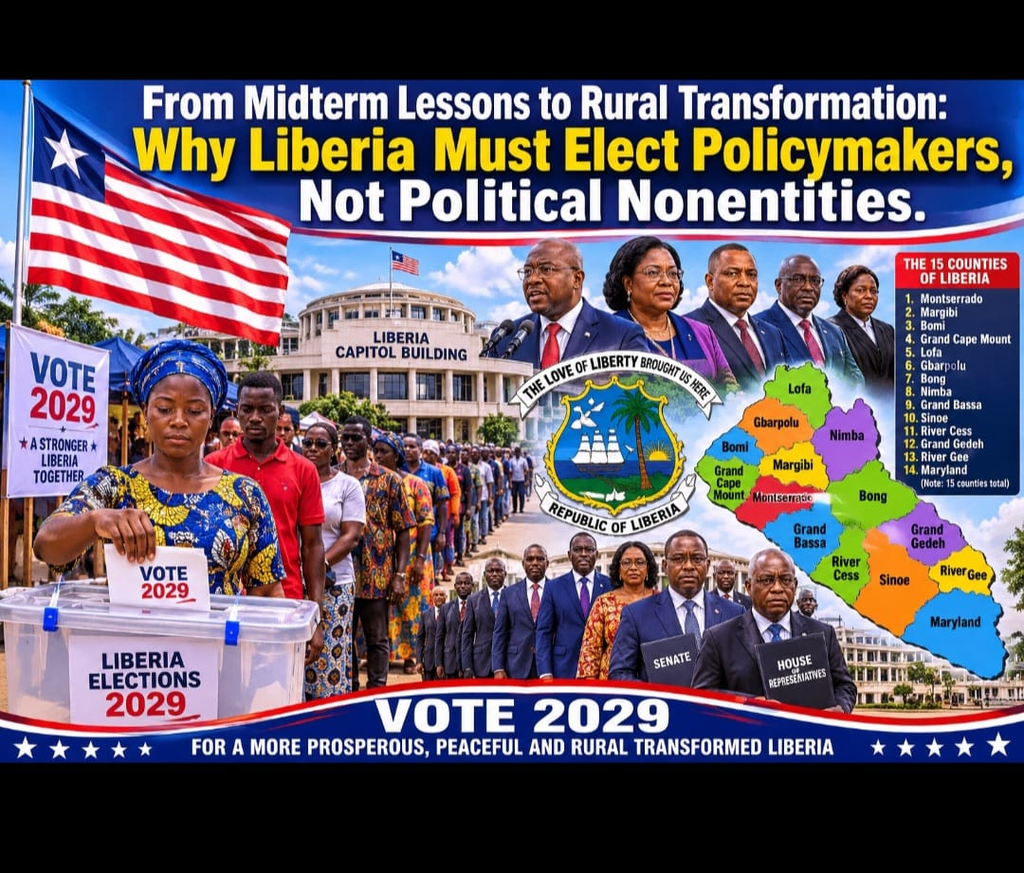
This is why Liberia must elect policymakers, not political nonentities.
A policymaker is not simply someone who can speak well at rallies or distribute money during campaign season.
A policymaker is someone who understands how government works and who can translate community needs into legislation, oversight, and budget advocacy.
Such a person knows that a bad road is not merely an inconvenience; it is an economic barrier.
It prevents farmers from moving cassava, rice, cocoa, palm oil, vegetables, fish, and other goods from villages to local markets, county capitals, ports, and eventually international markets.
When roads are impassable, transportation costs rise, crops spoil, profits shrink, and rural poverty deepens.
Similarly, a policymaker understands that poor education is not just a problem for parents and teachers.
It is a national economic emergency.
Children in rural Liberia should not receive an inferior education simply because they were born far from Monrovia.
They deserve qualified teachers, safe school buildings, books, modern learning materials, access to technology, and pathways to higher education or vocational training.
A legislator who truly represents rural citizens should advocate for educational investments that prepare young people for a changing economy.
This includes agriculture, construction, health care, information technology, entrepreneurship, environmental management, and skilled trades.
Health care is another area where political representation must become more serious.
Too many rural families face long distances to clinics, shortages of medicines, inadequate maternal care, understaffed facilities, and poor emergency transportation.
For women in labor, children with malaria, accident victims, and elderly citizens with chronic illnesses, the difference between a functioning clinic and an abandoned one can be the difference between life and death.
Rural health must therefore be a legislative priority, not an afterthought.
Elected officials should demand stronger public health budgets, improved staffing, medicine supply systems, ambulance services, community health programs, and better coordination between national and county level health authorities.
Electricity and clean drinking water are equally essential.
In the 21st century, it is unacceptable for large segments of the population to remain without reliable energy and safe water.
Electricity can support schools, clinics, small businesses, refrigeration, communication, and local industries.
Clean water reduces waterborne disease, protects children, saves women and girls from spending hours fetching water, and improves overall community health.
These are not luxuries that should be reserved for urban elites.
They are basic development requirements.
Liberia cannot claim to be moving forward while many rural citizens remain without the infrastructure necessary for a decent life.
The comparison with U.S. midterms is useful because it reminds Liberians that democracy should connect political power with public demands.
Yet Liberia must also avoid copying the worst features of American politics.
The United States has its own challenges: excessive campaign spending, partisan polarization, misinformation, racial division, voter apathy, and political systems that sometimes reward conflict more than cooperation.
Liberia should learn from the principle of accountability without importing the destructive habits of permanent political hostility.
Politics should not become an arena in which citizens blindly defend parties while their communities remain poor.
Political competition is healthy when it forces candidates to offer better ideas and demonstrate stronger records.
It becomes harmful when it divides communities and prevents citizens from focusing on shared needs.
Liberian young people have a particularly important role to play in changing the political conversation.
Social media has given young people an unprecedented platform to debate, organize, criticize, and share information.
Yet too much online discussion is consumed by trivia, insults, gossip, celebrity arguments, partisan propaganda, and personal attacks.
Such activity may generate attention, but it does not bring medicine to a clinic, water to a village, books to a classroom, or buyers to a farmer’s produce.
Young Liberians should use digital platforms to ask serious questions of candidates and public officials.
For example, before the 2029 elections, young people can organize online forums and community discussions around concrete issues.
They can ask legislative candidates to explain their plans for feeder roads, agricultural processing, youth employment, school quality, maternal health, electricity, and clean water.
They can create public scorecards that track representatives’ attendance, bills, budget advocacy, town-hall meetings, and responses to local concerns.
They can use radio, Facebook, WhatsApp, community gatherings, and civic organizations to share factual information about candidates’ records.
This would move political participation beyond emotional loyalty and toward evidence-based citizenship.
The phrase “their records should speak in 2029” captures the standard that Liberia needs.
By 2029, incumbent lawmakers should not be asking voters to support them merely because they belong to a major party, have influential friends, or can finance an expensive campaign.
They should clearly account for their service.
They should explain what they promised, what they achieved, what obstacles they faced, and what they will do differently if reelected.
Voters, in turn, should compare promises with outcomes.
If a representative or a senator has failed to advocate for the county,district, ignored public concerns, misused influence, or demonstrated no understanding of public policy, that representative or senator should be removed through the ballot box.
To “fire” unproductive leaders is not an act of disrespect; it is the normal responsibility of citizens in a democracy.
Public office is not a private inheritance, a reward for wealth, or a permanent title.
It is a temporary trust.
When officials do not perform, voters have the right and duty to replace them.
This is one of the most powerful lessons that can be drawn from midterm elections in the United States: elected officeholders must remain conscious that the public can withdraw its support.
Political leaders should fear the judgment of informed citizens more than they desire the approval of political patrons.
However, accountability also requires citizens to be realistic.
Rural development cannot be achieved overnight, and no single representative can solve decades of neglect.
Roads require funding, engineering, environmental review, maintenance, and coordination across levels of government.
Improving education requires more than building schools; it requires teacher training, curriculum reform, adequate salaries, transportation, and monitoring.
Health care requires personnel, equipment, medicines, and a functioning supply chain.
Therefore, voters should judge candidates not only by completed projects but also by the seriousness of their policy agenda, their ability to collaborate, their legislative discipline, and their transparency.
Liberia’s future depends on changing the meaning of politics.
Politics should not be understood as the art of gaining power for personal benefit.
It should be understood as the process through which citizens organize their common life and decide how public resources will be used.
Politics is about who gets roads, who receives quality education, whose community has a clinic, whose farm can reach a market, whose children drink clean water, and whose voice is heard in the national budget.
In this sense, politics is not distant from everyday life. It is everyday life.
For rural Liberia to advance, citizens must demand representation that is grounded in lived realities rather than urban obsession.
Monrovia is important; it is the capital and the center of national institutions.
But Liberia is larger than Monrovia.
A national development strategy that ignores the countryside will create deeper inequality, encourage migration to already crowded urban areas, and leave agricultural communities trapped in poverty.
The Legislature must represent the entire republic, including the villages, farms, coastal communities, and interior towns where citizens work hard but receive too little from the state.
The path forward is clear. Rural Liberians should elect individuals whose advocacy resonates with their needs.
They should support candidates who understand policy, respect public funds, communicate honestly, and work to secure development opportunities for their districts.
They should reject candidates who appear only during election season, offer empty good for nothing slogans, and disappear after votes are counted.
Young people should redirect political discussion toward the issues that determine the future of their counties, districts, towns and villages.
And in 2029, voters should examine records, not rhetoric.
If Liberia embraces this standard, elections can become more than contests for office.
They can become instruments of rural transformation.
By electing serious policymakers instead of political nonentities, Liberians can give their democracy a new meaning, one rooted in accountability, dignity, opportunity, and development for every community.
Support Independent Journalism
Your support helps FrontPage Africa continue delivering independent, credible, and impactful journalism. Every contribution strengthens our ability to investigate, inform, and hold power accountable while keeping quality journalism accessible to our readers.
Support our journalism or subscribe to receive the latest FrontPage Africa stories and updates.