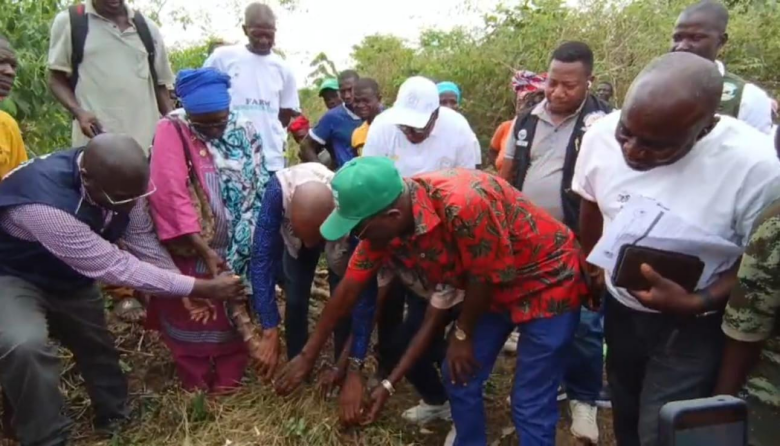
MONROVIA –The Ministry of Agriculture, through its Rural Economic Transformation Project (RETRAP), has celebrated a bumper cassava harvest in Pokundu, Grand Cape Mount County — marking the first of four
pilot cassava cluster farms aimed at transitioning smallholder farmers from subsistence production to commercial agriculture.
Funded by the World Bank, the initiative commenced in 2024 with mechanized land clearing across 320 hectares. Heavy-duty tractors prepared approximately 80 hectares at each site, introducing structured, large-scale farming practices to participating communities.
The Pokundu cluster comprises 50 organized farmers, each cultivating approximately 1.6 hectares. Similar cluster farms are operational in Kakata (Margibi County), Todee (Montserrado County), and Zansue (Bong County). Each 80-hectare cluster is projected to produce an estimated 1,600 metric tons of cassava, significantly strengthening domestic supply and expanding value chain opportunities.
Delivering remarks on behalf of Agriculture Minister Dr. J. Alexander Nuetah, Deputy Minister for Planning and Development Mr. David K. Akoi described the harvest as a major milestone in Liberia’s agricultural reform agenda.
“Today’s harvest marks a turning point in our efforts to transform agriculture from subsistence farming into a commercially driven sector that creates income, jobs, and opportunity for rural communities,” Mr. Akoi said.
He noted that the cluster model addresses long-standing constraints — including low productivity, limited market access, and weak rural infrastructure — by organizing farmers, strengthening value chains, and improving access to shared facilities such as feeder roads and storage.
Through RETRAP, we are organizing farmers into productive clusters, strengthening value chains, and ensuring that agriculture becomes a central pillar of Liberia’s economic transformation. This harvest is proof that when we invest in our farmers, we invest in the future of Liberia,” he added.
RETRAP’s National Project Coordinator, Mr. Galah Toto, commended the farmers for their dedication and hard work.
“If you had not worked hard, we would not be seeing such big cassava tubers today. We hope to continue in 2026, expanding cassava production into new areas,” he said.
Also speaking at the ceremony, the Country Director of the World Food Programme (WFP), Dr. Agbessi Komla Amewoa, reaffirmed the agency’s commitment to strengthening Liberia’s food systems.
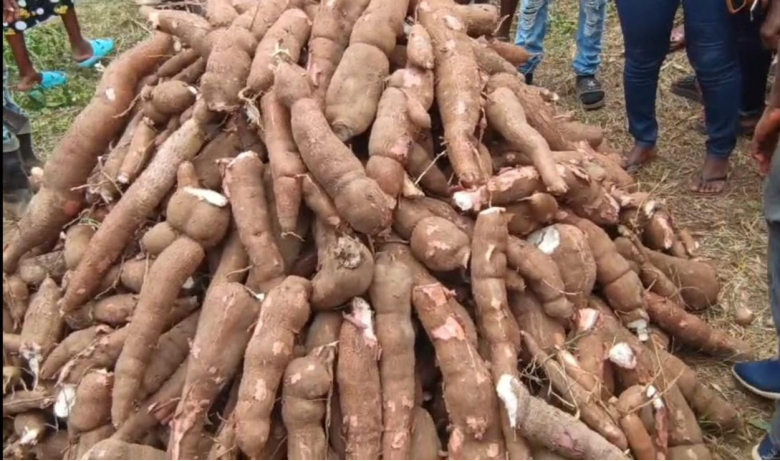
WFP serves as an institutional buyer of locally produced commodities, including rice and cassava, purchasing directly from Liberian farmers to create reliable markets and address a key constraint that has historically limited smallholder production.
Dr. Amewoa noted that since 2023, WFP has not imported food for its Liberia operations, as all commodities have been procured locally. Through the Home-Grown School Feeding Programme, WFP purchases from approximately 15,000 smallholder farmers, providing meals to about 80,000 schoolchildren nationwide.
“When you produce more, WFP can buy more, and together we strengthen Liberia’s pathway to full food self-sufficiency,” Dr. Amewoa stated.
A similar harvest was also launched in Zansue, Bong County, further demonstrating the expanding impact of the cluster farm model.
These cassava harvests highlight the tangible results of strong government leadership, strategic investment, and farmer dedication — advancing Liberia’s journey toward a resilient, commercially driven agricultural sector.
Support Independent Journalism
Your support helps FrontPage Africa continue delivering independent, credible, and impactful journalism. Every contribution strengthens our ability to investigate, inform, and hold power accountable while keeping quality journalism accessible to our readers.
Support our journalism or subscribe to receive the latest FrontPage Africa stories and updates.